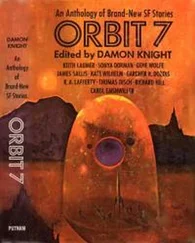
Orbit 2
Здесь есть возможность читать онлайн «Orbit 2» весь текст электронной книги совершенно бесплатно (целиком полную версию без сокращений). В некоторых случаях можно слушать аудио, скачать через торрент в формате fb2 и присутствует краткое содержание. Год выпуска: 1967, Издательство: Berkley Medallion, Жанр: Фантастика и фэнтези, на английском языке. Описание произведения, (предисловие) а так же отзывы посетителей доступны на портале библиотеки ЛибКат.
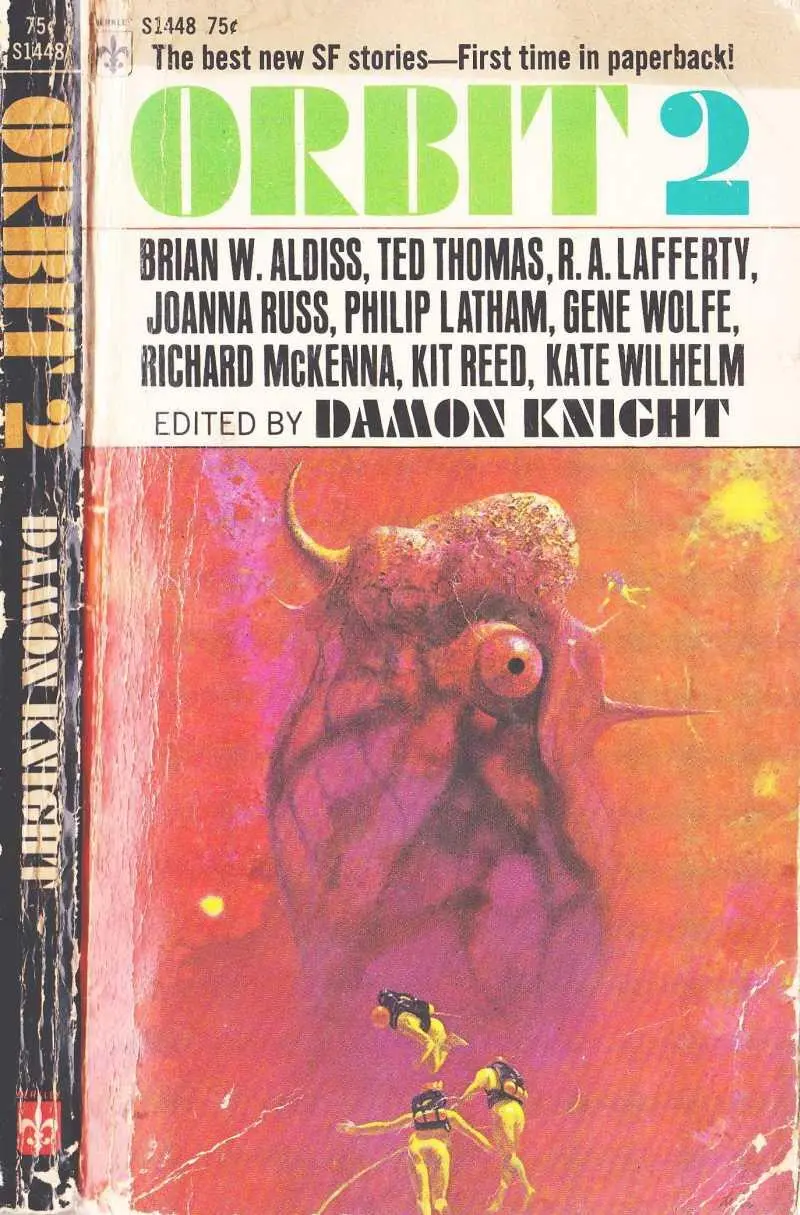
- Название:Orbit 2
- Автор:
- Издательство:Berkley Medallion
- Жанр:
- Год:1967
- ISBN:нет данных
- Рейтинг книги:3 / 5. Голосов: 1
-
Избранное:Добавить в избранное
- Отзывы:
-
Ваша оценка:
Orbit 2: краткое содержание, описание и аннотация
Предлагаем к чтению аннотацию, описание, краткое содержание или предисловие (зависит от того, что написал сам автор книги «Orbit 2»). Если вы не нашли необходимую информацию о книге — напишите в комментариях, мы постараемся отыскать её.
For each new volume, editor Damon Knight invites contributions from established SF authors as well as from new writers, and selects the best of the hundreds of submitted manuscripts.
Damon Knight is founder and first president of Science Fiction Writers of America, author of five SF novels, four collections of short stories and has edited fourteen SF anthologies.
Orbit 2 — читать онлайн бесплатно полную книгу (весь текст) целиком
Ниже представлен текст книги, разбитый по страницам. Система сохранения места последней прочитанной страницы, позволяет с удобством читать онлайн бесплатно книгу «Orbit 2», без необходимости каждый раз заново искать на чём Вы остановились. Поставьте закладку, и сможете в любой момент перейти на страницу, на которой закончили чтение.
Интервал:
Закладка:
“If that’s so, I don’t want to come out of it,” the Mexican said feelingly, “but I don’t think so. I'm real, if this world isn’t. When I pinch myself it hurts. My insides work.”
“Me too. But I could sure smell saltwater and diesel oil for a few seconds there. Silva almost made us slip back.”
“Kruger was right, I guess,” the Mexican said slowly, “but it’s tough on poor old Silva.”
They walked on in silence beside the rippling stream. Then Kinross said, “I’ve got a hankering for apples. Wonder if there are any here?”
“Sure,” said Garcia, “just over here.” He crossed the stream and pointed out apples on a low-hanging bough. They were large, bright red and without blemish. Kinross ate several with relish before he noticed that they had no seeds and remarked on it to the Mexican.
“Watch it,” warned Garcia. “No looking close.”
“Well, they taste good,” Kinross said.
“I’ll tell you something,” the Mexican said abruptly. “There’s only one tree here. You find it wherever you look for it and it’s always got what you want growing on it. I found that out while you were asleep. I experimented.”
Kinross felt the strange dread run over him gently. “That might be dangerous,” he warned.
“I didn’t try to make it be two trees,” the Mexican assured him. “Something already told me I shouldn’t look too close.
“There’s something else, too,” Garcia said, when Kinross did not answer. “I’ll let you find it out for yourself. Let’s climb this bank and see what’s on top.”
“Good idea,” Kinross agreed, leading off.
The bank was steeply convex, smooth and regular. Kinross climbed at an angle in order to have a gentler grade and suddenly realized that he was nearly down to the stream again. He swore mildly at his inattention and turned back up the slope, more directly this time. After a few minutes he looked back to see how far down the stream was and realized with a shock that he was really looking up the bank. He looked in front of him again and the floodplain of the little stream was almost at his feet. He could not remember which way he had been going and panic fingered at him.
“Give up,” Garcia said. “Do you feel it now?”
“I feel something, but what it is. .”
“Feel lost, maybe?” the Mexican asked.
“No, not lost. Camp, or anyway Kruger, is that way.” Kinross pointed upstream.
“Sure it isn’t downstream?”
“Sure as sure,” Kinross insisted.
“Well, go on back and I’ll meet you there,” the Mexican said, starting off downstream. “Look for landmarks on the way,” he called over his shoulder.
Kinross didn’t see any landmarks. Nothing stood out in any large, general way. As he approached the group around Kruger’s body he saw Garcia coming along the bank from the opposite direction.
“Garcia, does this damn creek run in a circle?” he called in surprise.
“No,” said the Mexican. “You feel it now, don’t you? This world is all one place and you can’t cut it any finer. Every time you go up the bank it leads you down to the stream bed. Whichever way you walk along the stream, you come to Kruger.”
Kinross woke up to see Kerbeck splashing water over his head in the stream. Garcia was sleeping nearby and Kinross woke him.
“What’ll we eat this morning?” he asked. “Papayas, d’ye think?”
“Bacon and eggs,” the Mexican yawned. “Let’s find a bacon and egg tree.”
“Don’t joke,” Kinross said. “Kruger won’t like it.”
“Oh well, papayas,” Garcia said. He walked down to the stream and splashed water in his face. Then the two men walked up the little valley.
“What do you mean, ‘this morning’,” Garcia asked suddenly. “I don’t remember any night.”
The night was pitch black. “Kinross,” Garcia called out of the blackness.
“Yes?”
“Remember how it got suddenly dark just now?”
“Yes, but it was a long while back.”
“Bet you won’t remember it in the morning.”
“Will there be a morning?” Kinross asked. “I’ve been awake forever.” Sleep was a defense.
“Wake up, Kinross,” Garcia said, shaking him. “It’s a fine morning to gather papayas.”
“Is it a morning?” Kinross asked. “I don’t remember any night.”
“We gotta talk,” the Mexican grunted. “Unless we want to sing to ourselves like Kerbeck or moan and cry like Silva over there.”
“Silva? I thought that was the wind.”
“No wind in this world, Kinross.”
Kinross bit into papaya pulp. “How long have we been here, do you think?” he asked Garcia.
“It’s been a while.”
“I can’t remember any whole day. Silva was blinded. Was that yesterday? Kerbeck stopped talking and started singing. Was that yesterday?”
“I don’t know,” the Mexican said. “It seems like everything happened yesterday. My beard grew half an inch yesterday.”
Kinross rubbed his own jaw. The brown whiskers were long enough to lie flat and springy.
He was walking alone when,a whisper came from just behind his head. “Kinross, this is Kruger. Come and talk to me.”
Kinross whirled to face nothing. “Where?” he whispered.
“Just start walking,” came the reply, still from behind.
Kinross started up the bank. He climbed steadily, remembering vaguely a previous attempt at doing so, and suddenly looked back. The stream was far below, lost under the convex curve of the bank that was really a valley wall. Miles across the valley was the other wall, curving up in countersymmetry to the slope he was climbing. He pressed on, wondering, to come out on a height of land like a continental divide. Smooth, sweeping curves fell off enormously on either hand into hazy obscurity.
He walked along it to the right. It had the same terrain of vague grass and indefinite shrubs and trees, flat shades of green with nothing standing out. After a while he saw a gently rounded height rising to his left, but the whisper directed him down a long gentle slope to his right and then up a shorter, steeper slope to a high plain. There was a vast curve to it, almost too great to sense, but the horizon on the left seemed lower than that on the right. He walked on steadily.
Kinross seemed tireless to himself. He did not know how long he had been walking. He climbed another abrupt slope and a series of shallow but enormous transverse swales replaced the rounded plain. The land still curved downward to the left. Far ahead was a clear mountain shape.
It, too, was green. He started up a concave slope which turned steeply convex so that he seemed to be defying gravity as he climbed it. Then the slope leveled off considerably and he was approaching a wall of dark forest beyond which a reddish-black rock pinnacle soared into the sky.
He pushed into the forest, to find it only a half-mile belt of woods which gave way to a desert. This was a dull red, gently rising plain over which were scattered huge reddish boulders many times higher than his head. He picked his way between them over ground which seemed hot and vibrating until he came to the base of the rock pinnacle. As he neared it a pattern of intersecting curves on top indicated that it was cratered.
It was a vertical climb, but Kinross made it with the same inexplicable ease as the earlier ones. He descended a little way into the crater and said, “Here I am, Kruger.”
Kruger’s natural voice spoke out of the air from a point directly ahead. “Sit down, Kinross. Tell me what you think.”
Kinross sat crosslegged on the rough rock surface. “I think you’re running this show, Kruger,” he said. “I think maybe you saved my life. Past that, I don’t know what to think.”
Читать дальшеИнтервал:
Закладка:
Похожие книги на «Orbit 2»
Представляем Вашему вниманию похожие книги на «Orbit 2» списком для выбора. Мы отобрали схожую по названию и смыслу литературу в надежде предоставить читателям больше вариантов отыскать новые, интересные, ещё непрочитанные произведения.


Обсуждение, отзывы о книге «Orbit 2» и просто собственные мнения читателей. Оставьте ваши комментарии, напишите, что Вы думаете о произведении, его смысле или главных героях. Укажите что конкретно понравилось, а что нет, и почему Вы так считаете.