Elliot Ackerman - 2034
Здесь есть возможность читать онлайн «Elliot Ackerman - 2034» весь текст электронной книги совершенно бесплатно (целиком полную версию без сокращений). В некоторых случаях можно слушать аудио, скачать через торрент в формате fb2 и присутствует краткое содержание. Город: New York, Год выпуска: 2021, ISBN: 2021, Издательство: Penguin Press, Жанр: Фантастика и фэнтези, prose_military, на английском языке. Описание произведения, (предисловие) а так же отзывы посетителей доступны на портале библиотеки ЛибКат.
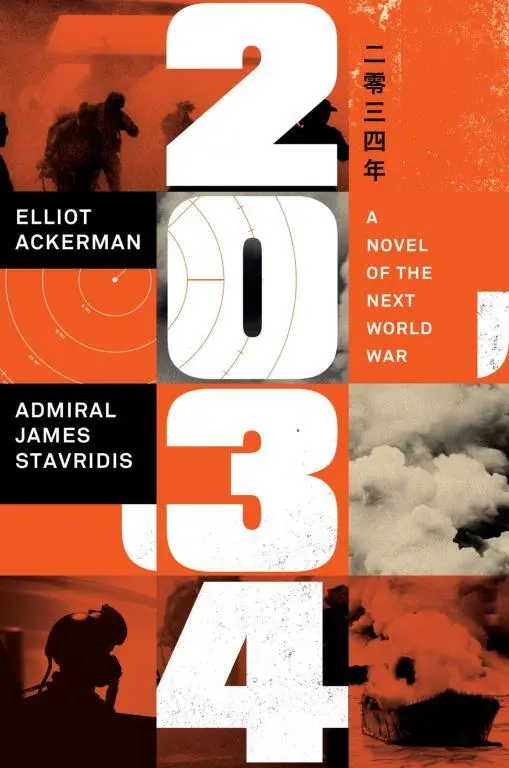
- Название:2034
- Автор:
- Издательство:Penguin Press
- Жанр:
- Год:2021
- Город:New York
- ISBN:978-1-98488-125-0
- Рейтинг книги:4 / 5. Голосов: 2
-
Избранное:Добавить в избранное
- Отзывы:
-
Ваша оценка:
2034: краткое содержание, описание и аннотация
Предлагаем к чтению аннотацию, описание, краткое содержание или предисловие (зависит от того, что написал сам автор книги «2034»). Если вы не нашли необходимую информацию о книге — напишите в комментариях, мы постараемся отыскать её.
, conducting a routine freedom of navigation patrol in the South China Sea when her ship detects an unflagged trawler in clear distress, smoke billowing from its bridge. On that same day, US Marine aviator Major Chris “Wedge” Mitchell is flying an F-35E Lightning over the Strait of Hormuz, testing a new stealth technology as he flirts with Iranian airspace. By the end of that day, Wedge will be an Iranian prisoner, and Sarah Hunt’s destroyer will lie at the bottom of the sea, sunk by the Chinese Navy. Iran and China have clearly coordinated their moves, which involve the use of powerful new forms of cyber weaponry that render US ships and planes defenseless. In a single day, America’s faith in its military’s strategic pre-eminence is in tatters. A new, terrifying era is at hand.
So begins a disturbingly plausible work of speculative fiction, co-authored by an award-winning novelist and decorated Marine veteran and the former commander of NATO, a legendary admiral who has spent much of his career strategically out maneuvering America’s most tenacious adversaries. Written with a powerful blend of geopolitical sophistication and literary, human empathy,
takes us inside the minds of a global cast of characters—Americans, Chinese, Iranians, Russians, Indians—as a series of arrogant miscalculations on all sides leads the world into an intensifying international storm. In the end, China and the United States will have paid a staggering cost, one that forever alters the global balance of power.
Everything in 2034 is an imaginative extrapolation from present-day facts on the ground combined with the authors’ years working at the highest and most classified levels of national security. Sometimes it takes a brilliant work of fiction to illuminate the most dire of warnings: 2034 is all too close at hand, and this cautionary tale presents the reader a dark yet possible future that we must do all we can to avoid.
2034 — читать онлайн бесплатно полную книгу (весь текст) целиком
Ниже представлен текст книги, разбитый по страницам. Система сохранения места последней прочитанной страницы, позволяет с удобством читать онлайн бесплатно книгу «2034», без необходимости каждый раз заново искать на чём Вы остановились. Поставьте закладку, и сможете в любой момент перейти на страницу, на которой закончили чтение.
Интервал:
Закладка:
11:49 July 20, 2034 (GMT+5:30)
New Delhi
Vice Admiral Patel immediately ordered two taxicabs, one for Farshad and the other for his nephew. The three of them hardly spoke as they waited. Farshad never considered himself a prejudiced man—in his mind bigotry was a safe harbor for weaklings. However, all through his life, he’d noticed how on the few occasions he’d met an American he’d immediately recoiled at their presence (he had a similar reaction to Israelis, though had an easier time self-rationalizing this response as something other than bigotry). But when Farshad witnessed Chowdhury’s palpable grief as the first reports came in from San Diego and Galveston, he couldn’t help but feel something akin to pity. What he did next not only surprised his American friend but also surprised himself. As the two sat next to each other on the love seat in the admiral’s den, Farshad reached over and placed his right hand consolingly on the American’s left arm.
The first taxicab arrived. There was no question that Chowdhury would be taking it instead of Farshad. The American’s need was more urgent. As his uncle shuttled him to the door, he turned to Farshad and said, “Thank you.” Farshad said nothing in return. He suspected that the American was thanking him for the gesture from before, but he couldn’t be certain. He reminded himself never to trust an American.
Farshad asked Patel when the second taxicab would arrive. Instead of answering, Patel invited Farshad to sit with him a little longer in the den. Farshad made a slight protest—he, too, had to check in with the officials at his embassy—but Patel ignored him. “How about a cup of tea?” he said.
Farshad’s patience was running low, but he gathered up enough composure to accept the invitation. Somehow, despite himself, he trusted this old admiral. Patel disappeared into his kitchen and returned with the pot of tea. He sat next to Farshad on the love seat, their knees almost touching as Patel prepared Farshad’s cup and then his own. Patel exhaled heavily. “A tragedy, this.”
Farshad frowned. “Inevitable,” he replied, and then blew curlicues of steam from the surface of his cup.
“Inevitable?” asked Patel. “Really? You don’t think this could’ve been avoided?”
As he thought of the annihilation of two American cities, Farshad considered the ancient antipathies that existed toward the United States, deep antipathies, not merely those of his own nation but those of all the world. It was America’s perpetual overreach that had led to today’s events. How long could one country continue stoking up resentment before someone eventually struck a mortal blow? His word choice had been correct: inevitable .
He checked his watch and again asked about the cab. Patel ignored the request. “I can’t say that I agree with you,” he began. “This conflict hasn’t felt like a war—at least not in the traditional sense—but rather a series of escalations, each one greater than the last. But a single break in this chain of escalation could defuse the entire conflict and halt this cycle of violence. That’s why my word is tragic , not inevitable . A tragedy is a disaster that could otherwise have been avoided.” Patel took another sip from his tea, and Farshad could feel the old admiral’s gaze from over the rim of his cup. If Patel was searching for agreement, he would have none. Farshad sat rigid in his seat, his shoulders swept back, his hands in his lap. His face expressed nothing. Patel continued, “You above all others should know that today could have been avoided. You were on the bridge of the Rezkiy when the Russians sabotaged the undersea cables. The Americans never would have launched at Zhanjiang had that accident not occurred. That’s another word for you: accident. ” Instead of three syllables Patel spoke it in one, spitting it out, its falseness in his mouth like a bite into spoiled fruit.
Farshad became defensive. He offered other words, like miscalculation and unintentional , to describe what the Russians had done in the Barents Sea. But he knew they were lies and soon retired them, drawing silent and resigning himself only to, “How did you figure out that I was on the Rezkiy ?”
“You just told me,” Patel replied.
Farshad smiled. He couldn’t help it; he liked this wily old man.
Placing Farshad on the Rezkiy was a simple act of deduction on Patel’s part—Farshad had flown through Moscow, and how many Iranian liaison officers did Tehran have assigned to the Russian fleet? Not many. Patel now asked his Iranian counterpart to engage with him in a similar deductive exercise. The Indian government, Patel explained, wanted its ship back from the Revolutionary Guards. Patel understood that unlike the Russians in the Barents Sea, the seizure of the privately owned tanker was an actual miscalculation that had led to an impasse between their two governments. After laying out the facts as he saw them, Patel expounded on “the unique position of our two countries.”
According to Patel, arbitration of the Sino-American War now fell to India. Among the nations of the world, events had conspired to make New Delhi the best interlocutor between Washington and Beijing, and it would take Iranian cooperation as well. Only their countries had a chance of ending the hostilities. He alluded to “sweeping actions” his government might be called upon to take in the coming days. “Without our intervention,” Patel explained, “the Americans will counterstrike, and the Chinese will counterstrike the counterstrike. Tactical nuclear weapons will turn into strategic ones. And that will lead to the end. For all of us…. But our intervention can work and will only work if it’s allowed to unfold freely, if no other nation interferes.” Patel turned to Farshad. Like a spouse begging their partner to give up a lover, he said simply, “When I say interference , I’m talking about the Russians.”
Farshad understood. He knew that Patel saw the Russians clearly, just as he and his government saw them clearly. Farshad found himself thinking of Kolchak, who could trace his lineage to the Imperial Navy, his ancestors having served on both the tsars’ dreadnoughts and on the Soviets’ guided missile cruisers. Within four generations Kolchak’s family had veered from imperialist to communist to capitalist—at least the current Russian version of capitalist. Did this mean that Kolchak’s character, and that of his ancestors, was unprincipled and opportunistic? Or did it simply mean that he came from a people who had always done what they must to survive?
“The world is in disarray,” said Patel, who took another sip of his tea, placing the cup delicately on its saucer. “Do you think the Russians won’t continue to take advantage of that? Do you think they’ll stop with a ribbon of land in Poland?” Patel didn’t wait for an answer; instead, he began to shake his head at Farshad. “You’re next. The Strait of Hormuz is next.” Patel then explained, in great detail, a Russian plan to seize Larak and Hormuz Islands, two rocky, treeless outcroppings strategically positioned in the center of the strait. “From those islands, their fleet could close down all maritime traffic. They could choke off the export of oil from the Gulf, skyrocketing the price of Russia’s own oil. A nice little piece of extortion, don’t you think?”
Farshad had drawn silent. Eventually, he asked, “Why are you telling me this?”
“I thought you’d be grateful,” scoffed Patel. “You should be.”
Farshad allowed the silence to return between them, and in that silence was an affirmation that he, like Patel, understood that nothing was granted for free. If this information was true, there would be a price associated with it. If it were a lie, Patel wouldn’t ask him for a thing. Farshad sat on the love seat and allowed the old admiral to make his request. “We need your help,” Patel eventually said. “First, we need our tanker released. Its seizure has caused quite a stir here, and that has been, well… embarrassing for us. However, and more importantly, when our government takes decisive action, it’s very probable that the Pakistanis might use that as an opportunity to stir up trouble, perhaps an attack on Kashmir, or some domestic terrorism sponsored by one of their ISI surrogates. When it comes to the Pakistanis, emotions run very high in our country. Perhaps you can understand how this would prove a—how shall I put this?—a distraction.”
Читать дальшеИнтервал:
Закладка:
Похожие книги на «2034»
Представляем Вашему вниманию похожие книги на «2034» списком для выбора. Мы отобрали схожую по названию и смыслу литературу в надежде предоставить читателям больше вариантов отыскать новые, интересные, ещё непрочитанные произведения.











Обсуждение, отзывы о книге «2034» и просто собственные мнения читателей. Оставьте ваши комментарии, напишите, что Вы думаете о произведении, его смысле или главных героях. Укажите что конкретно понравилось, а что нет, и почему Вы так считаете.