Elliot Ackerman - 2034
Здесь есть возможность читать онлайн «Elliot Ackerman - 2034» весь текст электронной книги совершенно бесплатно (целиком полную версию без сокращений). В некоторых случаях можно слушать аудио, скачать через торрент в формате fb2 и присутствует краткое содержание. Город: New York, Год выпуска: 2021, ISBN: 2021, Издательство: Penguin Press, Жанр: Фантастика и фэнтези, prose_military, на английском языке. Описание произведения, (предисловие) а так же отзывы посетителей доступны на портале библиотеки ЛибКат.
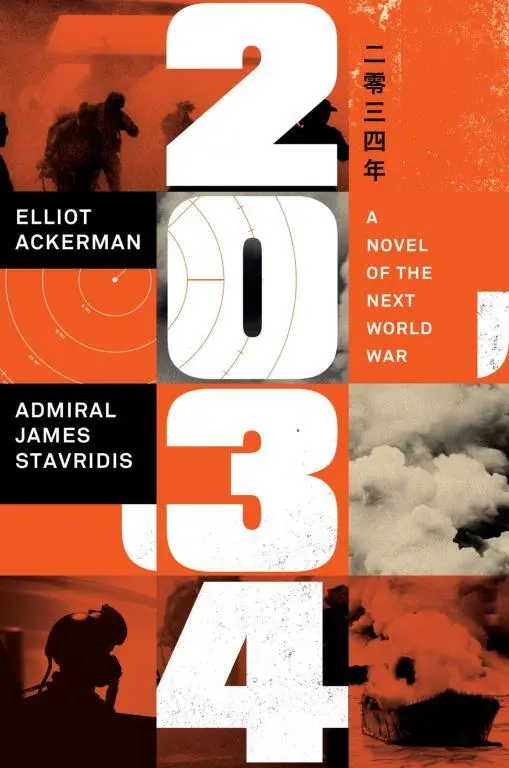
- Название:2034
- Автор:
- Издательство:Penguin Press
- Жанр:
- Год:2021
- Город:New York
- ISBN:978-1-98488-125-0
- Рейтинг книги:4 / 5. Голосов: 2
-
Избранное:Добавить в избранное
- Отзывы:
-
Ваша оценка:
2034: краткое содержание, описание и аннотация
Предлагаем к чтению аннотацию, описание, краткое содержание или предисловие (зависит от того, что написал сам автор книги «2034»). Если вы не нашли необходимую информацию о книге — напишите в комментариях, мы постараемся отыскать её.
, conducting a routine freedom of navigation patrol in the South China Sea when her ship detects an unflagged trawler in clear distress, smoke billowing from its bridge. On that same day, US Marine aviator Major Chris “Wedge” Mitchell is flying an F-35E Lightning over the Strait of Hormuz, testing a new stealth technology as he flirts with Iranian airspace. By the end of that day, Wedge will be an Iranian prisoner, and Sarah Hunt’s destroyer will lie at the bottom of the sea, sunk by the Chinese Navy. Iran and China have clearly coordinated their moves, which involve the use of powerful new forms of cyber weaponry that render US ships and planes defenseless. In a single day, America’s faith in its military’s strategic pre-eminence is in tatters. A new, terrifying era is at hand.
So begins a disturbingly plausible work of speculative fiction, co-authored by an award-winning novelist and decorated Marine veteran and the former commander of NATO, a legendary admiral who has spent much of his career strategically out maneuvering America’s most tenacious adversaries. Written with a powerful blend of geopolitical sophistication and literary, human empathy,
takes us inside the minds of a global cast of characters—Americans, Chinese, Iranians, Russians, Indians—as a series of arrogant miscalculations on all sides leads the world into an intensifying international storm. In the end, China and the United States will have paid a staggering cost, one that forever alters the global balance of power.
Everything in 2034 is an imaginative extrapolation from present-day facts on the ground combined with the authors’ years working at the highest and most classified levels of national security. Sometimes it takes a brilliant work of fiction to illuminate the most dire of warnings: 2034 is all too close at hand, and this cautionary tale presents the reader a dark yet possible future that we must do all we can to avoid.
2034 — читать онлайн бесплатно полную книгу (весь текст) целиком
Ниже представлен текст книги, разбитый по страницам. Система сохранения места последней прочитанной страницы, позволяет с удобством читать онлайн бесплатно книгу «2034», без необходимости каждый раз заново искать на чём Вы остановились. Поставьте закладку, и сможете в любой момент перейти на страницу, на которой закончили чтение.
Интервал:
Закладка:
The smile vanished from Kolchak’s face. “Perhaps.”
“Perhaps?” answered Farshad. He could feel the old familiar rage brimming up from the center of his chest, into his limbs. He felt duped. “That explosion must have destroyed every cable.”
“And so what if it did?” answered Kolchak. “A de-escalation between Beijing and Washington hardly benefits us. It doesn’t benefit your nation either. Let’s sow a little chaos into this crisis. Let’s see what happens then. The result will be advantageous, for both of our countries. Who knows, then we might—” Before Kolchak could finish the thought, the ship’s collision alarm sounded.
Orders were rapidly shouted across the bridge—a new heading, a new speed (“Reverse right rudder, full ahead left!”), a reflexive set of impact-avoidance measures—while both Kolchak and Farshad scanned off the bow. At first, Farshad couldn’t see the obstacle that threatened collision. There was no ship. No iceberg. No large object that assured catastrophe. There was only clear sky. And a mist of seawater that still lingered in the air after the explosion.
It was the mist that concealed the obstacle.
Sharks, dozens of them, an entire school, bobbing upward like so many apples in a barrel, their white bellies presented to the sun. The evasive maneuvers continued. Farshad could do nothing; a sailor in name only, he couldn’t help the crew avoid the collision. The Rezkiy plowed through the field of dead fish, their bodies hitting the thin hull, reminding Farshad of the ice floes that had so often kept him awake at night— dong, dong, dong . Then a far sharper noise combined with this hollow thudding, a noise like a fistful of metal spoons tossed down a garbage disposal; the shark carcasses were passing through the twin propellers of the Rezkiy.
Farshad followed Kolchak out to the bridge wing. They turned to the stern of the ship to assess the damage. The seawater mist still lingered in the air. The sunlight passed through it, casting off brilliant rainbows—blues, yellows, oranges, reds.
So much red.
Farshad realized the red wasn’t only in the air; it was also in the water. The slightly damaged Rezkiy set a new course, leaving a wide swath of blood in its wake.

21:02 June 26, 2034 (GMT+8)
300 nautical miles off the coast of Zhanjiang
The internet was out across the entire eastern seaboard. Eighty percent of the connectivity in the Midwest was gone. Connectivity on the West Coast had been reduced by 50 percent.
A nationwide power outage.
The airports closed.
The markets panicked.
Hunt listened to the updates arriving via the BBC World Service on the handheld radio Quint had given her. She immediately understood the implications. She scrambled down four levels to the radio room, where Quint was also listening to the news and awaiting her.
“Anything yet?” she asked.
“Nothing,” he said.
Hooper wasn’t there, he was asleep in the berthing, and Hunt was glad it was only her and the old chief. She knew the message she was waiting for, and she felt as though she wanted the fewest people possible around when it arrived. The idea of receiving her task in front of someone from a younger generation, like Hooper, felt particularly difficult. Perhaps this was because he would have to live with the consequences longer than any of them. This was Hunt’s train of thought as she sat in the cramped radio room with Quint, the two of them listening to static on the HF radio set, waiting.
And then the message arrived.
10:47 June 26, 2034 (GMT-4)
Washington, D.C.
Chowdhury wasn’t in the room when they made the decision. To assuage his guilt about what followed, he would always cling to that fact. In the years to come he would have ample opportunity to imagine the discussion around the Situation Room conference table beneath the dim generator-powered lights. He would imagine the positions taken by Trent Wisecarver, by the various service chiefs and cabinet secretaries, the tabulations of arguments for or against what they were about to do—what they had all committed themselves to do when the president had put down her “red line” and dared her counterparts in Beijing to cross it.
Which was what it seemed Beijing had now done, though not in the way anyone had anticipated. The cutting of the undersea cables and the resulting plunge into darkness was the demonstrable fact that, when discussed around the conference table, proved Beijing had crossed the red line. The question was the response. And even that was settled in remarkably short order. Chowdhury envisioned the scene—a disquisition of US interests by Wisecarver, followed by a range of options (or lack thereof) presented by the Joint Chiefs, and then formal nuclear authorizations being granted by the president herself. Chowdhury didn’t need to imagine any more than that because he had seen the principals as they exited into the West Wing, their dour expressions failing to contain the knowledge of the decision they had settled upon, even though they themselves didn’t yet understand past intellectualization the destruction they would unleash. How could they?
With the orders dispatched, Wisecarver set up a duty rotation among the national security staff and Chowdhury was sent home, to return the following morning. He expected the strike to occur sometime in the night. There would, of course, be a response from Beijing. And the national security staff needed to be ready for it. On Chowdhury’s drive home, entire blocks were still without power. Only about half the traffic lights in the city worked; the other half were blacked out or shuffling their colors nonsensically onto empty streets. In only a few more days, the trash would begin to pile up. When he tuned in to his favorite radio station he was met with static.
So he drove in silence.
And he thought.
He thought the same thought all through that night—as he ate dinner with his mother and Ashni, as he carried the girl up to bed with her arms looped heavily around his neck like two ropes, and as he wished his mother good night in the guest room and she kissed him, uncharacteristically, on the forehead and then touched his cheek with her cupped palm as she hadn’t done in years, not since his divorce. The thought was this: I have to get my family somewhere safe.
Chowdhury knew where that place was. It wasn’t a bomb shelter (if those even existed anymore), or outside of the city (although that wouldn’t be a bad start). No, he concluded; none of that would be enough.
He knew what he needed to do.
Who he needed to call.
In the quiet of his home, with his mother and daughter sleeping so near he would need to speak in a whisper, he picked up his phone and dialed. The answer came after the first ring.
“Admiral Anand Patel speaking….”
Chowdhury froze. A beat of silence followed.
“Hello? Hello?”
“Hello, Uncle. It’s me, Sandeep.”
13:36 June 27, 2034 (GMT+8)
300 nautical miles off the coast of Zhanjiang
White light on the horizon.
That’s how Sarah Hunt would always remember it.
11:15 June 30, 2034 (GMT+8)
Taiwan Taoyuan International Airport
Lin Bao believed he had known them, but he hadn’t.
Читать дальшеИнтервал:
Закладка:
Похожие книги на «2034»
Представляем Вашему вниманию похожие книги на «2034» списком для выбора. Мы отобрали схожую по названию и смыслу литературу в надежде предоставить читателям больше вариантов отыскать новые, интересные, ещё непрочитанные произведения.












Обсуждение, отзывы о книге «2034» и просто собственные мнения читателей. Оставьте ваши комментарии, напишите, что Вы думаете о произведении, его смысле или главных героях. Укажите что конкретно понравилось, а что нет, и почему Вы так считаете.