Elliot Ackerman - 2034
Здесь есть возможность читать онлайн «Elliot Ackerman - 2034» весь текст электронной книги совершенно бесплатно (целиком полную версию без сокращений). В некоторых случаях можно слушать аудио, скачать через торрент в формате fb2 и присутствует краткое содержание. Город: New York, Год выпуска: 2021, ISBN: 2021, Издательство: Penguin Press, Жанр: Фантастика и фэнтези, prose_military, на английском языке. Описание произведения, (предисловие) а так же отзывы посетителей доступны на портале библиотеки ЛибКат.
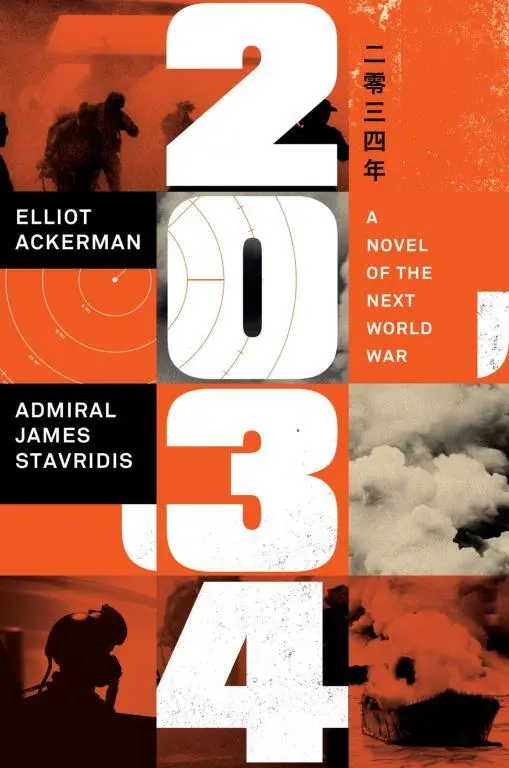
- Название:2034
- Автор:
- Издательство:Penguin Press
- Жанр:
- Год:2021
- Город:New York
- ISBN:978-1-98488-125-0
- Рейтинг книги:4 / 5. Голосов: 2
-
Избранное:Добавить в избранное
- Отзывы:
-
Ваша оценка:
2034: краткое содержание, описание и аннотация
Предлагаем к чтению аннотацию, описание, краткое содержание или предисловие (зависит от того, что написал сам автор книги «2034»). Если вы не нашли необходимую информацию о книге — напишите в комментариях, мы постараемся отыскать её.
, conducting a routine freedom of navigation patrol in the South China Sea when her ship detects an unflagged trawler in clear distress, smoke billowing from its bridge. On that same day, US Marine aviator Major Chris “Wedge” Mitchell is flying an F-35E Lightning over the Strait of Hormuz, testing a new stealth technology as he flirts with Iranian airspace. By the end of that day, Wedge will be an Iranian prisoner, and Sarah Hunt’s destroyer will lie at the bottom of the sea, sunk by the Chinese Navy. Iran and China have clearly coordinated their moves, which involve the use of powerful new forms of cyber weaponry that render US ships and planes defenseless. In a single day, America’s faith in its military’s strategic pre-eminence is in tatters. A new, terrifying era is at hand.
So begins a disturbingly plausible work of speculative fiction, co-authored by an award-winning novelist and decorated Marine veteran and the former commander of NATO, a legendary admiral who has spent much of his career strategically out maneuvering America’s most tenacious adversaries. Written with a powerful blend of geopolitical sophistication and literary, human empathy,
takes us inside the minds of a global cast of characters—Americans, Chinese, Iranians, Russians, Indians—as a series of arrogant miscalculations on all sides leads the world into an intensifying international storm. In the end, China and the United States will have paid a staggering cost, one that forever alters the global balance of power.
Everything in 2034 is an imaginative extrapolation from present-day facts on the ground combined with the authors’ years working at the highest and most classified levels of national security. Sometimes it takes a brilliant work of fiction to illuminate the most dire of warnings: 2034 is all too close at hand, and this cautionary tale presents the reader a dark yet possible future that we must do all we can to avoid.
2034 — читать онлайн бесплатно полную книгу (весь текст) целиком
Ниже представлен текст книги, разбитый по страницам. Система сохранения места последней прочитанной страницы, позволяет с удобством читать онлайн бесплатно книгу «2034», без необходимости каждый раз заново искать на чём Вы остановились. Поставьте закладку, и сможете в любой момент перейти на страницу, на которой закончили чтение.
Интервал:
Закладка:
“Wealthy Russians?” Kolchak laughed. “There is no such thing.”
Farshad didn’t understand. He mentioned their ubiquitous mega yachts in the Mediterranean and Black Seas, their ostentatious villas on the Amalfi and Dalmatian coasts. Whenever Farshad traveled abroad and he saw some resplendent thing—a villa, a boat, a private jet idling on the tarmac, or a woman bejeweled beyond measure—and he asked to whom it all belonged, the inevitable response was always some Russian.
Kolchak was shaking his head. “No, no, no,” he said. “There are no wealthy Russians.” He stubbed his cigarette out in the ashtray. “There are only poor Russians with money.”
While lighting another cigarette, Kolchak began to pontificate about the Rodina , his “Mother Russia,” how in its many iterations, whether they be tsarist, imperialist, or communist, it had never enjoyed the legitimacy of other world powers. “During the empire our tsars spoke French at court,” said Kolchak. “During communism our economy was a hollow shell. Today, under the federation, our leaders are viewed as criminals by the rest of the world. In New York City, or in London, they don’t respect any of us, not even President Putin. To them, President Putin isn’t the grandfather of our Federation; no, to them he is simply another poor Russian, a gangster at best, even though he has retaken our ancestral territories in Crimea, Georgia, and Greater Ukraine; even though he has crippled America’s political system, so that now their president doesn’t even have a party but has to run as one of these enfeebled ‘independents.’ We are a cunning people. Our leader is one of us and is equally cunning. You asked what Russia will do if the United States acts? Isn’t it obvious? What does the fox do in the henhouse?” Kolchak’s lips peeled back from his teeth in a smile.
Farshad had always understood, or at least understood intellectually, that his country and Russia had many shared interests. But with Kolchak, he began to understand the depth of their kinship, the degree by which their two nations had developed in tandem, sharing a trajectory. Both had imperial and ancient pasts; the Russian tsars, the Persian shahs. Both had endured revolutions; the Bolsheviks, the Islamists. And both had suffered the antipathies of the West: economic sanctions, international censure. Farshad also understood, or at least intuited, the opportunity now presenting itself to his Russian allies.
They had left their home port of Kaliningrad three weeks before. On the first week of their journey, the Rezkiy had tracked numerous ships from the US Third and Sixth Fleets, which aggressively patrolled the western Atlantic and these northern Baltic waters. And then, quite suddenly, their American antagonists had vanished. After the dual catastrophes in the South China Sea, the destination of the American fleet became obvious. Equally obvious was the opportunity presented by its absence. No fewer than five hundred fiber-optic cables, which accounted for 90 percent of North America’s 10G internet access, crisscrossed these icy depths.
“If the Americans detonate a nuclear weapon,” said Kolchak, “I don’t think the world will much care if we tamper with a few undersea cables.” He held Farshad in his gaze. “I also don’t think the world would say much if our troops seized a sliver of Poland, to unite Kaliningrad to the Russian mainland.” Kolchak pointed to a map on the wall. He traced out a corridor with his finger, which would give Russia direct overland access to its one Baltic port. Putin himself had often spoken about reclaiming this strip of land. “If the Americans detonate a nuclear weapon, they will become the pariah state they have always claimed we are.”
“Do you think they’d ever go through with it?” Farshad asked Kolchak.
“Ten or even fifteen years ago, I would have said no. Today, I am not so sure. The America they believe themselves to be is no longer the America that they are. Time changes everything, doesn’t it. And now, it is changing the world’s balance in our favor.” Kolchak checked his watch. He shut his laptop and glanced up at Farshad. “But it is late. You must get some rest.”
“I can’t sleep,” said Farshad.
“How come?”
Farshad allowed the quiet to settle between them, so that Kolchak could perceive the faint dong, dong, dong of the ice floes glancing against the hull of the ship. “I find that sound unnerving,” Farshad admitted. “And the ship constantly rolls.”
Kolchak reached across the table and grasped Farshad affectionately by the arm. “You mustn’t let either bother you. Go back to your room, lie down. The rolling you will get used to. And the noise? It has always helped me to imagine that the noise is something else.”
“Like what?” Farshad asked skeptically.
Dong, dong, a couple more ice floes glanced against the hull.
“Like a bell, tolling out a change in the time.”

23:47 May 22, 2034 (GMT+8)
South China Sea
A knock on his door.
Middle of the night.
Lin Bao groaned as he sat up. What can it be now? he wondered. Such interruptions to his sleep had become routine. Last night, the commanders of two destroyers in his battle group had a dispute as to their order in formation, which Lin Bao had to resolve; the night before that there had been an unexpected weather advisory, a typhoon that thankfully never materialized; then a missed communications window with one of his submarines; before that an excess of hard-water moisture in one of his ship’s reactors. The list blurred in his sleep-deprived mind. If Lin Bao stood on the cusp of a great moment in his nation’s history, it didn’t feel that way. Lin Bao felt consumed by the minutiae of his command, and convinced that he might never again enjoy a full night’s rest.
He did, however, feel a small surge of satisfaction that the complex mix of cyber cloaking, stealth materials, and satellite spoofing had kept his fleet well hidden. While the Americans surely suspected them of heading for the vicinity of Chinese Taipei, their old adversary had been unable to develop the precise targeting data required for a counter-maneuver. Eventually, the Americans would find them. But by then it would be too late.
“Comrade Admiral, your presence is requested in the combat information center.”
Lin Bao awoke to another knock. “Comrade Admiral—”
Lin Bao flung open his door. “I heard you the first time,” he snapped at the young sailor, who couldn’t have been more than nineteen, and who looked as sleep-deprived as the admiral. “Tell them”—he coughed—“tell them I’m coming.” The sailor nodded once and hurried down the corridor. As he dressed, Lin Bao regretted his outburst. It was a manifestation of the strain he was under. To exhibit that strain to his crew was to exhibit his weakness to them, and they were under a similar strain. For the past three weeks, ever since they had gone dark, the Zheng He Carrier Battle Group—along with the Navy’s three other strike groups, elements of special forces from the People’s Army, strategic land-based bombers, and hypersonic missiles from the air force—had all converged in a noose around Chinese Taipei, or Taiwan, as the West insisted on calling it. Although Lin Bao’s command remained cloaked, he could almost feel the massive American global surveillance network groping for his precise location.
The operation, as designed by Minister Chiang and approved by the Politburo Standing Committee, was playing out in two phases, each of which adhered to one of Sun Tzu’s famous axioms, the first being, Let your plans be dark and impenetrable as night, and when you move, fall like a thunderbolt. As dramatically as the Chinese fleet had vanished, it would soon reappear around Taiwan, moving like that proverbial thunderbolt. Never before had a nation concentrated its military strength with such stealth. It would take weeks, or even as much as a month, for the Americans or any other power to position combat assets to counter it. The second phase of Minister Chiang’s plan was likewise based on Sun Tzu: The supreme art of war is to subdue your enemy without fighting. Minister Chiang believed that the sudden revelation of his forces off the coast would present the Legislative Yuan, the governing body of so-called Taiwan, with only one choice: a vote of dissolution followed by annexation into the People’s Republic. Not a single shot would need to be fired. When Minister Chiang had proposed his plan to the Politburo Standing Committee, he had argued that surrounding Taiwan so suddenly would result in a bloodless checkmate. Although skepticism existed among certain committee members, including Zhao Leji, the much-feared octogenarian secretary of the Central Commission for Discipline Inspection, ultimately the majority placed its confidence in Minister Chiang.
Читать дальшеИнтервал:
Закладка:
Похожие книги на «2034»
Представляем Вашему вниманию похожие книги на «2034» списком для выбора. Мы отобрали схожую по названию и смыслу литературу в надежде предоставить читателям больше вариантов отыскать новые, интересные, ещё непрочитанные произведения.












Обсуждение, отзывы о книге «2034» и просто собственные мнения читателей. Оставьте ваши комментарии, напишите, что Вы думаете о произведении, его смысле или главных героях. Укажите что конкретно понравилось, а что нет, и почему Вы так считаете.