Isaac Asimov - The Early Asimov. Volume 2
Здесь есть возможность читать онлайн «Isaac Asimov - The Early Asimov. Volume 2» весь текст электронной книги совершенно бесплатно (целиком полную версию без сокращений). В некоторых случаях можно слушать аудио, скачать через торрент в формате fb2 и присутствует краткое содержание. Год выпуска: 1986, ISBN: 1986, Издательство: Del Rey, Жанр: Фантастика и фэнтези, на английском языке. Описание произведения, (предисловие) а так же отзывы посетителей доступны на портале библиотеки ЛибКат.
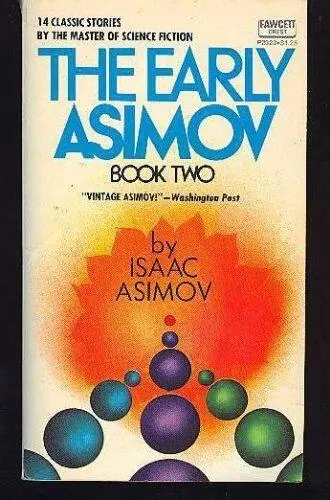
- Название:The Early Asimov. Volume 2
- Автор:
- Издательство:Del Rey
- Жанр:
- Год:1986
- ISBN:ISBN: 034-532589-3
- Рейтинг книги:5 / 5. Голосов: 1
-
Избранное:Добавить в избранное
- Отзывы:
-
Ваша оценка:
The Early Asimov. Volume 2: краткое содержание, описание и аннотация
Предлагаем к чтению аннотацию, описание, краткое содержание или предисловие (зависит от того, что написал сам автор книги «The Early Asimov. Volume 2»). Если вы не нашли необходимую информацию о книге — напишите в комментариях, мы постараемся отыскать её.
The Early Asimov. Volume 2 — читать онлайн бесплатно полную книгу (весь текст) целиком
Ниже представлен текст книги, разбитый по страницам. Система сохранения места последней прочитанной страницы, позволяет с удобством читать онлайн бесплатно книгу «The Early Asimov. Volume 2», без необходимости каждый раз заново искать на чём Вы остановились. Поставьте закладку, и сможете в любой момент перейти на страницу, на которой закончили чтение.
Интервал:
Закладка:
Orloff tucked his monocle into his vest pocket and said tremulously, 'But if a force field is the same thing as interatomic forces, why is it that steel has such a strong interatomic binding force without bucking space? There's a flaw there.'
Prosser eyed him in annoyance. 'No flaw. Critical strength depends on number of generators. In steel, each atom is a force-field generator. That means about three hundred billion trillion generators for every ounce of matter. If we could use that many- As it is, one hundred generators would be the practical limit. That only raises the critical point to ninety-seven or thereabout.'
He got to his feet and continued with sudden fervor, 'No. Problem's over, I tell you. Absolutely impossible to create a force field capable of holding Earth's atmosphere for more than a hundredth of a second. Jovian atmosphere entirely out of question. Cold figures say that; backed by experiment. Space won't stand it!
'Let the Jovians do their damnedest. They can't get out! That's final! That's final! That's final!'
Orloff said, 'Mr. Secretary, can I send a spacegram anywhere in the Station? I want to tell Earth that I'm returning by the next ship and that the Jovian problem is liquidated - entirely and for good.'
Birnam said nothing, but the relief on his face as he shook hands with the colonial commissioner, transfigured the gaunt homeliness of it unbelievably.
And Dr. Prosser repeated, with a birdlike jerk of his head, 'That's final!'
Hal Tuttle looked up as Captain Everett of the spaceship Transparent, newest ship of the Comet Space Lines, entered his private observation room in the nose of the ship.
The captain said, 'A spacegram has just reached me from the home offices at Tucson. We're to pick up Colonel Commissioner Orloff at Jovopolis, Ganymede, and take him back to Earth.'
'Good. We haven't sighted any ships?'
'No, no! We're way off the regular space lanes. The first the System will know of us will be the landing of the Transparent on Ganymede. It will be the greatest thing in space travel since the first trip to the Moon.' His voice softened suddenly, 'What's wrong, Hal? This is your triumph, after all.'
Hal Tuttle looked up and out into the blackness of space. 'I suppose it is. Ten years of work, Sam. I lost an arm and an eye in that first explosion, but I don't regret them. It's the reaction that's got me. The problem is solved; my lifework is finished.'
'So is every steel-hulled ship in the System.'
Tuttle smiled. 'Yes. It's hard to realize, isn't it?' He gestured outward. 'You see the stars? Part of the time, there's nothing between them and us. It gives me a queazy feeling.' His voice brooded, 'Nine years I worked for nothing. I wasn't a theoretician, and never really knew where I was headed -just tried everything. I tried a little too hard and space wouldn't stand it. I paid an arm and an eye and started fresh.'
Captain Everett balled his fist and pounded the hull - the hull through which the stars shone unobstructed. There was the muffled thud of flesh striking an unyielding surface - but no response whatever from the invisible wall.
Tuttle nodded, 'It's solid enough, now - though it flicks on and off eight hundred thousand times a second. I got the idea from the stroboscopic lamp. You know them - they flash on and off so rapidly that it gives all the impression of steady illumination.
'And so it is with the hull. It's not on long enough to buckle space. It's not off long enough to allow appreciable leakage of the atmosphere. And the net effect is a strength better than steel.'
He paused and added slowly, 'And there's no telling how far we can go. Speed up the intermission effect. Have the field flick off and on millions of times per second - billions of times. You can get fields strong enough to hold an atomic explosion. My lif ework!'
Captain Everett pounded the other's shoulder. 'Snap out of it, man. Think of the landing on Ganymede. The devil! It will be great publicity. Think of Orloff's face, for instance, when he finds he is to be the first passenger in history ever to travel in a spaceship with a force-field hull. How do you suppose he'll feel?'
Hal Tuttle shrugged. 'I imagine he'll be rather pleased.'
With 'Not Final!' I completed my third year as a Writer -three years since my initial trip to Campbell 's office. In that time I had earned just a hair short of a thousand dollars (not as bad as it sounds in days when college tuition was only four hundred dollars a year) and I had about a quarter of that in my savings account.
Still, you can see that there was nothing in that financial record to lead me to think that writing was a possible way of making a living - especially since I had no dream of ever writing anything but magazine science fiction.
On June 10, 1941, in the course of a talk with Fred Pohl, I mentioned my frustration at not being able to make a sale to Unknown. Fred said he had a good idea for a fantasy, and from that it was a short step to an agreement to go halfies. We'd talk the idea over, I would write it, and we'd split the sale, if any, fifty-fifty.
Fred must have been willing because (as I found out three days later) his magazines were doing poorly and he was being relieved of his editorial position.
It was too bad, of course, but not an irredeemable catastrophe. Pohl had had nearly two years of valuable editorial experience, and the time would come when this would stand him in good stead in a much more important and longer-enduring role as editor of Galaxy, which during the 1950s and 1960s was to compete with Astounding for leadership in the field.
As for myself, I could scarcely complain. Pohl had accepted eight of my stories (over a quarter of those I had written and nearly half of those I had sold up to then). Of these, six had already been published and one ('Super-Neutron') was safely slated for publication in the forthcoming issue of Astonishing. That left the ninth, 'Christmas on Ganymede.' It was not yet paid for, nor had it actually been set in type, and, regretfully, Pohl had to return it. However, I sold it within two weeks to Thrilling Wonder Stories for a little more than Pohl would have been able to pay me, so no harm was done even there. -And though I regretted the loss of a market, Pohl had safely seen me through the period during which I developed to the point where Campbell and Astounding itself could become my major market.
At first, when 'Christmas on Ganymede' was returned, I thought it was because the Pohl magazines had been suspended altogether. If the publishers had intended that, they changed their minds. Astonishing continued a couple of years, until it was killed by the World War II paper shortage. Super Science Stones survived World War II and even a little past the 1940s, and was yet to publish one more story of mine.
But back to June 10- Taking Fred's fantasy idea, I wrote the story entirely on my own, calling it 'Legal Rights.' Once again, though, a collaboration didn't succeed. On July 8, Campbell rejected it, the first rejection I had received from him in half a year.
By that time, though, Fred was agenting again. I gave him the story, rather shamefacedly, and forgot about it. He changed the name to 'Legal Rites' (much better) and rewrote it quite a bit. Seven years later, he actually-sold it.
Legal Rites (with James.MacCreigh) [14]
Already the stars were out, though the sun had just dipped under the horizon, and the sky of the west was a blood-stuck gold behind the Sierra Nevadas.
'Hey!' squawked Russell Harley. 'Come back!'
But the one-lunged motor of the old Ford was making too much noise; the driver didn't hear him. Harley cursed as he watched the old car careen along the sandy ruts on its half-flat tires. Its taillight was saying a red no to him. No, you can't get away tonight; no, you'll have to stay here and fight it out.
Читать дальшеИнтервал:
Закладка:
Похожие книги на «The Early Asimov. Volume 2»
Представляем Вашему вниманию похожие книги на «The Early Asimov. Volume 2» списком для выбора. Мы отобрали схожую по названию и смыслу литературу в надежде предоставить читателям больше вариантов отыскать новые, интересные, ещё непрочитанные произведения.


Обсуждение, отзывы о книге «The Early Asimov. Volume 2» и просто собственные мнения читателей. Оставьте ваши комментарии, напишите, что Вы думаете о произведении, его смысле или главных героях. Укажите что конкретно понравилось, а что нет, и почему Вы так считаете.