Isaac Asimov - The Early Asimov. Volume 2
Здесь есть возможность читать онлайн «Isaac Asimov - The Early Asimov. Volume 2» весь текст электронной книги совершенно бесплатно (целиком полную версию без сокращений). В некоторых случаях можно слушать аудио, скачать через торрент в формате fb2 и присутствует краткое содержание. Год выпуска: 1986, ISBN: 1986, Издательство: Del Rey, Жанр: Фантастика и фэнтези, на английском языке. Описание произведения, (предисловие) а так же отзывы посетителей доступны на портале библиотеки ЛибКат.
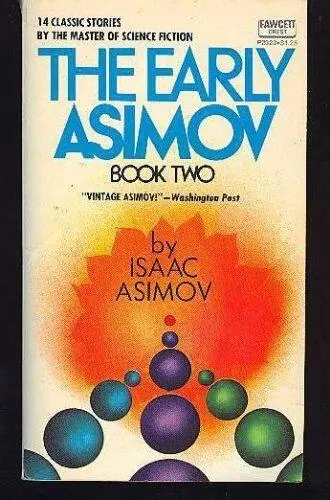
- Название:The Early Asimov. Volume 2
- Автор:
- Издательство:Del Rey
- Жанр:
- Год:1986
- ISBN:ISBN: 034-532589-3
- Рейтинг книги:5 / 5. Голосов: 1
-
Избранное:Добавить в избранное
- Отзывы:
-
Ваша оценка:
The Early Asimov. Volume 2: краткое содержание, описание и аннотация
Предлагаем к чтению аннотацию, описание, краткое содержание или предисловие (зависит от того, что написал сам автор книги «The Early Asimov. Volume 2»). Если вы не нашли необходимую информацию о книге — напишите в комментариях, мы постараемся отыскать её.
The Early Asimov. Volume 2 — читать онлайн бесплатно полную книгу (весь текст) целиком
Ниже представлен текст книги, разбитый по страницам. Система сохранения места последней прочитанной страницы, позволяет с удобством читать онлайн бесплатно книгу «The Early Asimov. Volume 2», без необходимости каждый раз заново искать на чём Вы остановились. Поставьте закладку, и сможете в любой момент перейти на страницу, на которой закончили чтение.
Интервал:
Закладка:
It was about time that I made another stab at Unknown, and I did so with a story called The Oak,' which, as I recall, was something about an oak tree that served as an oracle and delivered ambiguous statements. I submitted it to Campbell on July 16, 1940, and it was promptly rejected.
One of the bad things about writing for Unknown was that the magazine was one of a kind. If Unknown rejected a story, there was no place else to submit it. It was possible to try Weird Tales, a magazine that was older than any science fiction magazine, but it dealt with old-fashioned, creaky horror tales and paid very little to boot. I wasn't really interested in trying to get into it. (And besides, they rejected both 'Life Before Birth' and 'The Oak' when I submitted them.)
Still, July 29, 1940, was a turning point in my career, although, of course, I had no way of telling it. I had up to that point written twenty-two stories in twenty-five months. Of these I had sold (or was to sell) thirteen, while nine never sold at all and no longer exist. The record wasn't abysmal but neither was it great - let's call it mediocre.
However, as it happened, except for two short-short stories that were special cases, I never again wrote a science fiction story I could never sell. I had found the range.
But not Campbell 's range particularly. In August I wrote 'Heredity,' which I submitted to Campbell on August 15, and which he rejected two weeks later. Fortunately, Pohl snapped it up at once.
Heredity [4]
Dr. Stefansson fondled the thick sheaf of typewritten papers that lay before him, 'It's all here, Harvey - twenty-five years of work.'
Mild-mannered Professor Harvey puffed idly at his pipe, 'Well, your part is over - and Markey's, too, on Ganymede. It's up to the twins, themselves, now.'
A short ruminative silence, and then Dr. Stefansson stirred uneasily, 'Are you going to break the news to Allen soon?'
The other nodded quietly, 'It will have to be done before we get to Mars, and the sooner the better.' He paused, then added in a tightened voice, 'I wonder how it feels to find out after twenty-five years that one has a twin brother whom one has never seen. It must be a damned shock.'
'How did George take it?'
'Didn't believe it at first, and I don't blame him. Markey had to work like a horse to convince him it wasn't a hoax. I suppose I'll have as hard a job with Allen.' He knocked the dottle from his pipe and shook his head.
'I have half a mind to go to Mars just to see those two get together,' remarked Dr. Stefansson wistfully.
'You'll do no such thing, Stef. This experiment's taken too long and means too much to have you ruin it by any such fool move.'
'I know, I know! Heredity versus environment! Perhaps at last the definite answer.' He spoke half to himself, as if repeating an old, familiar formula, 'Two identical twins, separated at birth; one brought up oh old, civilized Earth, the other on pioneer Ganymede. Then, on their twenty-fifth birthday brought together for the first time on Mars - God! I wish Carter had lived to see the end of it. They're his children.'
'Too bad! - But we're alive, and the twins. To carry the experiment to its end will be our tribute to him.'
There is no way of telling, at first seeing the Martian branch of Medicinal Products, Inc., that it is surrounded by anything but desert. You can't see the vast underground caverns where the native fungi of Mars are artificially nurtured into huge blooming fields. The intricate transportation system that connects all parts of the square miles of fields to the central building is invisible. The irrigation system; the air-purifiers; the drainage pipes, are all hidden.
And what one sees is the broad squat red-brick building and Martian desert, rusty and dry, all about.
That had been all George Carter had seen upon arriving via rocket-taxi, but him, at least, appearances had not deceived. It would have been strange had it done so, for his life on Ganymede had been oriented in its every phase towards eventual general managership of that very concern. He knew every square inch of the caverns below as well as if he had been born and raised in them himself.
And now he sat in Professor Lemuel Harvey's small office and allowed just the slightest trace of uneasiness to cross his impassive countenance. His ice-blue eyes sought those of Professor Harvey.
'This - this twin brother o' mine. He'll be here soon?'
Professor Harvey nodded, 'He's on his way over right now.'
George Carter uncrossed his knees. His expression was almost wistful, 'He looks a lot like me, d'ya rack on?'
'Quite a lot. You're identical twins, you know.'
'Hmm! Rackon so! Wish I'd known him all the time - on Ganny!' He frowned, 'He's lived on Airth all's life, huh?'
An expression of interest crossed Professor Harvey's face. He said briskly, 'You dislike Earthmen?'
'No, not exactly,' came the immediate answer. 'It's just the Airthmen are tenderfeet. All of 'm I know are.'
Harvey stifled a grin, and conversation languished.
The door-signal snapped Harvey out of his reverie and George Carter out of his chair at the same instant. The professor pressed the desk-button and the door opened.
The figure on the threshold crossed into the room and then stopped. The twin brothers faced each other.
It was a tense, breathless moment, and Professor Harvey sank into his soft chair, put his finger-tips together and watched keenly.
The two stood stiffly erect, ten feet apart, neither making a move to lessen the distance. They made a curious contrast - a contrast all the more marked because of the vast similarity between the two.
Eyes of frozen blue gazed deep into eyes of frozen blue. Each saw a long, straight nose over full, red lips pressed firmly together. The high cheekbones were as prominent in one as in the other, the jutting, angular chin as square. There was even the same, odd half-cock of one eyebrow in twin expressions of absorbed, part-quizzical interest.
But with the face, all resemblance ended. Allen Carter's clothes bore the New York stamp on every square inch. From his loose blouse, past his dark purple knee breeches, salmon-colored cellulite stockings, down to the glistening sandals on his feet, he stood a living embodiment of latest Terrestrial fashion.
For a fleeting moment, George Carter was conscious of a feeling of ungainliness as he stood there in his tight-sleeved, close-necked shirt of Ganymedan linen. His unbuttoned vest and his voluminous trousers with their ends tucked into high-laced, heavy-soled boots were clumsy and provincial. Even he felt it - for just a moment.
From his sleeve-pocket Allen removed a cigarette case - it was the first move either of the brothers had made - opened it, withdrew a slender cylinder of paper-covered tobacco that spontaneously glowed into life at the first puff.
George hesitated a fraction of a second and his subsequent action was almost one of defiance. His hand plunged into his inner vest pocket and drew therefrom the green, shriveled form of a cigar made of Ganymedan greenleaf. A match flared into flame upon his thumbnail and for a long moment, he matched, puff for puff, the cigarette of his brother.
And then Allen laughed - a queer, high-pitched laugh, 'Your eyes are a little closer together, I think.'
'Rackon 'tis, maybe. Y'r hair's fixed sort o' different.' There was faint disapproval in his voice. Allen's hand went selfconsciously to his long, light-brown hair, carefully curled at the ends, while his eyes flickered over the carelessly-bound queue into which the other's equally long hair was drawn.
'I suppose we'll have to get used to each other. - I'm willing to try.' The Earth twin was advancing now, hand outstretched.
Читать дальшеИнтервал:
Закладка:
Похожие книги на «The Early Asimov. Volume 2»
Представляем Вашему вниманию похожие книги на «The Early Asimov. Volume 2» списком для выбора. Мы отобрали схожую по названию и смыслу литературу в надежде предоставить читателям больше вариантов отыскать новые, интересные, ещё непрочитанные произведения.


Обсуждение, отзывы о книге «The Early Asimov. Volume 2» и просто собственные мнения читателей. Оставьте ваши комментарии, напишите, что Вы думаете о произведении, его смысле или главных героях. Укажите что конкретно понравилось, а что нет, и почему Вы так считаете.