Michael Kube-McDowell - Odyssey
Здесь есть возможность читать онлайн «Michael Kube-McDowell - Odyssey» весь текст электронной книги совершенно бесплатно (целиком полную версию без сокращений). В некоторых случаях можно слушать аудио, скачать через торрент в формате fb2 и присутствует краткое содержание. Год выпуска: 2004, ISBN: 2004, Издательство: I Books, Жанр: Фантастика и фэнтези, на английском языке. Описание произведения, (предисловие) а так же отзывы посетителей доступны на портале библиотеки ЛибКат.
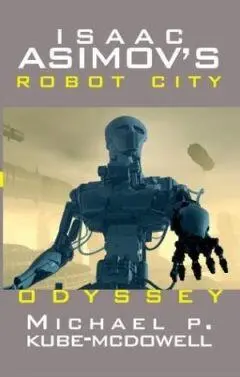
- Название:Odyssey
- Автор:
- Издательство:I Books
- Жанр:
- Год:2004
- ISBN:ISBN: 0-743-47924-6
- Рейтинг книги:3 / 5. Голосов: 1
-
Избранное:Добавить в избранное
- Отзывы:
-
Ваша оценка:
Odyssey: краткое содержание, описание и аннотация
Предлагаем к чтению аннотацию, описание, краткое содержание или предисловие (зависит от того, что написал сам автор книги «Odyssey»). Если вы не нашли необходимую информацию о книге — напишите в комментариях, мы постараемся отыскать её.
Odyssey — читать онлайн бесплатно полную книгу (весь текст) целиком
Ниже представлен текст книги, разбитый по страницам. Система сохранения места последней прочитанной страницы, позволяет с удобством читать онлайн бесплатно книгу «Odyssey», без необходимости каждый раз заново искать на чём Вы остановились. Поставьте закладку, и сможете в любой момент перейти на страницу, на которой закончили чтение.
Интервал:
Закладка:
“If you had not destroyed your robot colony-,” Aranimas said, his voice rising.
“I told you before, the robots did that on their own,” Derec insisted. “But that doesn’t mean you’re stuck. You take this ship to any Spacer world and you’ll find millions of robots. And you won’t have to steal them, either. Robots are a major trade item between the worlds. Any one of them would be happy for a new customer.”
That was not entirely true, of course. It was highly doubtful the Spacers would willingly turn over examples of their most advanced technology to an alien race, and even if they were willing, there was the problem of what Aranimas could offer as payment. But if Derec could make Aranimas believe it was the truth, coax him to take the ship to a human world, he would at least have succeeded in alerting them to the aliens’ existence, and possibly have laid the groundwork for his own release.
“If commerce is so welcome, why did your robots destroy themselves?”
“Because you came in firing your weapons and declared yourself an enemy,” Derec said. “If you’d come in as a friend, it would have been different. Take me to your navigator. I’ll help him set a course for the nearest Spacer world.” And find out where we are in the process, he added silently.
“I will evaluate the options,” Aranimas said, moving toward the corridor. “In the meantime, you will continue your work. I will return tomorrow to see my robot activated.”
The reprogramming could not be postponed any longer, Derec decided, He did not think Aranimas would return soon. He would have to hope that Wolruf would not, either.
Unfortunately, Derec did not have the equipment to alter the robot’s programming directly, which would have been risky anyway. Since it was intimately bound up in the Laws of Robotics, the robot’s definition of what a human was comprised some of the most crucial and most deeply engraved patterns within its brain. What needed doing would have to be done more indirectly.
“Alpha,” he said. “Did you scan the organism that was just here?”
“Yes, Derec.”
“And earlier today, did you scan another type of organism visiting the lab?”
“Yes, Derec.”
“What’d you think of them?”
“I have no previous knowledge of humans of this type-”
That was the kind of response Derec had been fearing. “Stop. They’re not humans.”
“Sir, I am aware that my data library is not complete. However, I am unable to categorize them in any other fashion unless you can provide me with evidence for your assertion.”
“Compare their appearance with mine.”
“Sir, I acknowledge that there are numerous anomalous differences. However, those differences fall in areas where the definition of a human has a wide latitude, such as skin color and covering, dimensions, and vocal timbre. The similarities are in more fundamental areas such as bilateral symmetry, bipedal locomotion, oxygen respiration-”
“They are humanoid, as you are. But they are not human.”
“I note your assertion, sir, but I am unable to confirm it.”
Derec understood that he was not being called a liar. When it had no independent knowledge, a robot would ordinarily accept the word of a human as gospel. But a robot was under no obligation to accept a human’s claim that it was raining when its own sensors told it otherwise.
This was not that clear-cut an issue, but the robot was biased toward a generous definition of what a human was. Otherwise there was the danger of a robot’s being used as an assassin by the simple step of persuading it that its target was not a human. Derec understood, but even so was annoyed. “I suppose that if they had twelve arms and belched fire when they talked, you might believe me.”
“Sir, in the matter at hand the morphological considerations are not primary in my analysis.”
“Explain. What are the discriminators?”
“Sir, I base my conclusion on the observation that the organisms called Aranimas and Wolruf are intelligent beings capable of independent reasoned thought.”
“How do you know?”
“Sir, you carried on a dialogue with each of them. Although humans on occasion talk to nonanimate objects and may give the appearance of carrying on a dialogue with certain animals, I perceived your discussions as having a qualitatively different character.”
“Are you saying that because I treated them as human, you have to think of them that way?”
“Where there is uncertainty, as thee may be when a human wears a costume or disguise, I am obliged to use such cues as are available. Your behavior created a strong presumption that Aranimas and Wolruf are human.”
“I talk to you the same way I talked to them. Does that make you a human?”
“No, Derec. I am a robot, a technological artifact. To the degree that I may seem to be human, it is only because I have been designed to do so in order to more easily interact with humans.”
Derec was growing frustrated. “Tell me this, then. How do you tell the difference between a robot and a human at a distance?”
“Sir, just as I have an operational definition of that class of organisms called humans, I also have one of that class of objects called robots. It is ordinarily possible to distinguish between the two based on the characteristics they do not have in common. It is not a perfect system, however, and may be fooled, as by a humaniform robot of the type developed by Dr. Han Fastolfe.”
Derec had to concede the point to the robot. If only I could show it skin scrapings from the three of us-but if Aranimas or Wolruf happened to have a cellular structure, I’d be no better off. It might even decide its right arm is human-
“Robot, are Spacers, Settlers, and Earthpeople all human?” he asked suddenly.
“Yes.”
“Have you personally observed every member of those groups?”
“No, Derec. There are approximately eight billion Earthpeople, five billion Spacers, and-”
“If you have not observed them individually, how is it you are able to classify them all as human?”
“Spacers and Settlers are descendants of the original human community on Earth,” the robot replied. “Therefore, any individual correctly identified as a Settler or Spacer cannot be other than human.”
“Why is that?” Derec asked, though he knew the answer.
“They share a phylogenetic relationship. The offspring of a human must be human.”
“In other words, what really counts is biology-the genes and DNA humans carry in their cells.”
“Yes.”
“And the guidelines that are built into your definition of a human are simply shortcuts to make it unnecessary for you to subject everyone you encounter to a biological assay. The final criterion is DNA.”
“That is correct, Derec.”
“But you have no way of examining a person’s DNA directly.”
“No, sir.”
“Fine. You said that each of the anomalies in Aranimas’s appearance fell within the acceptable parameters for natural variation and mutation.”
“Yes, sir.”
“I ask you to calculate the probability that all of Aranimas’s anomalies would appear in a single organism.”
The robot scarcely hesitated. “The probability is extremely small.”
“And for Wolruf?”
“The probability is somewhat higher, but still on the order of one chance in ten to the fifteenth power.”
“In other words, there is less than a one in ten thousand chance that a mutation this extreme would have arisen once in all of human history. And here there are two of them, not only alive at the same time but in the same place, and both as different from each other as they are from me.”
“It is quite remarkable. No doubt further study of these individuals would be of great benefit.”
Читать дальшеИнтервал:
Закладка:
Похожие книги на «Odyssey»
Представляем Вашему вниманию похожие книги на «Odyssey» списком для выбора. Мы отобрали схожую по названию и смыслу литературу в надежде предоставить читателям больше вариантов отыскать новые, интересные, ещё непрочитанные произведения.




Обсуждение, отзывы о книге «Odyssey» и просто собственные мнения читателей. Оставьте ваши комментарии, напишите, что Вы думаете о произведении, его смысле или главных героях. Укажите что конкретно понравилось, а что нет, и почему Вы так считаете.