David Weber - Hell's Gate
Здесь есть возможность читать онлайн «David Weber - Hell's Gate» весь текст электронной книги совершенно бесплатно (целиком полную версию без сокращений). В некоторых случаях можно слушать аудио, скачать через торрент в формате fb2 и присутствует краткое содержание. Город: New York, Год выпуска: 2006, ISBN: 2006, Издательство: Baen publishing Enterprises, Жанр: Фантастика и фэнтези, Фэнтези, Альтернативная история, на английском языке. Описание произведения, (предисловие) а так же отзывы посетителей доступны на портале библиотеки ЛибКат.
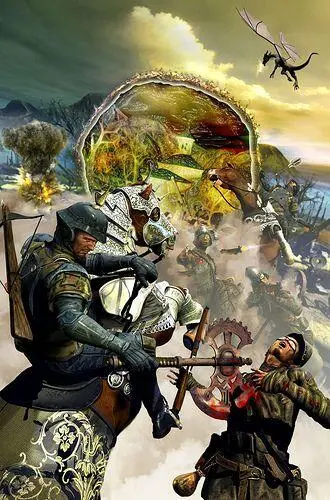
- Название:Hell's Gate
- Автор:
- Издательство:Baen publishing Enterprises
- Жанр:
- Год:2006
- Город:New York
- ISBN:1-4165-0939-9
- Рейтинг книги:3 / 5. Голосов: 1
-
Избранное:Добавить в избранное
- Отзывы:
-
Ваша оценка:
Hell's Gate: краткое содержание, описание и аннотация
Предлагаем к чтению аннотацию, описание, краткое содержание или предисловие (зависит от того, что написал сам автор книги «Hell's Gate»). Если вы не нашли необходимую информацию о книге — напишите в комментариях, мы постараемся отыскать её.
Hell's Gate — читать онлайн бесплатно полную книгу (весь текст) целиком
Ниже представлен текст книги, разбитый по страницам. Система сохранения места последней прочитанной страницы, позволяет с удобством читать онлайн бесплатно книгу «Hell's Gate», без необходимости каждый раз заново искать на чём Вы остановились. Поставьте закладку, и сможете в любой момент перейти на страницу, на которой закончили чтение.
Интервал:
Закладка:
And so, the Empire had grown ever larger. There had never really been a conscious plan to forge an empire in the first place. At every stage, it had been primarily a pragmatic matter of seeking border security, not fresh lands to rule, yet the result had been the same. Ternathia had become a spreading, irresistable tide, bringing Ternathian arts and technology to the cultures it had engulfed, learning from those cultures, in turn, and?always?intermarrying with them. The Calirath Dynasty had been wise enough to bind its subject peoples to it by making them full members in the Empire which had overrun them, and marriage had been one of the promises and guarantors of that equality. So had respect for local religions. The process of absorption had worked both ways, gradually and almost always successfully, over centuries, and one reason it had was the fact that the Ternathian traders had brought with them something far more valuable than gold or spices or precious stones.
Ternathians had been the first to harness the Talents of the mind. Legend had it that Erthain the Great, the semi-mythical founder of the House of Calirath, had been the very first Talent. Andrin took that with a hefty lump of skeptical salt, but there was no question that Ternath was, indeed, the birthplace of the Talents. The telepathy of the Voices, Precognition, Mapping, the prescient Glimpses which were the heritage and curse of Ternathian royalty, Telekinesis, Distance Viewing?all of them had been developed and nurtured in Ternath, and then bequeathed to the children of Ternathia.
Intermarriage had carried those Talents throughout the sprawling Empire. Eventually, they had spread far beyond Ternathia's borders, through other intermarriages, and today their possession wove throughout all Sharona, like a gleaming net of precious gold.
Yet the world had turned and changed, until, eventually, the vast territory under direct Ternathian rule could no longer be administered at an affordable cost. Ultimately, a Ternathian emperor had made the decision to set free those provinces the Empire could no longer afford to govern. Andrin had always been glad Ternathia's borders had shrunk not from the fire of rebellion, or the crumbling of internal decay, but because her ancestors had been wise enough to return control of its far-flung provinces to the people who lived there.
That was the reason the wealthy Kingdom of Shurkhal and the many smaller kingdoms which shared its cultural heritage were once again Shurkhal and her sister states, just as the Harkalian states were once again sovereign, with legal bonds to no one but themselves. It was better that way. Andrin knew that. Not only because her tutors?including her father and mother?had taught her so, but because she could see it for herself.
It was worse than folly to grip something one could no longer afford to keep, simply for the perverse joy of possession. It was cruel to do so, and cruel to hold people in bondage. Had they wanted to remain Ternathian, she thought, they would doubtless have found a way to make it profitable for Ternathia to keep them. But only a few kingdoms or republics or principalities had refused their freedom when it was offered.
Ternathia's empire had shrunk steadily, and for the most part gracefully, and those who ruled the Ternathian Empire had retained their humanity in the process. Andrin Calirath was proud to be part of that lineage, proud to be the daughter of Ternathia's current Emperor, who still ruled five hundred and seventeen million souls, give or take a few hundred thousand. And she was proud that even as they had taken back their freedom, Ternathia's one-time provinces had retained much of what Ternath had brought them. Proud of their independence and individuality, yes, but also mindful of thousands of years of shared history and the common heritage which continued to bind them together, as well.
After Ternathia and Farnalia, the next largest "empires," if the term could be used, were the Arpathians of the Septentrion, famous for furs, amber, vast herds of horses, and nomadic warriors, and Uromathia.
In reality, there was no such thing as an "Arpathian Empire"?the Septs were far too fiercely independent for anything that centralized?but the Septentrion formed a recognizable union of cultures, religion, and political interests. It gave all the Septs representation, enforced the peace between them, and dominated the immense sweep of land from the Ibral Sea to the Scurlis Sea, four thousand miles to the east.
South of Arpathia lay the tangled kingdoms of the Uromathian culture. Those kingdoms included Eniath, whose fierce deserts had given rise to a people with a love of horses and hawks that rivaled Andrin's own, as well as to genuine empires and several smaller independent states. The larger of the two empires was the Uromathian Empire itself, which had given the entire culture its name and rivaled modern Ternathia in size.
The smaller Hinorean Empire was no welterweight, but it couldn't match its larger neighbor, Uromathia, in size or wealth. Uromathians tended to produce enormous population densities, far greater than Ternathia's or, indeed, than the rest of Sharona in general. There were so many Uromathians, in fact, that large numbers of them had migrated to the new universes discovered beyond the portals.
Andrin had never met any Uromathians in person, although she'd seen a handful of envoys who'd come to Hawkwing Palace on official business. They were an exotic people, but far smaller than most Ternathians. Andrin had been taller than any of the male Uromathians she'd seen, which doubtless would have made them uncomfortable had they actually met her face-to-face.
Sweeping her gaze back toward the west, she skipped over the triangular jut of land that was Harkala and its sister states, once part of Ternathia but longe since independent once more. The long Ricathian coastline led her eyes up past Shurkhal?another former Ternathian province, famous for its vast stretches of uninhabitable desert?and the Grand Ternathian Canal, linking the Mbisi and the Finger Sea.
Then her gaze reached the portion of the map north of Shurkhal, along the Mbisi's eastern shore, where the nation of Othmaliz lay between the peoples of the west and the peoples of the east. Like Shurkhal and Harkala, Othmaliz had once been part of Ternathia's empire. Also like Shurkhal and Harkala, Othmaliz had returned to native rule when Ternathia withdrew from the eastern half of its empire.
Andrin's gaze stopped there, for in Othmaliz, lay Tajvana.
Her skin tingled with the strange fire of her still-undefined Glimpse as she moved her eyes past the long, narrow, knife-like promontory known as Ibral's Blade, which ran parallel to the incredibly long and narrow Ibral Straits. That narrow passage of water opened up into the Sea of Ibral, which lapped against the city's ancient shoreline, and her heart burned with a strange passion she stared at the name on the map.
Tajvana.
The very name was magical, imbued with a history so deep it could hardly be grasped. Capital city of Ternathia for twenty-three centuries. Beauty beyond imagining. Ancient power, unrivaled in the history of mankind. Wealth almost beyond calculation, because it had been wealthy for so many millennia. Tajvana, which could be reached from the west only through the Ibral Straits, straddled the even narrower Ylani Straits, beyond which lay the dark and chilly waters of the Ylani Sea.
The Ylani was totally landlocked, save for that one tiny outlet, through Tajvana. Historically, whoever controlled the Ylani Straits had controlled the rich trade routes between Ricathia and Ternathia in the west, and Arpathia and Uromathia in the east. The importance of that trade had begun to fade as colonization had spread from Chairifon across the globe of Sharona, opening new markets, new sources of raw materials and goods, but only until the Larakesh Portal had suddenly appeared in the mountains just west of the sleepy little Ylani Sea seaport of the same name some eighty years ago. The only way for shipping to reach Larakesh from the rest of the world was through the Ibral and Ylani Straits, which meant?once again?through Tajvana. The ancient city had become, if possible, even wealthier than before, and the Portal Authority's decision to locate its headquarters there had restored it to the very first rank of important cities. Yet it was still the sheer history of the city which resonated so deeply with Andrin's very blood and sinew. Tajvana was unique, the one city on the face of Sharona which had known both financial and political power, virtually without interruption, for at least five thousand years. The city was as old as Ternathia itself, a jewel the Ternathian emperors had voluntarily given up.
Читать дальшеИнтервал:
Закладка:
Похожие книги на «Hell's Gate»
Представляем Вашему вниманию похожие книги на «Hell's Gate» списком для выбора. Мы отобрали схожую по названию и смыслу литературу в надежде предоставить читателям больше вариантов отыскать новые, интересные, ещё непрочитанные произведения.





Обсуждение, отзывы о книге «Hell's Gate» и просто собственные мнения читателей. Оставьте ваши комментарии, напишите, что Вы думаете о произведении, его смысле или главных героях. Укажите что конкретно понравилось, а что нет, и почему Вы так считаете.