Robert Sawyer - Frameshift
Здесь есть возможность читать онлайн «Robert Sawyer - Frameshift» весь текст электронной книги совершенно бесплатно (целиком полную версию без сокращений). В некоторых случаях можно слушать аудио, скачать через торрент в формате fb2 и присутствует краткое содержание. Год выпуска: 1998, ISBN: 1998, Издательство: Tor Science Fiction, Жанр: Фантастика и фэнтези, на английском языке. Описание произведения, (предисловие) а так же отзывы посетителей доступны на портале библиотеки ЛибКат.
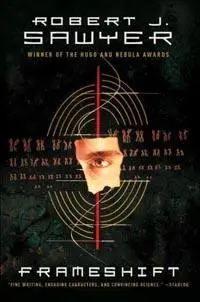
- Название:Frameshift
- Автор:
- Издательство:Tor Science Fiction
- Жанр:
- Год:1998
- ISBN:0-812-57108-8
- Рейтинг книги:4 / 5. Голосов: 1
-
Избранное:Добавить в избранное
- Отзывы:
-
Ваша оценка:
Frameshift: краткое содержание, описание и аннотация
Предлагаем к чтению аннотацию, описание, краткое содержание или предисловие (зависит от того, что написал сам автор книги «Frameshift»). Если вы не нашли необходимую информацию о книге — напишите в комментариях, мы постараемся отыскать её.
Frameshift — читать онлайн бесплатно полную книгу (весь текст) целиком
Ниже представлен текст книги, разбитый по страницам. Система сохранения места последней прочитанной страницы, позволяет с удобством читать онлайн бесплатно книгу «Frameshift», без необходимости каждый раз заново искать на чём Вы остановились. Поставьте закладку, и сможете в любой момент перейти на страницу, на которой закончили чтение.
Интервал:
Закладка:
“Of course.” She showed Pierre a variety of policies: the predictable Silver and Bronze Plans, with progressively fewer benefits; a hospital-only plan; a drug-only plan; and so on. But Tiffany pressed hard for the Gold Plan, and Pierre finally agreed, telling himself he would have made exactly the same decision even if her blouse had been done up all the way.
“You won’t regret your choice,” said Tiffany. “You’re not just buying health insurance — you’re buying peace of mind.” She got a form from her briefcase and handed it to Pierre. “If you could just fill this out — and don’t forget to date it January second.” She opened the left side of her jacket.
There was a pocket inside the jacket, with a row of identical retractable ballpoint pens clipped to it. She extracted one, closed her jacket, and handed the pen to Pierre.
He pressed down on the pen’s button with his thumb, extending the point, and filled out the forms. When he was done, he handed the form back to her, and absently went to put the pen in his own breast pocket.
Tiffany pointed at it. “My pen… ?” she said.
Pierre smiled sheepishly and handed it back to her. “Sorry.”
“So, I’ll call you at the beginning of the year,” she said. “But be careful between now and then — we wouldn’t want anything to happen to you before you’re insured.”
“I still don’t know if I’m going to take the test,” he said.
She nodded. “It’s up to you.”
Pierre thought, It hardly seems that way , but decided not to argue the point further.
Chapter 10
Pierre had searched long and hard for an area to specialize in. His first instinct had been to do research directly into Huntington’s disease, but ever since the Huntington’s gene had been discovered, many scientists were concentrating on that. Naturally, Pierre hoped they would find a cure — and soon enough to help him, of course, if it turned out that he himself did have the disease. But Pierre also knew of the need for objectivity in science: he couldn’t afford to piss away what time he might have left chasing slim leads that would probably amount to nothing-leads that someone without Huntington’s would know enough to abandon, but that he, out of desperation, might devote far too much time to.
Pierre decided instead to concentrate on an area most other geneticists were by and large ignoring, in hopes that such territory would be more likely to yield a breakthrough that might indeed get him a Nobel Prize. He centered his research on the so-called junk DNA, or introns : the 90 percent of the human genome that did not code for protein synthesis.
Exactly what all that DNA did do no one was quite sure. Some parts seemed to be foreign sequences from viruses that had invaded the genome in the past; others were endlessly stuttering repeats — ironically, similar in structure to the very unusual gene that caused Huntington’s; others still were deactivated leftovers from our evolutionary past. Most geneticists felt the Human Genome Project could be completed much more quickly if the junk nine-tenths were simply ignored. But Pierre harbored the suspicion that there was something significant coded in some as yet undeciphered way into that mess of nucleotides.
His new research assistant, a UCB grad student named Shari Cohen, did not agree.
Shari was tiny and always immaculately dressed, a porcelain doll with pale skin and lustrous black hair — and a giant diamond engagement ring.
“Any luck at the library?” asked Pierre.
She shook her head. “No, and I’ve got to say this seems like a long shot, Pierre.” She spoke with a Brooklyn accent. “After all, the genetic code is simple and well understood.”
And so, indeed, it seemed to be. Four bases made up the rungs of the DNA ladder: adenine, cytosine, guanine, and thymine. Each of those was a letter in the genetic alphabet. In fact, they were usually referred to simply by their initial letters: A, C, G, and T. Those letters combined together to form the three-letter words of the genetic language.
“Well,” said Pierre, “consider this: the genetic alphabet has four letters, and all its words are three letters long. So, how many possible words does the genetic language have?”
“Four to the third,” said Shari, “which is sixty-four.”
“Right,” said Pierre. “Now, what do these sixty-four words actually do?”
“They specify the amino acids to be used in protein synthesis,” replied Shari. “The word AAA specifies lysine, AAC specifies asparagine, and so on.”
Pierre nodded. “And how many different amino acids are used in making proteins?”
“Twenty.”
“But you said there are sixty-four words in the genetic vocabulary.”
“Well, three of the words are punctuation marks.”
“But even taking those into account, that still leaves sixty-one words to express only twenty concepts.” He moved across the room and pointed to a wall chart labeled “The Genetic Code.”
Shari came over to stand next to him. “Well, just as in English, the genetic language has synonyms.” She pointed at the first box on the chart.
“GCA, GCC, GCG, and GCT all specify the same amino acid, alanine.”
“Right. But why do these synonyms exist? Why not just use twenty words, one for each amino?”
Shari shrugged. “It’s probably a safety mechanism, to reduce the likelihood of transcription errors garbling the message.”
Pierre waved at the chart. “But some aminos can be specified by as many as six different words, and others by only one. If synonyms protected against transcription errors, surely you’d want some for every word.
Indeed, if you were designing a sixty-four-word code simply for redundancy, you might devote three words apiece to each of the twenty amino acids, and use the four remaining words for punctuation marks.”
Shari shrugged. “I guess. But the DNA system wasn’t designed; it evolved.”
“True, true. Still, nature tends to come up with optimized solutions through trial and error. Like the double helix itself — remember how Crick and Watson knew they’d found the answer to how DNA was put together?
It wasn’t because their version was the only possible one. Rather, it was because it was the most beautiful one. Why would some aspects of DNA be absolutely elegant, while others, including something as important as the actual genetic code, be sloppy? My bet is that God or nature, or whatever it was that put DNA together, is not sloppy.”
“Meaning?” said Shari.
“Meaning maybe the choice of which synonym is used when specifying an amino acid actually encodes additional information.”
Shari’s delicate eyebrows went up. “Like, if we’re an embryo, insert this amino, but if we’ve already been born, don’t insert it!” She clapped her hands together. The mystery of how cells differentiated throughout the development of a fetus still hadn’t been solved.
Pierre held up his hand. “It can’t be anything as direct as that, or geneticists would have noticed it long ago. But the choices of synonyms over a long stretch of DNA — be it in the active portions, or in the introns — might indeed be significant.”
“Or,” said Shari, now pouting slightly at having her idea rejected, “it might not.”
Pierre smiled. “Sure. But let’s find out, one way or the other.”
A Sunday morning.
Molly Bond loved going over to San Francisco — loved its seafood restaurants, its neighborhoods, its hills, its cable cars, its architecture.
The street Molly was on was deserted; not surprising, given how early it was. Molly had come to San Francisco to attend the Unitarian fellowship there; she wasn’t particularly religious, and had found the hypocrisy of most of the clergy she’d met in her life unbearable, but she did enjoy the Unitarian approach, and today’s guest speaker — an expert on artificial intelligence — sounded fascinating.
Читать дальшеИнтервал:
Закладка:
Похожие книги на «Frameshift»
Представляем Вашему вниманию похожие книги на «Frameshift» списком для выбора. Мы отобрали схожую по названию и смыслу литературу в надежде предоставить читателям больше вариантов отыскать новые, интересные, ещё непрочитанные произведения.

Обсуждение, отзывы о книге «Frameshift» и просто собственные мнения читателей. Оставьте ваши комментарии, напишите, что Вы думаете о произведении, его смысле или главных героях. Укажите что конкретно понравилось, а что нет, и почему Вы так считаете.