Peter Hamilton - Fallen Fragon
Здесь есть возможность читать онлайн «Peter Hamilton - Fallen Fragon» весь текст электронной книги совершенно бесплатно (целиком полную версию без сокращений). В некоторых случаях можно слушать аудио, скачать через торрент в формате fb2 и присутствует краткое содержание. Жанр: Фантастика и фэнтези, на английском языке. Описание произведения, (предисловие) а так же отзывы посетителей доступны на портале библиотеки ЛибКат.
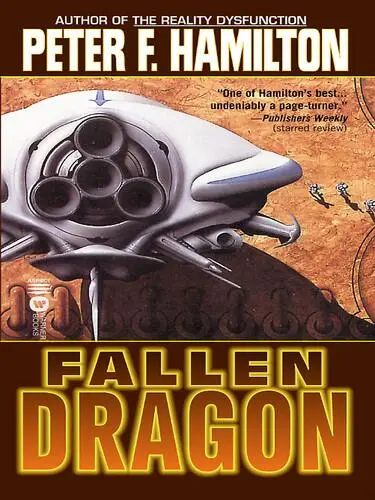
- Название:Fallen Fragon
- Автор:
- Жанр:
- Год:неизвестен
- ISBN:нет данных
- Рейтинг книги:3 / 5. Голосов: 1
-
Избранное:Добавить в избранное
- Отзывы:
-
Ваша оценка:
Fallen Fragon: краткое содержание, описание и аннотация
Предлагаем к чтению аннотацию, описание, краткое содержание или предисловие (зависит от того, что написал сам автор книги «Fallen Fragon»). Если вы не нашли необходимую информацию о книге — напишите в комментариях, мы постараемся отыскать её.
Fallen Fragon — читать онлайн бесплатно полную книгу (весь текст) целиком
Ниже представлен текст книги, разбитый по страницам. Система сохранения места последней прочитанной страницы, позволяет с удобством читать онлайн бесплатно книгу «Fallen Fragon», без необходимости каждый раз заново искать на чём Вы остановились. Поставьте закладку, и сможете в любой момент перейти на страницу, на которой закончили чтение.
Интервал:
Закладка:
The room had a singular imprint that was all her own. It wasn't just the air that was cold. Most people, he thought, would instinctively keep their distance.
So why didn't I?
Two lonely people. Maybe that was why they'd kept dancing around each other in the bar. They weren't opposites attracting after all.
"I've never been to Scotland," he said.
Joona was bending over the heatstore block that sat in the ancient fireplace, turning up its output. The black surface began to glow a deep orange, as if there were still embers in the grate. She gave him a fast, nervous smile. "You want to come with me?" There was surprise and hope in her voice.
"Sure. If you want me to come with you."
"I don't mind. It would be nice."
For a moment he thought she was going to jump back into bed with him. Instead she grabbed a big red-and-green-check nightshirt from the back of a chair and struggled into it.
"I'll put some coffee in the microwave," she said. "Then I have to do my yoga: it helps me center myself. We can go after that."
"Okay," he said, trying to keep pace with events. "I can pick up my stuff from the hotel on the way to the station."
"Will you book the train tickets? I hate using the datapool. I can pay you."
"Sure." He hunted around for his clothes, wondering what he'd gone and said yes to.
Lawrence and Joona took an express train straight out of Amsterdam direct to Edinburgh, traveling in a big U, down south to Paris, across to London, then up north again to the end of the 1-pulse line at Waverley. To start with, Lawrence was impressed by Holland. The old canals were still draining the land. Windmills stood guard along the straight-edged waterways, although little wind now reached their sails, thanks to the extensive forests that had grown up in the last two centuries across the old farmland. There was a huge variety of trees, but with the canals slicing through them they formed such a regular grid it made them look like nothing more than fields. In a sense they were, not that they were cultivated, but the land management teams maintained them carefully. Even now, the drainage system couldn't be allowed to fall into disrepair, and the roots were a big potential hazard. It gave him an impression of an artificial environment barely one step ahead of Amethi. He thought that in a way Holland must be the first example of large-scale terraforming; human engineering and ingenuity wresting a livable nation out of an alien environment.
Lawrence soon tired of the fenlands, especially as their speed blurred details. "So why Scotland?" he asked.
Joona put her feet up on the table, ignoring the disapproving looks of the other passengers in the carriage. "My grandmother is Scottish. We're going to stay with her."
"Where, exactly?"
"Fort William."
He put his interface glasses on and accessed the datapool to find where that was.
"You spend a lot of time trawling, don't you?" Joona said.
"My education had a lot of holes. You must do a fair bit of accessing yourself."
"As little as possible. I prefer books."
"There's a time and a place for hard copy. My dad had a thing for books, too. I guess that's why I never use them." He grinned at the face she pulled. "What's your subject at Prodi?"
"I'm taking ecological management."
"Right." It wasn't what he expected. "Doesn't that mean you'll wind up working for a company?"
"There are companies, and there are companies. And then mere are government agencies, at least by name. In practice they're another branch of corporate reclamation and revitalization divisions. But I won't take a job with any of them. There are still some private landowners who use the land in the traditional fashion. They farm, or log timber or run stables. That's what I want to help keep alive."
"Farming?" he said skeptically. "I thought that's what damaged the land in the first place?"
"Industrial farming did, yes. Pesticides and nitrates were poured over the soil in the quest for higher yields and to hell with the consequences. Agricultural machinery actually got so big and so heavy that it compacted the subsoil. By the end, in the developed nations, topsoil was little more than a matrix that suspended chemicals and water so the crop roots could absorb them. Then the companies developed protein cell technology and killed farming altogether."
"And stopped us raising and slaughtering animals for food. I mean, can you imagine how barbaric that was? Eating living things. It's disgusting."
"It's perfectly natural. Not that people think that way today. And I didn't say protein cells are a bad thing. After all, it means no one on Earth starves. But, as always, they went to extremes and eliminated every valid alternative. All I'm asking for is to keep a few pockets of independence alive."
"You mean like working museums?"
"No! These are havens for people who reject your corporate uniculture existence. There are more of them than governments and corporations like to admit. More of us."
"Ah, right, communes of back-to-the-earthers. So will you also be refusing the kind of medical technology that comes out of our wicked corporations?"
She gave him an exasperated stare. "That's so typical, denigrate something you know nothing about. I never said I was rejecting technology. It's the current global society that I refuse to obey. Technology doesn't have to come only from corporate labs, to be exploited for profit and policy implementation. It could come from universities where it would be made freely available to benefit everyone. Even small independent communities could support researchers. If we all had free access to data we could build a culture of distributed specialization."
"The old global village idea. Nice, but you still need factories and urban centers. You should know that culture always flourishes at the heart of society."
"The datapool is the heart of our society. You're still thinking in physical terms when you talk about cohesion. You can live in a cottage in the middle of a forest with every need taken care of, and still be totally in tune with the rest of the world."
"But why live there, when you can also live in a city, and interact with people, and go down to a bar in the evening and have a laugh and a drink? We don't all want to be hermits."
"I know. But your companies don't want anyone to be a hermit or anything else. According to them, we all have to fit into this uniculture they're trying to establish like neat little blocks on a circuit board. I don't want to be a part of that I want my freedom."
"I think you're exaggerating."
She pointed to a badge on her coat lapel. It had a single eye at the center. "Open your eyes."
He managed to steer the conversation off politics and got her talking about music, which was always a relatively safe topic. You could disagree about bands, performers and composers without storming out or throwing things. She enjoyed orchestral symphonies from several classical and modern composers; from postelectronic music she listened to what he thought of as ballads and street poetry. Although she had thousands of hours of tracks loaded into her multimedia player card, she became animated about live concerts, telling him about all the venues she'd visited, the bands and orchestras she'd heard. As far as entertainment went, she was scornful of the i's, although she admitted to watching several current soaps. The i's, she claimed, were something she grew out of. And she really hated AS-generated dramas, preferring to visit theaters. Amsterdam had a host of small nonmainstream theaters where her student status got her reduced rates, she said, and the city had hundreds of performance groups eager to put on their works.
Lawrence almost pointed out that having so many groups evolve in a city proved his argument about culture. But he still wasn't sure how she'd respond to that kind of teasing.
Читать дальшеИнтервал:
Закладка:
Похожие книги на «Fallen Fragon»
Представляем Вашему вниманию похожие книги на «Fallen Fragon» списком для выбора. Мы отобрали схожую по названию и смыслу литературу в надежде предоставить читателям больше вариантов отыскать новые, интересные, ещё непрочитанные произведения.





Обсуждение, отзывы о книге «Fallen Fragon» и просто собственные мнения читателей. Оставьте ваши комментарии, напишите, что Вы думаете о произведении, его смысле или главных героях. Укажите что конкретно понравилось, а что нет, и почему Вы так считаете.