Stephen Baxter - Time
Здесь есть возможность читать онлайн «Stephen Baxter - Time» — ознакомительный отрывок электронной книги совершенно бесплатно, а после прочтения отрывка купить полную версию. В некоторых случаях можно слушать аудио, скачать через торрент в формате fb2 и присутствует краткое содержание. Год выпуска: 1999, ISBN: 1999, Издательство: Voyager, Жанр: Фантастика и фэнтези, на английском языке. Описание произведения, (предисловие) а так же отзывы посетителей доступны на портале библиотеки ЛибКат.
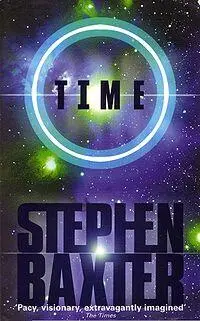
- Название:Time
- Автор:
- Издательство:Voyager
- Жанр:
- Год:1999
- ISBN:0-00-225768-8
- Рейтинг книги:5 / 5. Голосов: 1
-
Избранное:Добавить в избранное
- Отзывы:
-
Ваша оценка:
Time: краткое содержание, описание и аннотация
Предлагаем к чтению аннотацию, описание, краткое содержание или предисловие (зависит от того, что написал сам автор книги «Time»). Если вы не нашли необходимую информацию о книге — напишите в комментариях, мы постараемся отыскать её.
st The book begins at the end of space and time, when the last descendants of humanity face an infinite but pointless existence. Due to proton decay the physical universe has collapsed, but some form of intelligence has survived by embedding itself into a lossless computing substrate where it can theoretically survive indefinitely. However, since there will never be new input, eventually all possible thoughts will be exhausted. Some portion of this intelligence decides that this should not have been the ultimate fate of the universe, and takes action to change the past, centering around the early 21
century. The changes come in several forms, including a message to Reid Malenfant, the appearance of super-intelligent children around the world, and the discovery of a mysterious gateway on asteroid 3753 Cruithne.
Time — читать онлайн ознакомительный отрывок
Ниже представлен текст книги, разбитый по страницам. Система сохранения места последней прочитанной страницы, позволяет с удобством читать онлайн бесплатно книгу «Time», без необходимости каждый раз заново искать на чём Вы остановились. Поставьте закладку, и сможете в любой момент перейти на страницу, на которой закончили чтение.
Интервал:
Закладка:
“Thank you.”
Maura let the girl lead her to a small fenced-off area where three cars sat, parked roughly on the grass. Maura picked one and, with the simulacrum of youthful exhilaration granted her by lunar G, she vaulted neatly over the door into the driver’s seat.
The car was just a white box of metal and ceramic, open, with a joystick and a small control panel. It had Boeing markings, and simple instructions marked in big block capitals. The car wasn’t wheeled; instead there was a turbofan in a pod at each corner. Maura quickly learned how to use the joystick to make the pods swivel this way and that.
And when she fired up the engine — noiseless, powered by clean-burning hydrogen — the car shot straight up into the air. At a touch of the joystick, it tipped and squirted back and forth, like
something out of The Jetsons.
Anna jumped into the air and circled higher. When she passed out of Tycho’s shadow into sunlight, her wings seemed to burst into flame. Then she turned and streaked toward the heart of the dome.
Maura followed more cautiously, skimming a few feet above the grass.
Never-Never Land was maybe the size of a football field. It seemed to be mostly grassed over, but here and there ponds glinted, blue as swimming pools. She could see small robot gardeners trundling cautiously over the grass, clipping and digging.
Low mounds protruded from the grass. One of them had an open door, bright artificial light streaming out. Maybe the children slept in there, to keep down their hours of exposure to the Moon’s high radiation levels.
At the very center of the dome was an area fenced-off by a tall glass wall. Maura knew that not even her blue pass would get her through that perimeter; for within was the artifact — transport, bubble, whatever — that the children had constructed in Nevada to protect them from the nuke and carry them here.
Even now, no adult had the faintest idea how it worked.
Anna flew toward the dome’s single giant tree.
It looked like an oak to Maura, but its trunk had to be twenty feet across, and each of its branches, broad and sturdy, was no less than three or four feet thick. But the tree looked somehow stunted, constrained to grow broad and flat rather than tall; if it had remained in proportion it might, she supposed, have reached five or six hundred feet, busting out of this stadium-sized dome.
Anna glided to a branch and settled there gracefully, folding her wings behind her. Maura killed her engine and, with a soft creak, the air car settled into place in a crook of the branch.
Maura saw some of the other children, seemingly far below. There were two groups, each of four or five kids; the oldest of them looked around ten. After five years on the Moon, they looked skinny, graceful. One group was playing what looked like a tag game, chasing with great loping strides and somersaults and spectacular lunar leaps. Maura could hear them laughing, the sound drifting up to her like the ripple of water.
The other group seemed more solemn. They were moving around each other, but in a series of patterns, each of which they would hold for a fraction of a second of stillness, and then move on to the next. They seemed to be talking, or maybe singing, but Maura couldn’t make out any words.
“Anna, where are the Tybee children? Tom and Billie—”
Anna pointed.
The Tybees were part of the solemn party below. Maura recognized Tom, ten years old now, his face round and set and serious. At his waist he had his electronic Heart — battered, dirty, probably nonfunctioning, a gift from his long-lost mother. She wondered which one of the younger kids was Billie.
Once she had promised his father that she would protect Tom. It was a promise that had brought her all this way. And yet, what protection could she offer him? What could she ever have given him?
“Can you tell me what they are doing down there?”
“They’re working. It’s what your people call—”
“Multiplexing. Yes, I know. What are they talking about?”
Anna’s face worked. “They are considering constraints on the ultimate manifold.”
Maura suspected that she was going to struggle with the rest of this conversation. “The manifold of what?”
“Universes. It is of course a truism that all logically possible universes must exist. The universe, this universe, is described — umm, that’s the wrong word — by a formal system. Mathematics. A system of mathematics.”
Maura frowned. “You mean a Theory of Everything?”
Anna waved a hand, as if that were utterly trivial, and her beautiful wings rustled. “But there are many formal systems. Some of them are less rich, some more. But each formal system, logically consistent internally, describes a possible universe, which therefore exists.”
Maura tried to follow that. “Give me an example of a formal system.”
“The rules of geometry. I mean, Euclid’s geometry.”
“High school stuff.”
Anna looked at her with reproof. “I never went to high school, Maura.”
“I’m sorry.”
“Some of these universes, as described by the formal systems, are rich enough to support self-aware substructures. Life. Intelligence. And some of the universes aren ‘t rich enough. A universe described by Euclidean geometry probably isn’t, for example. Therefore it can’t be observed. What the group down there is trying to establish is whether a universe that cannot be observed, though it exists, may be said to have a different category of existence.” Anna glanced at Maura. “Do you understand?”
“Not a damn word.”
Anna smiled.
Maura could see firefly robots hovering over the heads of the children, peering down, recording everything they did and said. There might be a rich treasure of knowledge and wisdom being conjured up in the dance of those slim forms, but the world’s massed experts couldn’t begin to decode it. IBM had quoted development times in decades just to construct a translation software suite.
The children had, it seemed, evolved their own language from elements of their native spoken languages, mixed with gestures, dance, and music. It was a complex, multilevel communication channel, with many streams of information multiplexed together. Linguists believed it was a true language, with a unifying grammar. But it transcended human languages in the richness of its structure, the speed and compression of its data transmission, the fact that it was analog — the angle of an arm or head held just so seemed to make an immense difference to meaning — and its rate of evolution, sometimes changing daily.
And besides, there seemed to be some features that could not be translated into English, even in principle. Such as new tenses. There was one based on palindromic constructions, symmetric in time, that seemed to be designed to describe situations with looping causality, or even causality violation.
Grammar for a time traveler.
Some theorists were saying that the orderly linear perception of time, of neat cause and effect, enjoyed by humans was an artifact of a limited consciousness: like the way the brain could “construct” an image of a face from a few lines on a page. Perhaps the children could experience time on a deeper level: non-linearly, even acausally.
And the farthest-out theorists wondered if their minds were somehow linked, permanently, by the neutrino ocean that filled the universe. As if Feynman radio technology was allowing some higher strata of consciousness and self-awareness to operate here.
The various strategies that had been tried to keep a handle on the children had yet to pay off. The Trojan Horse kids — like little Billie Tybee, below — seemed to have melted into the strange community here without a backward glance. The Trojan Horses had been heavily indoctrinated with a basic common grammar and quantification rules in the hope that they would at least continue to talk comprehensibly to the outside world. But even that had failed. They just didn’t have the patience or inclination to translate their thoughts into baby talk for their parents.
Читать дальшеИнтервал:
Закладка:
Похожие книги на «Time»
Представляем Вашему вниманию похожие книги на «Time» списком для выбора. Мы отобрали схожую по названию и смыслу литературу в надежде предоставить читателям больше вариантов отыскать новые, интересные, ещё непрочитанные произведения.




Обсуждение, отзывы о книге «Time» и просто собственные мнения читателей. Оставьте ваши комментарии, напишите, что Вы думаете о произведении, его смысле или главных героях. Укажите что конкретно понравилось, а что нет, и почему Вы так считаете.