Stephen Baxter - The Time Ships
Здесь есть возможность читать онлайн «Stephen Baxter - The Time Ships» — ознакомительный отрывок электронной книги совершенно бесплатно, а после прочтения отрывка купить полную версию. В некоторых случаях можно слушать аудио, скачать через торрент в формате fb2 и присутствует краткое содержание. Год выпуска: 1995, ISBN: 1995, Издательство: HarperCollins, Жанр: Фантастика и фэнтези, на английском языке. Описание произведения, (предисловие) а так же отзывы посетителей доступны на портале библиотеки ЛибКат.
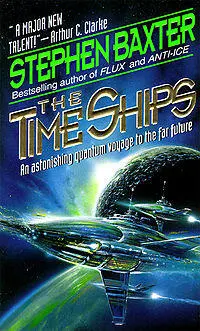
- Название:The Time Ships
- Автор:
- Издательство:HarperCollins
- Жанр:
- Год:1995
- ISBN:0-002-24609-0
- Рейтинг книги:5 / 5. Голосов: 1
-
Избранное:Добавить в избранное
- Отзывы:
-
Ваша оценка:
The Time Ships: краткое содержание, описание и аннотация
Предлагаем к чтению аннотацию, описание, краткое содержание или предисловие (зависит от того, что написал сам автор книги «The Time Ships»). Если вы не нашли необходимую информацию о книге — напишите в комментариях, мы постараемся отыскать её.
by H. G. Wells, it was officially authorized by the Wells estate to mark the centenary of the original’s publication.
Won:
British SF Association Award in 1995
John W. Campbell Memorial Award for Best SF Novel in 1996
Philip K. Dick Award in 1996
Nominated for:
Hugo Award for Best Novel in 1996
Locus Award for Best SF Novel in 1996
Arthur C. Clarke Award in 1996
The Time Ships — читать онлайн ознакомительный отрывок
Ниже представлен текст книги, разбитый по страницам. Система сохранения места последней прочитанной страницы, позволяет с удобством читать онлайн бесплатно книгу «The Time Ships», без необходимости каждый раз заново искать на чём Вы остановились. Поставьте закладку, и сможете в любой момент перейти на страницу, на которой закончили чтение.
Интервал:
Закладка:
[3]
The Universal Constructor
In contrast to my sparse cell, Nebogipfel, it turned out, had been provided with a veritable suite. There were four rooms, each as large as mine and roughly conical in form, and fitted with doors and windows, which our hosts had not thought fit to provide for me: it was evident that they had a higher view of his intellect than mine!
There was the same lack of furniture that I had suffered, although Morlocks have sample needs, and it was not such an incongruity for Nebogipfel. In one room, though, I found a bizarre object: a table-like affair perhaps twelve feet long and six wide, topped with a soft orange covering. There were pockets arranged around the rim of this table, all edged with a hard substance that glowed green. The table was an approximate rectangle, although its edges were irregularly shaped; and a single ball — white, of some dense material — sat on the table-top. When I pushed the ball across the table-top it ran well enough, although, without a covering of baize, its speed was a little free, and it caromed off cushions at the rim with a satisfying solidity.
I tried to discern some deeper meaning of this device; but, for all the world — as you will have guessed from my description — it was like nothing so much as a billiards table! I wondered at first if this was some other distorted echo of a nineteenth-century hotel room — but a rather bizarre selection if so, and, lacking anything in the way of cues, and only a single ball, it was not likely to give me much sport.
Baffled, I abandoned the table, and tested the doors and windows. The doors worked by simple handles, to be grasped and turned, but the doors led only to other rooms within the suite, or to my original chamber; there were no ways out to the world beyond. I found, though, that the panels covering the transparent windows could be lifted up, and for the first time I was able to inspect this new 1891, this White Earth.
My viewpoint was raised some thousand feet or more from the ground! we seemed to be at the apex of some immense cylindrical tower, whose flanks I could see sweeping down below me. Everything I saw reinforced the first impression I had gained when I had obtained that last glimpse over the rim of the Time-Car, just before the cold overcame me: that this was a world forever sunk into the Ice. The sky was the color of gunmetal, and the icebound land a gray-white like exposed bone, with none of that attractive blueness one sees sometimes about prettier snow-fields. Looking out now, I could see quite clearly how dreadfully stable this world-state truly was, just as Nebogipfel had described: the daylight glinted fiercely from the mantle of scarred Ice which sheathed the earth, and the whiteness of that world-wide carapace hurled the warmth of the sun back into the sink of space. The poor earth was dead, caught at the bottom of this pit of icy, climatic stability, for evermore — it was the ultimate Stability of Death.
Here and there I saw a Constructor — in form just like our own, here in Nebogipfel’s apartment — standing on the frozen landscape. Each Constructor was always alone, standing there like some ill-wrought monument, a splash of steel gray against the bone white of the ice. I never saw any of them move! It was as if they simply appeared in the sites where they stood, reassembling themselves, perhaps, from the air. (Indeed, as I found later, this first assessment of mine was not so far from the truth.)
Dead the land was, but not without the evidence of intelligence. There were more great buildings — like our own — puncturing the landscape. They took simple geometric forms: cylinders, cones and cubes. My vantage point showed me the south and west, and from my aerie I could see these great buildings scattered as far afield as Battersea, Fulham, Mitcham and beyond. They were spaced perhaps a mile apart on average, as far as I could see; and the whole prospect — the fields of Ice, the mute Constructors, the sparse, anonymous buildings — combined to make up a bleak, inhuman London.
I returned to Nebogipfel, who still stood before his Constructor. The metal pelt of the thing rippled and shone, as if it were the surface of some tilted pond with metal fish moving beneath, and then a protuberance — a tube a few inches wide — thrust out of the surface, glistening with the silvery metal texture of the pyramid, and pressed towards Nebogipfel’s waiting face.
I recognized this arrangement, of course; it was the return of the eye-scope device I had seen earlier. In a moment it would be fitted to Nebogipfel’s skull.
I prowled around the rim of the Constructor. As I have described, in appearance the Constructor was like a heap of melted slag; it was animate to some degree — and mobile, for I had seen this object, or one similar, crawl over my own body — but I could not begin to guess as to its purpose. Inspecting closely, I saw how the surface was covered by a series of metal hairs: cilia, like iron filings, which waved about in the air, quite active and intelligent. And I had the infuriating, eye-hurting sensation that there were further levels of detail to all this, beyond the grasp of my aging vision. The texture of this mobile surface was at the same time fascinating and repulsive: mechanical, but with something of the quality of life. I was not tempted to touch it — I could not bear the thought of those squirming cilia latching onto my skin — and I had no instruments with which to probe. Without any means of making a closer examination, I was unable to undertake a study of the pyramid’s internal structure.
I noticed a certain degree of activity about the lowest rim of the pyramid. Crouching down, I saw how tiny communities of metal cilia — the size of ants, or smaller — were continually breaking away from the Constructor. Generally these fallen pieces seemed to dissolve as they fell against the floor, doubtless breaking up into components too small for me to see; but at times I saw how these discarded bits of Constructor trekked hither and thither across the floor, again after the fashion of ants, to unknown destinations. In a similar fashion — I observed now — more clumps of the cilia emerged from the floor, clambered up the skirts of the Constructor, and merged into its substance, as if they had always been a part of it!
I remarked on this to Nebogipfel. “It is astonishing,” I said, “but it is not hard to surmise what is going on. The components of the Constructor attach and detach themselves. They squirm off over the floor — or even fly away through the air, for all I know, or can see. The discarded pieces must either die off, in some fashion, if they are defective — or else join the glistening carcass of some other unfortunate Constructor.
“Confound it,” I said, “the planet must be covered with a thin slime of these detached cilia, squirming this way and that! And, in some interval of time — perhaps a century — there must be nothing left of the original body of this beast we see here. All its bits, its analogues of hair and teeth and eyes, have trekked off for a visit to its neighbors!”
“It is not a unique design,” Nebogipfel said. “In your body — and mine — cells die and are replaced continually.”
“Perhaps, but even so — what does it mean to say that this Constructor, here, is — an individual? I mean: if I buy a brush — and then replace the handle, and then the head — do I have the same brush?”
The Morlock’s red-gray eye turned back to the pyramid, and that tube of extruded metal sank into the hole in his face with a liquid noise.
“This Constructor is not a single machine, like a motor-car,” he retorted. “It is a composite, made up of many millions of submachines — limbs, if you like. These are arranged in a hierarchical form, radiating out from a central trunk along branches and twigs, after the manner of a bush. The smallest limbs, at the periphery, are too small for you to see: they work at the molecular or atomic levels.”
Читать дальшеИнтервал:
Закладка:
Похожие книги на «The Time Ships»
Представляем Вашему вниманию похожие книги на «The Time Ships» списком для выбора. Мы отобрали схожую по названию и смыслу литературу в надежде предоставить читателям больше вариантов отыскать новые, интересные, ещё непрочитанные произведения.







Обсуждение, отзывы о книге «The Time Ships» и просто собственные мнения читателей. Оставьте ваши комментарии, напишите, что Вы думаете о произведении, его смысле или главных героях. Укажите что конкретно понравилось, а что нет, и почему Вы так считаете.