Charles Sheffield - Starfire
Здесь есть возможность читать онлайн «Charles Sheffield - Starfire» весь текст электронной книги совершенно бесплатно (целиком полную версию без сокращений). В некоторых случаях можно слушать аудио, скачать через торрент в формате fb2 и присутствует краткое содержание. Год выпуска: 2000, ISBN: 2000, Издательство: Bantam Spectra, Жанр: Фантастика и фэнтези, на английском языке. Описание произведения, (предисловие) а так же отзывы посетителей доступны на портале библиотеки ЛибКат.
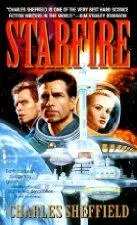
- Название:Starfire
- Автор:
- Издательство:Bantam Spectra
- Жанр:
- Год:2000
- ISBN:0553577395
- Рейтинг книги:3 / 5. Голосов: 1
-
Избранное:Добавить в избранное
- Отзывы:
-
Ваша оценка:
Starfire: краткое содержание, описание и аннотация
Предлагаем к чтению аннотацию, описание, краткое содержание или предисловие (зависит от того, что написал сам автор книги «Starfire»). Если вы не нашли необходимую информацию о книге — напишите в комментариях, мы постараемся отыскать её.
,
subjects planet Earth to yet another cosmic blast from the Alpha Centauri supernova. But while the blast that hit Earth in
simply cooked the Southern hemisphere and knocked out unshielded technology with a flash of gamma rays, this wave promises to do some real damage, with a sleet of trillion-nuclei bundles moving at one-tenth the speed of light.
Warned by the first catastrophe, Earth began building an electromagnetic shield out of the orbiting
station to divert the incoming apocalypse. But not only will the storm come earlier than expected, the carnage may be worse than anyone imagined — preliminary data shows that the supernova was no accident, and that the wave of particles may in fact be a beam. Crackerjack hard-SF author Charles Sheffield brings back much of the cast of
for this suspenseful, well-paced follow-up, the two most satisfying returnees being sociopath-savant Oliver Guest and his former patient Seth Parsigian. In the book’s subplot, the brilliant Guest and gruff Parsigian must team up to solve a string of grisly child murders on
that threatens to push the shield project even further behind schedule.
Starfire — читать онлайн бесплатно полную книгу (весь текст) целиком
Ниже представлен текст книги, разбитый по страницам. Система сохранения места последней прочитанной страницы, позволяет с удобством читать онлайн бесплатно книгу «Starfire», без необходимости каждый раз заново искать на чём Вы остановились. Поставьте закладку, и сможете в любой момент перейти на страницу, на которой закончили чтение.
Интервал:
Закладка:
There were cuss words that you could think but not say on a national broadcast. Celine breathed deeply and said, “Here in Washington we are experiencing an unusual atmospheric effect. It is presumably due to the particle storm. It will probably not last more than a few minutes, but I recommend that we all move indoors until this is over.”
She forced a smile, turned, and walked steadily toward the stone path leading to the White House. When she was safely off camera she ripped away her cordless lapel mike, dropped it to the floor, and stamped it flat.
“Mertok! What the fuck is going on here?”
“It’s all right, Madam President.” He was hurrying to her side. “When the particle bundles hit the upper atmosphere they strip off free electrons. They follow Earth’s magnetic lines of force, and they move fast. We knew this would happen. But there’s some sort of group phenomenon that produces visible lines, and we didn’t expect that. It is undoubtedly related to the size of the charged particle bundles. But I think that people have nothing to worry about.”
“Nothing to worry about? I’m supposed to tell people they have nothing to worry about — when the Sun is going out in the goddamned sky? Mertok, when should I tell people to worry?”
“Madam President.” He flapped a well-manicured hand toward the heavens. “See for yourself. It is already starting to fade.”
Celine looked up. He was right. The lines were less pronounced. But the sky behind the dark streaks was no longer blue. It shimmered pink and gold and pale mauve. The sun was brighter, and had a greenish tinge.
She glared at Mertok — his face was an unnatural greenish yellow. “And this?”
“Electrical discharge effects from free electrons. Like an aurora, but much more powerful — that’s why we can see it even in daylight, although of course the Sun is dimmed, too.” He was staring up, not looking at Celine at all. “How very interesting. I wonder how long it will last.”
Celine glared at him. He didn’t notice. Of course he didn’t notice. She had never realized it before, because Ben Mertok wore a veneer of political sophistication. But when you came right down to it, he and Wilmer and Star and the rest of the science advisors were the same under the skin.
They were all crazy. Show them a new scientific phenomenon, and the fact that the world might be ending became of minor importance.
Celine gestured to the crew to bring her a new microphone. She must continue her broadcast, reassuring anyone who had not run for cover that things were rapidly returning to normal.
Saying what?
Yes, sure, the world may be going to end. But we don’t want to talk about that, because it’s weeks away. And if Maddy Wheatstone is right, some people on Earth have been trying to make things worse, rather than better, by screwing up shield development. But for now things are just peachy. Why don’t we all go home and relax?
30
The Southern Hemisphere, as predicted, took the brunt of the particle storm. But Star Vjansander alone had warned of the extent of the damage, amplified by the extreme stability of the particle bundles.
Reports from smart sensors scattered over land and sea, and from survey teams returning to the surface from their underground hideouts in Australia and Antarctica, gave a first estimate of conditions south of the equator. Ninety-nine percent of the incident flux had burned its way right through the atmosphere and tunneled deep below the surface, still moving at close to a tenth of light speed. It was preceded by a blue flood of Cerenkov radiation. Ground and water impacts caused the violent disintegration of ten percent of the bundles, but the rest remained intact and hit the surface as intensely charged nodules. These became electrically neutral in a few hours, exploding violently to individual atoms as ambient electrons dissipated their positive charge.
The effects on plant and animal life were immediate and devastating. Each bundle was minute, but it contained the energy of a bullet from a supervelocity rifle. The high positive charge greatly increased the interaction cross section with living tissue. The result of a single impact was a clean cylindrical hole four to six millimeters across, seared at the edges and surrounded by extended tissue damage like a radiation burn.
The arriving bundles peppered the surface with a mean separation distance of four meters. Survival of individuals became a matter of luck and statistics. Most populations of pelagic fish were little affected, protected by many meters of water depth. One pod of humpback whales had apparently dived at the right time and remained intact; another, only a few kilometers away, had suffered twenty percent losses. On the Antarctic ice cap, a survey team found a close-packed colony of emperor penguins quietly nursing their eggs in the polar winter; but one bird in forty was dead or badly wounded. Diving skuas fought over and dismembered the dying.
Humans, warned and well prepared, had done rather well. The only casualties were the result of ignorance or folly. The highest percentage of losses came among the nine hundred and seventy thrill seekers who had headed south to Tierra del Fuego for the “big blip party.” The fourteen aircraft that took them there would no longer fly. Five hundred and ten survivors were waiting to be picked up and brought home, considerably chastened.
They were the exceptions. The general mood of the country and the world was upbeat. Even the southern countries, hardest hit, shared the euphoria. We survived this one, we’ll survive the big storm as well.
Not everyone, however, was pleased that the planet had got off so lightly. Gordy Rolfe’s best plans for Argos Group activities had been based on casualty counts in the tens to hundreds of millions, or at the very least a few million. Opportunities were always greatest in times of chaos.
He had followed the progress of the particle storm, moment by moment, from an observation post in a shallow shelter only a hundred meters from the northern edge of his Virginia estate. Of course, Argos Group equipment and staff were in place all around the globe, and they had reported to Gordy in real time. He rubbed his hands in satisfaction as the lands of southern Africa and Australia suffered their deadly sleet from heaven, more destructive than expected. He smiled when the Sun above his hideaway darkened in the sky and the broadcast from Washington was interrupted. But he frowned when Celine Tanaka returned, to announce that U.S. damage seemed to be minimal and the country would soon return to normal.
The best news was the rumor, reported to come from Washington but strongly denied there, that the particle storm due in three weeks would be vastly more fierce, energetic, and dangerous than anyone had expected. If a man couldn’t get mileage from that, he didn’t deserve to be in business.
Gordy, cheered by the thought, decided that nothing much more was going to happen today. It was late afternoon, and although it would soon be dawn on the other side of the world it was also the Southern Hemisphere’s winter. Any reports could wait a few hours, until the short Antarctic day was over.
The sky was probably back to normal, too, but it might be worth taking a look at it. Gordy rode the one-man lift to the surface and looked around him. It seemed a disappointingly normal August evening, the Sun big and red and all set to dip below the horizon. He sauntered back toward the old schoolhouse. If nothing else, he could look forward to a pleasant evening deep within his private sanctum.
The elevator taking him down the thousand-foot drop creaked and groaned more than usual. It was probably time for some rolfe maintenance. Gordy’s mind was on that as he left the elevator and ascended the tight spiral staircase of gray metal. If there was anything odd about the stairs or the locked hatch at the top, he certainly didn’t notice. His home seemed just as he had left it, the door leading through to the green jungle habitat locked tight.
Читать дальшеИнтервал:
Закладка:
Похожие книги на «Starfire»
Представляем Вашему вниманию похожие книги на «Starfire» списком для выбора. Мы отобрали схожую по названию и смыслу литературу в надежде предоставить читателям больше вариантов отыскать новые, интересные, ещё непрочитанные произведения.


Обсуждение, отзывы о книге «Starfire» и просто собственные мнения читателей. Оставьте ваши комментарии, напишите, что Вы думаете о произведении, его смысле или главных героях. Укажите что конкретно понравилось, а что нет, и почему Вы так считаете.