Charles Sheffield - Starfire
Здесь есть возможность читать онлайн «Charles Sheffield - Starfire» весь текст электронной книги совершенно бесплатно (целиком полную версию без сокращений). В некоторых случаях можно слушать аудио, скачать через торрент в формате fb2 и присутствует краткое содержание. Год выпуска: 2000, ISBN: 2000, Издательство: Bantam Spectra, Жанр: Фантастика и фэнтези, на английском языке. Описание произведения, (предисловие) а так же отзывы посетителей доступны на портале библиотеки ЛибКат.
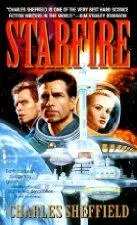
- Название:Starfire
- Автор:
- Издательство:Bantam Spectra
- Жанр:
- Год:2000
- ISBN:0553577395
- Рейтинг книги:3 / 5. Голосов: 1
-
Избранное:Добавить в избранное
- Отзывы:
-
Ваша оценка:
Starfire: краткое содержание, описание и аннотация
Предлагаем к чтению аннотацию, описание, краткое содержание или предисловие (зависит от того, что написал сам автор книги «Starfire»). Если вы не нашли необходимую информацию о книге — напишите в комментариях, мы постараемся отыскать её.
,
subjects planet Earth to yet another cosmic blast from the Alpha Centauri supernova. But while the blast that hit Earth in
simply cooked the Southern hemisphere and knocked out unshielded technology with a flash of gamma rays, this wave promises to do some real damage, with a sleet of trillion-nuclei bundles moving at one-tenth the speed of light.
Warned by the first catastrophe, Earth began building an electromagnetic shield out of the orbiting
station to divert the incoming apocalypse. But not only will the storm come earlier than expected, the carnage may be worse than anyone imagined — preliminary data shows that the supernova was no accident, and that the wave of particles may in fact be a beam. Crackerjack hard-SF author Charles Sheffield brings back much of the cast of
for this suspenseful, well-paced follow-up, the two most satisfying returnees being sociopath-savant Oliver Guest and his former patient Seth Parsigian. In the book’s subplot, the brilliant Guest and gruff Parsigian must team up to solve a string of grisly child murders on
that threatens to push the shield project even further behind schedule.
Starfire — читать онлайн бесплатно полную книгу (весь текст) целиком
Ниже представлен текст книги, разбитый по страницам. Система сохранения места последней прочитанной страницы, позволяет с удобством читать онлайн бесплатно книгу «Starfire», без необходимости каждый раз заново искать на чём Вы остановились. Поставьте закладку, и сможете в любой момент перейти на страницу, на которой закончили чтение.
Интервал:
Закладка:
He hesitated. For the first time, Maddy thought she had a chance.
“When do you want me to announce it?”
“Not now. And not during the blip storm — we’re not ready. The best time will be when the main wave hits.”
“Maddy, that’s the worst possible time. Everything and everyone will be stressed to their limit. This place will be in chaos.”
“Chaos is what the murderer will rely on.” They were approaching the open doors of the information center, and Maddy’s last opportunity for a private discussion. She took John’s arm, so that he had to turn and face her. “We’ll probably only have one chance — ever. The evidence just isn’t there. Will you do it?”
He nodded. “When I first heard about the murders I was upset because I could do nothing. Now maybe I can. Just tell me when. All right?”
Maddy wanted to shout, Yes! She also wanted to hug him. She had no time for either, because the entrance to the information center was suddenly full of people. At the front were Amanda Corrigan and Wilmer Oldfield. Behind them, crowding forward, were Star Vjansander and Lauren Stansfield and two data analysts whose names Maddy didn’t remember.
Star and both data analysts all began to speak at once. But it was Wilmer’s voice, calm and slow and serious, that continued and cut through the rest.
“Amanda found another anomaly in the Sniffer data. If Star’s right in her interpretation, everything just got a lot more interesting. You need to hear about this.”
28
As soon as John was settled in front of the displays, Wilmer Oldfield turned to Amanda Corrigan. “Ready to begin? It’s your discovery.”
“But I had no idea what I’d found.” Amanda wriggled in embarrassment and looked at the audience. Seven people, including Maddy hovering at the back. That was too many for Amanda’s comfort. She turned back to Wilmer Oldfield. “You explained it to me. Can’t you talk about it?”
“I’ll do the first bit, then we’ll see.” Wilmer moved to the display control panel and glanced at John. “Ask questions anytime, because I don’t know the best place to start. Let’s go with the first Sniffers we sent out, and what they measured. They were high-acceleration probes with low-cross-section instruments.” He moved the pen across the control pad, and a thin, wobbly line with a distinct curve appeared on the display.
Wilmer stared at it with disgust. “These bloody gadgets. Isn’t there a board someplace that I can draw on?”
“Behind you.” Lauren Stansfield stepped over to a wall and opened two small doors to reveal a white board. Maddy noticed that Lauren alone, of all the people in the room, was wearing custom-made clothing. The pin on her left breast glowed with the varying colors of a fire opal. Expensive — even if no one else in the room but Maddy knew it.
“Write with this,” Lauren went on. “Erase with this pad — a touch is enough, the pen is electronic.”
“Right.” Wilmer drew a small circle. “Here we are. And here’s Alpha C.” Another small circle. “And here’s the path of a Sniffer.”
He drew a wavering line between the two stellar systems. To Maddy’s eye it was no better than his effort at the control panel, but Wilmer nodded at it in satisfaction.
“Good enough. Now let’s look at the particles flung out by the Alpha C supernova. If you didn’t know any better, you’d expect them to spread out pretty much equally in all directions. Spheres, like this, expanding in time.”
He drew a set of rough circles, each centered on the point that depicted Alpha Centauri.
“If that’s what was happening, the particle density would go down as the inverse square of the distance from the supernova, as the surface area they pass through goes up. Then the number of particles that a Sniffer measured would be less for the Sniffers that were launched later, simply because they meet the particle flux farther from Alpha C.
“But we know that the particles and radiation didn’t come out equally in all directions — the gamma pulse proved that twenty-seven years ago. Instead, a shell of gases around the supernova bottled up everything inside. That shell expanded and thinned, until finally it was weak enough to rupture. Then everything — gamma rays and particles — could squirt out from inside in one particular direction. Like this.”
Wilmer erased the set of spheres and replaced them with a narrow cone, its point on Alpha Centauri and its axis running toward the solar system.
“Think of it like a searchlight beam. No matter how tightly focused the beam is, as you go farther away from the searchlight the circle of light that it throws gets bigger, and the brightness of the light in that circle becomes less. With lasers, the spread can be very small, so sometimes it looks like the beam’s not spreading at all. Sort of like this.”
He replaced the cone by a long, narrow cylinder, running between Alpha Centauri and Sol.
“That looks like the worst case imaginable.” Wilmer laid down the marker. “For it to happen, the particles thrown out by Alpha C would have to come straight at Sol, with no beam spreading at all. Looked impossible, so we didn’t worry about that case. The most reasonable situation seemed like the second one, the particles lying in a narrow cone that gradually widened as they went farther from Alpha C. And that’s exactly what the first Sniffers found. Sniffer-B met the particle wave farther away from the supernova, and the particle counts that it measured were less than for Sniffer-A. The density was falling like the inverse square of the distance. No worries.
“Then we get the latest Sniffer data. It meets the particle wave much closer to Sol and farther from Alpha C, and it’s also a different instrument design. Not easy to compare results. But your gal did it.” He nodded toward Amanda Corrigan, who blushed like an eight-year-old. “First thing she finds is bad news. We have the blip storm on the way real soonish, and we’re no way ready for it. You’ve all been working to batten down before it gets here. But Amanda noticed something else about the blip measurements. They didn’t match the blip that she could pull out of the old Sniffer data, once she knew to look for it. The most recent Sniffer data was taken farther from Alpha C, close to us. The particle counts in the blip should have been lower than in the old data — the inverse square falloff — or, at the very worst, no bigger. But the data don’t show that. They show the number of counts per unit volume increasing as the storm gets closer to the solar system. And that seemed flat impossible.”
Wilmer picked up the marker again and stepped to the board. “Star and me happened to be around, so Amanda came to us. The only thing we could think of was the obvious one. The particle beam pattern isn’t doing any of the things I drew. It’s doing this.”
He drew two wobbly curved arcs from Alpha Centauri toward the Sun, making a form like a very long and thin cucumber. “The particle beam spreads until it gets to here.” He marked a point roughly halfway between the two stellar systems. “Then it begins to converge again as it approaches Sol.”
Wilmer placed the marker carefully back on its holder and went to sit down. No one spoke until John asked, “Converges? Converges how much?”
“Not my department.” Wilmer turned to Amanda Corrigan. “How much?”
“I don’t know. We don’t have enough data points yet to make a good extrapolation.”
“We need an answer, even without data. Wilmer? Can theory help?”
“I can only go back to what Star has been saying all this past month. Alpha C didn’t just blow up and randomly squirt radiation and particles this way. It was made to explode. The gamma pulse and the particle beam were made to aim right for us. If you’ll accept those as working assumptions, plus a few other things, then we can calculate an answer.”
Читать дальшеИнтервал:
Закладка:
Похожие книги на «Starfire»
Представляем Вашему вниманию похожие книги на «Starfire» списком для выбора. Мы отобрали схожую по названию и смыслу литературу в надежде предоставить читателям больше вариантов отыскать новые, интересные, ещё непрочитанные произведения.



Обсуждение, отзывы о книге «Starfire» и просто собственные мнения читателей. Оставьте ваши комментарии, напишите, что Вы думаете о произведении, его смысле или главных героях. Укажите что конкретно понравилось, а что нет, и почему Вы так считаете.