Greg Egan - Incandescence
Здесь есть возможность читать онлайн «Greg Egan - Incandescence» весь текст электронной книги совершенно бесплатно (целиком полную версию без сокращений). В некоторых случаях можно слушать аудио, скачать через торрент в формате fb2 и присутствует краткое содержание. Жанр: Фантастика и фэнтези, Космическая фантастика, на английском языке. Описание произведения, (предисловие) а так же отзывы посетителей доступны на портале библиотеки ЛибКат.
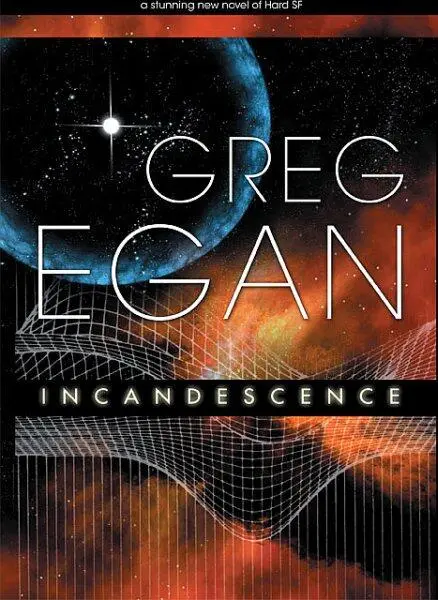
- Название:Incandescence
- Автор:
- Жанр:
- Год:неизвестен
- ISBN:нет данных
- Рейтинг книги:3 / 5. Голосов: 1
-
Избранное:Добавить в избранное
- Отзывы:
-
Ваша оценка:
Incandescence: краткое содержание, описание и аннотация
Предлагаем к чтению аннотацию, описание, краткое содержание или предисловие (зависит от того, что написал сам автор книги «Incandescence»). Если вы не нашли необходимую информацию о книге — напишите в комментариях, мы постараемся отыскать её.
Incandescence — читать онлайн бесплатно полную книгу (весь текст) целиком
Ниже представлен текст книги, разбитый по страницам. Система сохранения места последней прочитанной страницы, позволяет с удобством читать онлайн бесплатно книгу «Incandescence», без необходимости каждый раз заново искать на чём Вы остановились. Поставьте закладку, и сможете в любой момент перейти на страницу, на которой закончили чтение.
Интервал:
Закладка:
It was Neth who had pointed out that if you drew a space-time diagram with an outrageously large scale for the time axis — thirty-six times thirty-six spans for one heartbeat, say — then the different points of view of people moving with mildly different velocities could be mimicked quite accurately by the very slight rotations of the picture that would be needed to make their own particular paths point purely in the time direction. The problem remained that if lengths on this diagram were taken as fixed, two people moving with different velocities would consider each other's hearts to be beating faster than if their motion was the same, since a line that was "one heartbeat long" would span a smaller interval of time, and seem to pass more quickly, if it was slanted away from the time direction of the person who was measuring it. In reality, though, if the scale was large enough then the effect would be so tiny as to be impossible to measure. Who was to say that this wasn't happening?
It was an audacious hypothesis, but nobody had any better ideas. The team had labored for five shifts to find a geometry in accord with it. Their success, when it came, had been a mixed blessing, but nevertheless it had convinced Roi that they were on the right track.
The second geometry, like the first, was symmetrical about one special point, and allowed for circular orbits. Far from the Hub, the periods of these orbits were approximated by the old square-cube rule, but for smaller orbits the approximation broke down, and the periods became longer than that rule implied.
As a consequence, the ratio of garm-sard weight to shomal-junub weight was no longer fixed at three. It started out close to three for orbits far from the Hub, which was promising; the problem was, as you approached the Hub the ratio became larger, not smaller. The ratio was greater than three, everywhere, and the two and a quarter they had measured was nowhere to be found in this geometry.
The team had spent a further six shifts checking and rechecking their results. A single error anywhere in their calculations might have thrown the orbital periods and the weight ratios in the wrong direction. There was no error, though. The geometry they had found followed Zak's principle — that the sum of the true weights without spin was zero — and its connection respected Neth's idea that different people's space-time diagrams of moving objects should agree on the lengths of their paths. It was more beautiful, Roi thought, than the simpler geometry they'd found before; it certainly offered richer possibilities. But it did not describe the reality of the Splinter and the Hub.
As Roi had scrutinized the calculations, checking for some tiny, subtle mistake, an idea almost as outrageous as Neth's original hypothesis had occurred to her. Among other possibilities, they were hunting for a sign error: an addition in place of a subtraction, or vice versa. A mistake like that could easily be the cause of the problem. If there was no sign error in the calculation, though, might there not be one in the hypothesis itself?
Neth had supposed that the length in space-time that everyone agreed on obeyed the same rules as a length in space alone. The square of a length in space was the sum of the squares of its components in three different directions: garm-sard, shomal-junub, rarb-sharq. Neth had simply added in the square of the time component, after it had been multiplied by the scale factor that converted time to distance.
Why add the square of the time, though? Such perfect symmetry suggested that time was exactly like space, that apart from units of measurement the two things were indistinguishable. It was clear to Roi that time was different: you could walk back and forth along the garm-sard axis as often as you liked, but you could hardly do the same between future and past. If the first scheme they'd used to deal with time had set it too much apart, declaring it absolute, universal and immutable, perhaps their second attempt had gone too far in the other direction.
As a compromise, what if they looked for geometries whose connection preserved a slightly different quantity than Neth had suggested: instead of summing the squares of all the components, what if they summed the spatial ones then subtracted the time?
The team had debated the merits of Roi's proposal for more than half a shift. Many people had complained that it seemed arbitrary and ugly. Gul had pointed out that any object was motionless from its own perspective, so the "length" of its path for one heartbeat would be zero spans squared, minus one-heartbeat-converted-to-spans, squared: a negative number. But if, from another point of view, the object happened to be moving faster than the speed defined by Neth's spans-per-heartbeat scale, then whoever saw it moving that quickly would ascribe a positive length to its path. How could these two facts be reconciled, when the path length had to be preserved?
"Perhaps," Tan had suggested, "nothing can ever be seen to move faster than this speed."
"Then what happens," Gul had countered, "when I'm moving shomal at three quarters of this speed, compared to the rock of the Splinter, and you're moving just as fast junub? How fast do you think I'm moving?"
Tan had retreated into calculations, then emerged with an answer. "We each measure the other to be traveling at twenty-four parts in twenty-five of the critical speed. You can't simply add velocities in this scheme, the way you could in the first one."
Reflecting on this, Gul had not abandoned his misgivings completely, but he'd mused, "Then in principle the critical speed might be observable. It would not just be some magic large number that we choose for convenience, to turn time into space and make the mathematics work."
In the end, the team had agreed to test Roi's scheme at the start of the next shift. If it failed, as the others had, then they would move away from Tan's geometrical ideas and begin searching for an entirely new theory of motion.
Twenty-six people had gathered in the Calculation Chamber. Roi had looked in on Zak on her way; he'd offered her encouragement, but he'd been too tired to come and observe, let alone participate.
By consensus, Roi and Tan had been appointed lead calculators for this session. They would work independently of each other, while the remainder of the team, split in two, would act as their checkers. Only if both groups reached the same answer would it be trusted.
To save scratching out mathematical templates on skin, a wasteful and physically tiring process, Gul had devised an ingenious system for representing and manipulating templates by sliding stones around on a wire frame. It had taken Roi many shifts to master the system, but now she couldn't imagine working any other way. When each frame full of templates was completed, she copied the last template to a new frame, then passed the full frame to the first of the checkers.
The team had calculated and recalculated the consequences of Neth's idea many times, and the new templates had a very similar structure, so Roi made rapid progress, and each time she glanced around the chamber the checkers seemed to be keeping pace with her. The familiarity of the calculations also brought its perils, though; with the old version still fresh in their minds, the minor variations that Roi was introducing looked "wrong", like small mistakes that needed correcting. Several times Roi caught herself nearly reverting to the old templates.
She reached a template describing a connection that respected the new definition of space-time length, and whose geometry was symmetrical about the Hub. That she had come this far without any new problems emerging was an encouraging sign, but as yet it told her nothing concrete, because everything was still expressed in terms of two unknown templates that remained to be found.
Читать дальшеИнтервал:
Закладка:
Похожие книги на «Incandescence»
Представляем Вашему вниманию похожие книги на «Incandescence» списком для выбора. Мы отобрали схожую по названию и смыслу литературу в надежде предоставить читателям больше вариантов отыскать новые, интересные, ещё непрочитанные произведения.







Обсуждение, отзывы о книге «Incandescence» и просто собственные мнения читателей. Оставьте ваши комментарии, напишите, что Вы думаете о произведении, его смысле или главных героях. Укажите что конкретно понравилось, а что нет, и почему Вы так считаете.