Greg Egan - Incandescence
Здесь есть возможность читать онлайн «Greg Egan - Incandescence» весь текст электронной книги совершенно бесплатно (целиком полную версию без сокращений). В некоторых случаях можно слушать аудио, скачать через торрент в формате fb2 и присутствует краткое содержание. Жанр: Фантастика и фэнтези, Космическая фантастика, на английском языке. Описание произведения, (предисловие) а так же отзывы посетителей доступны на портале библиотеки ЛибКат.
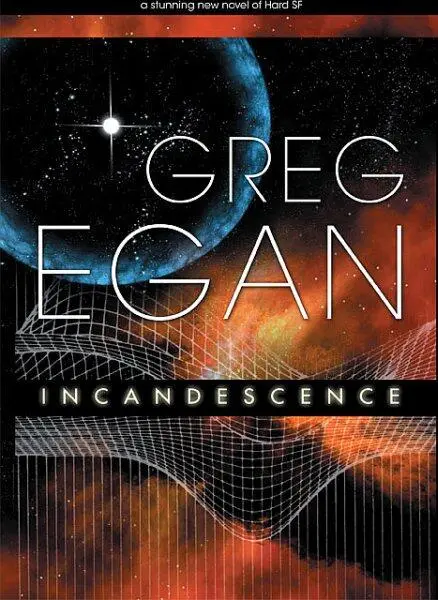
- Название:Incandescence
- Автор:
- Жанр:
- Год:неизвестен
- ISBN:нет данных
- Рейтинг книги:3 / 5. Голосов: 1
-
Избранное:Добавить в избранное
- Отзывы:
-
Ваша оценка:
Incandescence: краткое содержание, описание и аннотация
Предлагаем к чтению аннотацию, описание, краткое содержание или предисловие (зависит от того, что написал сам автор книги «Incandescence»). Если вы не нашли необходимую информацию о книге — напишите в комментариях, мы постараемся отыскать её.
Incandescence — читать онлайн бесплатно полную книгу (весь текст) целиком
Ниже представлен текст книги, разбитый по страницам. Система сохранения места последней прочитанной страницы, позволяет с удобством читать онлайн бесплатно книгу «Incandescence», без необходимости каждый раз заново искать на чём Вы остановились. Поставьте закладку, и сможете в любой момент перейти на страницу, на которой закончили чтение.
Интервал:
Закладка:
«I was inviting light-hearted speculation,» Rakesh said dryly, «not baleful philosophical pronouncements.»
«Then I'm sure they're having a wonderful time somewhere, sailing the high seas together.»
It was true that they were unlikely to have much in common any more; they were not part of a synchronization clan, they had made no appointment for a reunion. They had probably spent most of the past twenty-five thousand years as insentient data traveling through the Amalgam's network, but even if by some extraordinary coincidence they had crossed paths again, the chances were that their various measures of the time that had passed would have been millennia apart, placing the memories of their shared experiences into very different perspectives.
«So long as they're not still stuck at the node, then I'm happy,» Rakesh declared.
He shifted his attention back to the map — constructed inside his skull, but shared with Parantham — which pooled data from the Aloof and the Amalgam and annotated it according to the explorers' own priorities. It was easy to rule out all the stars that were younger than the rock itself; after that, the next obvious step was to try to account for the direction in which the rock was traveling.
The Aloof's map provided current velocities for the stars in the region — and like the stars' positions, these would have to be theoretical extrapolations from the latest data that could reach them at light speed — but it offered no past trajectories, either observed or computed. Rakesh wondered if this omission was a kind of strategic self-censorship; perhaps the Aloof considered that revealing just how long they'd been tracking these stars would grant some insight into the history of their civilization that they did not wish to disclose to outsiders. It could hardly have escaped their notice that the information would have been useful to their guests.
«Do they want us to find this planet, or not?» he muttered.
Parantham was undaunted. «They've had this meteor for at least fifty thousand years now. If their priority was making things easy for us, they could have located the planet themselves long ago, and sent us straight to it the moment we arrived. But that's not the deal. We're going to have to work for this. We knew that.»
The best dynamical model in the library couldn't wind back time fifty million years without generating uncertainties many times greater than the average distance between stars. Lahl had mentioned six hundred candidate stars; Rakesh couldn't whittle this down to less than five hundred with celestial mechanics alone.
Factoring in the chemistry of the rock made a difference. The Aloof's map included high-resolution spectra of each star, revealing the chemical composition of its outer layers precisely. Using a model of planetary-system formation it was possible to compute the probability of the rock's parent world being born from the same nebula as any given star. This reasoning was subject to its own uncertainties; nevertheless, the results allowed them to eliminate more than three hundred of their original candidates, and re-rank the two hundred that remained.
Before Rakesh could invoke any kind of high-powered statistical analysis, Parantham said, «That can't be right.» The chemistry-based ranking was not at all what might have been expected, with some candidates shuffled slightly down the list while others were promoted a few places. Rather, the second list more or less turned the first one on its head. The chemical profile of the region's stars placed the rock's origins in a completely different direction than that from which it seemed to have come.
«It must have undergone a sharp course change,» Rakesh suggested, «maybe even passing through another planetary system on its way.»
«Either that, or its chemistry's distorted for some reason,» Parantham said.
«So which trail do we follow?»
«Both, I suppose.»
Rakesh groaned. «So instead of halving our short list, we've just doubled it?»
Parantham said, «We haven't finished yet.»
«Of course not. I'm sure we can add another thousand candidates if we keep trying.»
Parantham selected close-up views of one star after another, but the Aloof's map displayed no planets around any of them. The data simply wasn't included, as if mere balls of rock were as irrelevant here as an anthill on a roadmap. Rakesh hadn't seriously expected to find the parent world in all its glory, teeming with long-lost DNA cousins, just by sitting here and zooming in on a map of the bulge, but a little more detail might have helped. The Amalgam's maps showed what was known, given the constraints, but if any world within the bulge had screamed «life» loudly enough for an observatory out in the disk to detect it, that would have been old news.
The gene fragments they'd found in the rock gave some tantalizing hints of the kind of proof-of-metabolism signature that the parent world's atmosphere might contain, though as ever there were uncertainties; these rock-dwelling microbes didn't have to be typical, let alone dominant on the planet as a whole, fifty million years later.
Rakesh said, «We need to make direct observations of our own.» The workshop had facilities that would allow them to construct a reasonably powerful telescope, but they lacked the raw materials to make anything big enough to analyze a planetary atmosphere from hundreds or thousands of light years away. They would need to travel further; they had no choice.
The console's main menu did not include any category for travel. It occurred to Rakesh that Lahl had never explained to them precisely how she'd got the message through to her hosts that she'd spent as much time as she could with the meteor, and wanted to move on.
After exploring every option pertaining to the habitat itself — including the ability to remodel the bathroom on command — Parantham finally realized that selecting a star on the map enabled a sub-menu with the unassuming option «Go to star». Choosing this did not change the map's viewpoint or magnification; rather, it caused the map to inquire politely, «Are you sure you wish to travel to this star?»
Rakesh said, «No, we're not sure yet, but thank you for asking.»
Parantham said, «Travel how? By what method? How long will it take?» The map remained silent. She re-invoked the option and the map asked again if she was sure, but it remained unresponsive to her requests for details.
Rakesh said, «Try some more stars, see if the option's always present.» They worked their way through a hundred candidates. In every case, the map claimed to be able to take them there.
«Does this mean they're all on the network?» Parantham wondered. The eavesdroppers out in the disk had only succeeded in mapping a small part of the Aloof's network, near the edge of the bulge. The nodes there weren't closely aligned with particular stars, but the known ones were certainly spread more thinly than the stars themselves. If the Aloof really did have receivers at all of the places where the map said it could take them, then either this was the best-connected region in the galaxy, or they had receivers at every single star in the bulge, period.
Rakesh said, «I doubt it. More likely they've just automated the ability to add new nodes.» Out in the disk, getting a receiver built at a new location was a major endeavor. First, you needed permission from the custodians of the local material resources. Then you had to organize the logistics of sending spores to construct the receiver itself. The technology had been streamlined over the millennia — with the need for eavesdroppers to chase the spillage of the Aloof's data around the inner disk providing a substantial boost — but it still wasn't something you did casually, just by pointing at an obscure star on a map and leaving the rest to insentient software.
Читать дальшеИнтервал:
Закладка:
Похожие книги на «Incandescence»
Представляем Вашему вниманию похожие книги на «Incandescence» списком для выбора. Мы отобрали схожую по названию и смыслу литературу в надежде предоставить читателям больше вариантов отыскать новые, интересные, ещё непрочитанные произведения.







Обсуждение, отзывы о книге «Incandescence» и просто собственные мнения читателей. Оставьте ваши комментарии, напишите, что Вы думаете о произведении, его смысле или главных героях. Укажите что конкретно понравилось, а что нет, и почему Вы так считаете.