Charles Sheffield - Proteus in the Underworld
Здесь есть возможность читать онлайн «Charles Sheffield - Proteus in the Underworld» весь текст электронной книги совершенно бесплатно (целиком полную версию без сокращений). В некоторых случаях можно слушать аудио, скачать через торрент в формате fb2 и присутствует краткое содержание. Год выпуска: 1995, ISBN: 1995, Издательство: Baen Books, Жанр: Фантастика и фэнтези, на английском языке. Описание произведения, (предисловие) а так же отзывы посетителей доступны на портале библиотеки ЛибКат.
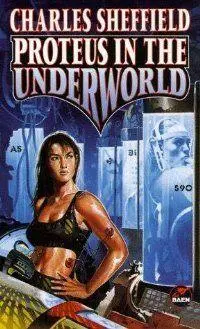
- Название:Proteus in the Underworld
- Автор:
- Издательство:Baen Books
- Жанр:
- Год:1995
- ISBN:0-671-87659-7
- Рейтинг книги:3 / 5. Голосов: 1
-
Избранное:Добавить в избранное
- Отзывы:
-
Ваша оценка:
Proteus in the Underworld: краткое содержание, описание и аннотация
Предлагаем к чтению аннотацию, описание, краткое содержание или предисловие (зависит от того, что написал сам автор книги «Proteus in the Underworld»). Если вы не нашли необходимую информацию о книге — напишите в комментариях, мы постараемся отыскать её.
Proteus in the Underworld — читать онлайн бесплатно полную книгу (весь текст) целиком
Ниже представлен текст книги, разбитый по страницам. Система сохранения места последней прочитанной страницы, позволяет с удобством читать онлайн бесплатно книгу «Proteus in the Underworld», без необходимости каждый раз заново искать на чём Вы остановились. Поставьте закладку, и сможете в любой момент перейти на страницу, на которой закончили чтение.
Интервал:
Закладка:
She went on through with the fourteen others of the visiting group. Like them she was officially described as a tourist, a simple working type from the inner system who was spending ten years’ savings to come out and gape and marvel at the wonders of the Kuiper Belt. A few were on their way home, but most of them would be going farther out to sample the still-stranger expanse of Cloudland, with its vast open spaces, great Harvesters, and billion-kilometer thinner-than-gossamer Space Farms.
The tour guide was a native of Samarkand. If he was representative of the wonders to come it would be a dull day. He was short and dumpy, with a pale face and fair, straggly hair. He offered comments on what they were seeing in the monotone of one who had said the same thing hundreds or thousands of times.
“Established in 2160 by the League of Brethren, originally from the Central Asian region of Earth. The Brethren took as their guiding doctrine the sacred rights and natural goodness of all things, and that doctrine continues to be applied here in the Colony.” He was leading them through a long, spiral room that vanished into the distance. Groups of workers, fat and thin and tall and short but all seemingly cheerful, were standing at thousand after thousand of identical machines. They were chatting to one another, and it was clear that the equipment mostly ran itself.
“We honor the guiding doctrine.” The tour leaders nasal drone went on and on. His eyes were half closed. “Because of this we refuse to consume any living organism—not even the single-celled ones which form the basis of most food production through Cloudland and the Kuiper Belt. Here you see our food being synthesized from elementary inorganic components, water and minerals and carbon dioxide and nitrogen. Observe the steadily increasing complexity of the molecules at each stage, as higher order synthesis is performed.”
The other tourists were already bored. Sondra could see their attention beginning to wander. She sympathized, but she could not allow herself to blank out. Somewhere here was the clue that she needed.
Somewhere?
Where?
She glanced from the guide to the workers that they passed. They were worse than ordinary looking. Back on Earth they would have drawn attention by their ugliness. Not just the occasional man or woman, either, but every one of them. And not the standardized ugliness of Cloudlanders, whose elongated stick-thin bodies and arms and short legs were all ugly to Earth eyes in the same generic way. The workers here had customized ugliness, all different.
Sondra started, and looked at the people of Samarkand through new eyes. Could that be it? She had carefully remained at the back of the group, remaining as inconspicuous as possible. She didn’t want to draw attention to herself now, by asking their guide a question. As they moved on to another assembly line, she whispered to the bored-looking man next to her: “These people look as though they could really use a form-change session.”
“I know.” He nodded at a stooped man standing by one of the machines, and grinned. “See him? If I looked like that I’d be in a tank sharpish, before anyone else could have a look at me.”
“Me too.” Sondra took care to glance in all directions before she spoke again. “I haven’t seen any tanks, though. Did you notice where they were when we came in? Suppose one of us was taken sick and needed remedial change. Where would we go?”
A woman on the other side of the man had turned to listen to the muttered conversation. Sondra stayed in through a few more remarks about the unattractive appearance of the people of Samarkand, then allowed herself to drop out of the exchange. She stepped a little closer to the back of the group. She was not missed. A couple of others were now peering about them, examining the workers or looking for evidence of form-change equipment.
It took a few minutes, but finally as they moved through to a smaller chamber one of the more aggressive members of the group piped up. “Excuse me.” It was a big dark-haired woman, wearing one of Earth’s popular peasant girl forms. “I have a question.” The guide, in mid-sentence monotone, ground to a halt. He stared uncomprehendingly at the interrupter.
“We’ve seen a good bit of your colony.” The woman waved an arm at their surroundings. “But we’ve seen no sign of your form-change tanks. Where are they?” It was like watching someone return from the dead. The guide stood up taller, his eyes popped open, and his pale cheeks turned pink.
“Form-change tanks!” He glared at the woman who had asked the question. “You may search Samarkand from one end to the other, and you will find no such thing. We have no place for decadence in our world.”
“But what if you get sick? Hey, what if I get sick?”
“Weren’t you listening to me? I told you already, the guiding doctrine of the League of Brethren is based on die natural goodness of all things. That includes human beings. We have no need of form-change to cure sickness, because sickness is no more than a failure to allow innate goodness to triumph over evil. The rest of the system may choose an unnatural method to combat the evil within, but we prefer our way. Nature’s way.”
The tour guide had left his prepared script far behind. Sondra, drifting away from the back of the group, decided that she liked him rather better this way. He was a kook, but now he was a kook with his own principles and convictions.
The woman who had asked the question did not agree. She had not enjoyed the answer at all. Sondra heard her voice rising in pitch and volume as she slipped through into an adjoining room.
“Are you telling me what I think you’re telling me? That if I get sick when I’m here on your dumb colony, you’re going to tell me to argue with myself, instead of somebody dumping me into the nearest form-change tank? Well, let me tell you something, mister … ”
The chamber that Sondra had entered was empty. She moved through it rapidly. The argument would help, but there was no way of knowing how much time she had before her absence from the tour group was noticed.
She had apparently left behind the main manufacturing region of the colony. The turning corridor along which she was hurrying had many closed doors, one every few meters. At the end lay a larger open door leading to a much bigger room.
Sondra paused a few feet short of the entrance. She could already see what was inside the room. She had realized that many rooms like this must exist within Samarkand as soon as she heard the tour guide speak of decadence and the absence of form-change equipment But she did not want to go any closer.
The view from a distance was quite bad enough. The people inside the room were slumped in upholstered chairs or moving unsteadily from place to place. Sondra saw faces with sunken, bleary eyes and withered cheeks, topped by white and scanty hair. Limbs were bony and lacking muscle, skin was wrinkled and marked with moles and spots of dark brown.
It might have been a scene from the files of the Office of Form Control, showing the terrible end results of illegal form use. Sondra knew that it was not. It was a picture of the world as it used to be, before purposive form-change had banished the specter of aging. People—except on Samarkand—employed the machines in biofeedback loops that permitted them to remain in peak physical condition throughout their whole lives, until finally the brain lost its power to follow the biofeedback regime. At that point irreversible physical and mental decline began.
Death had not been banished from the solar system. But now it came quickly, in just a few days.
Except on Samarkand. Here on Samarkand death crept in slowly, stealing life a little at a time. Muscles weakened, senses faded, eyes and ears lost their sensitivity. Hearts and lungs faltered and failed. Life was a long decline, its end a long disease. Sondra had not noticed this on the tour, for a simple reason: very old people could not and did not work.
Читать дальшеИнтервал:
Закладка:
Похожие книги на «Proteus in the Underworld»
Представляем Вашему вниманию похожие книги на «Proteus in the Underworld» списком для выбора. Мы отобрали схожую по названию и смыслу литературу в надежде предоставить читателям больше вариантов отыскать новые, интересные, ещё непрочитанные произведения.











Обсуждение, отзывы о книге «Proteus in the Underworld» и просто собственные мнения читателей. Оставьте ваши комментарии, напишите, что Вы думаете о произведении, его смысле или главных героях. Укажите что конкретно понравилось, а что нет, и почему Вы так считаете.