John Carr - Kalvan Kingmaker
Здесь есть возможность читать онлайн «John Carr - Kalvan Kingmaker» весь текст электронной книги совершенно бесплатно (целиком полную версию без сокращений). В некоторых случаях можно слушать аудио, скачать через торрент в формате fb2 и присутствует краткое содержание. Жанр: Фантастика и фэнтези, на английском языке. Описание произведения, (предисловие) а так же отзывы посетителей доступны на портале библиотеки ЛибКат.
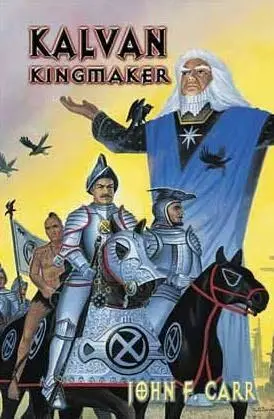
- Название:Kalvan Kingmaker
- Автор:
- Жанр:
- Год:неизвестен
- ISBN:нет данных
- Рейтинг книги:3 / 5. Голосов: 1
-
Избранное:Добавить в избранное
- Отзывы:
-
Ваша оценка:
Kalvan Kingmaker: краткое содержание, описание и аннотация
Предлагаем к чтению аннотацию, описание, краткое содержание или предисловие (зависит от того, что написал сам автор книги «Kalvan Kingmaker»). Если вы не нашли необходимую информацию о книге — напишите в комментариях, мы постараемся отыскать её.
Kalvan Kingmaker — читать онлайн бесплатно полную книгу (весь текст) целиком
Ниже представлен текст книги, разбитый по страницам. Система сохранения места последней прочитанной страницы, позволяет с удобством читать онлайн бесплатно книгу «Kalvan Kingmaker», без необходимости каждый раз заново искать на чём Вы остановились. Поставьте закладку, и сможете в любой момент перейти на страницу, на которой закончили чтение.
Интервал:
Закладка:
SEVEN
I
Kalvan followed Rector Mytron, who was wearing the university robes of green and maroon, instead of the blue robes of Father Dralm, to the massive plank door. The large room had formerly been the lesser hall of a baronial mansion belonging to his former aide, Baron Nicomoth, until he took a bullet in the eye at the Battle of Phyrax. Dying without wife or issue, Prince Ptosphes had claimed it for the Throne and presented it to Kalvan as the permanent site for his new University of Hos-Hostigos. It was an ideal place, situated just outside of Hostigos Town, close to the Royal Foundry (near State College in otherwhen), with a mansion as solid as a castle keep, a city-block of grounds and a dozen or more outbuildings. Mytron led Kalvan through the hall, out another door to the outside, where the former stable barn turned Artificer Workshop stood. Both doors were wide open and half a dozen forges, with varlets working the bellows, burned cherry red. On anvils the size of tree butts husky smiths pounded out splints of steel, turning them into three and four foot bayonets. Along the far side of the Workshop, apprentices sorted bayonets into groups, while others honed their blades. These were nasty Napoleonic spear-like bayonets, not the stubby knives of Kalvan's Korean War days.
Phylo, the Chief Artificer, took a musket and one of the newly made bayonets, which were hafted with tapered plugs instead of handles, and put the bayonet into the end of the firearm. Then a student approached him with a cloth and wood dummy and he proceeded to charge it with the musket and bayonet. When the student had proved that the bayonet could strike with reasonable impact, without becoming dislodged, Phylo dismissed the apprentice and took apart the musket and bayonet.
"Very nice, very nice," Kalvan said, "but what about the sockets we talked about?"
The gray-haired Chief Artificer shook his head. "Your Majesty, we did a complete inventory of every firearm in the Royal Armory and found that of the twelve thousand or more firearms, including muskets, arquebuses and calivers, no more than a few hundred shared the same bore or outside muzzle diameter. Our master gunsmiths believe that it would take more than a year to provide half the Armory's firearms with both socket and outside bushing for the bayonets. And that is only if we halved production of bayonets and produced only sockets and bushings."
That figure, of course, didn't include firearms already issued to the Royal Army. Winning five out of six major battles had over-stocked the Royal Armory on firearms. This wealth of firearms had had an unforeseen consequence; it had made a shambles of Kalvan's attempts to standardize musket barrels and bores. On the other hand, it did make possible Kalvan's plan to replace the Royal Army's pikes with muskets. Most here-and-now infantry were a combined arms army of pikemen and firearms, usually in equal proportion. It didn't take a genius to figure out the advantages of turning all those pikemen into musketeers; for one, it would double the rate of firepower in one fell swoop.
In actuality, Kalvan was finding it wasn't easy to get those proud pikemen to drop their sixteen-foot shafts in favor of a little five-foot musket with a four-foot blade. Nor had it been easy to convince them that what they saw as a drop in status was in reality a jump in military effectiveness, since the pikemen were convinced that any fool could point a stick and pull a trigger. Pike drills took real coordination and strength. Nor had they wanted to give up their breastplates and taces, armor which he knew would only be in the way and weigh them down as musketeers. The pikemen thought it would make them more vulnerable to enemy shot. They were both right, but as Great King, he won the argument. Morale, though, had suffered.
"Chief Phylo will you be able to outfit the entire Royal Army with your plug bayonets by spring?"
"Your Majesty, we can provide enough of the new bayonets for about half the Royal Army; the other half will have to make do with converted knives and short swords."
"Here's what we'll do then. Give all the new bayonets to the pikemen, which will help their morale. Make plugs for the musketeers; who'll be happy to have anything at all to help protect them from rampaging cavalry."
"A good plan, Your Majesty. That should halt some of the grumbling."
There was no easy way to reverse a lifetime of thinking and conditioning, but they were going to have to try if the Kingdom of Hos-Hostigos was going to survive and flourish. If only he had more time-even just two or three years, but time was one advantage Styphon's House wasn't about to relinquish.
The next stop was the former barn turned University auditorium or Great Hall. Kalvan noticed that since his last visit, over a month ago, the walls had been plastered, whitewashed and wainscoted with dark wood. At the head of the hall, above a large desk, were the Hos-Hostigos national flag and the University coat-of-arms, a retort crossed with a quill pen.
According to Rector Mytron the University enrollment was up to sixty-two students, not counting the part-time students in the Department of Military Science, which was primarily an adjunct to help quickly train the new Royal Army officers in what they called Kalvan-style, military tactics. Captain-General Harmakros of the Royal Army was the Department head of Military Science in all his copious spare time.
Rector Mytron sat at one of the tables and indicated that Kalvan was to sit at the other. His broad cherubic face beaming, he said, "Now Master Thalmoth will give his report on progress in the Department of Sappers and Engineers."
Master Thalmoth, weathered by age and hard work, but unbent, remained standing. Thalmoth was a former Hostigi artillery officer brought out of retirement by the war. He had a natural talent for engineering and had done a little bit of everything during his two decades as a mercenary artillery captain. He was a colonel in the Royal Army as well as head of the engineering department; his eighteen students were soon to be the nucleus of the first Sapper and Engineers Company.
Thalmoth had been experimenting with gun carriage design and had come up with improved trunnions for some of the big twenty-four pounders There was also, at Kalvan's suggestion, some work being done on pontoon bridges. Thalmoth was highly animated and already talking about the spring campaign against the Great Kingdom of Hos-Harphax. He planned to have another fourteen of the four-pound sakers, or light cannon, cast during the winter and with his new carriages. Thalmoth claimed he could take them into the Trygath backwoods if necessary.
This was far better than Kalvan had expected and he praised the old engineer for his good work. With the new four-pounders, plus the twelve he already had, and the six and eight-pounders already in service, Kalvan would be approaching the kind of mobile artillery force that Gustavus Adolphus had used so successfully in Germany during the Thirty Years War. He was going to have to talk to General Alkides of the Royal Artillery about training some additional gun crews. Maybe he couldn't outnumber his opponents but, By Galzar, he could out-shoot them.
Master Ermut, a big man with a fair beard, was the last to speak. Ermut, a former Styphon's House temple-farm slave, was living evidence of Kalvan's positive effect in his new world; Ermut was hale and hearty and even well dressed. Independently of Kalvan, Ermut had re-discovered the experimental method, while working in Kalvan's proto-paper mill and was the first real here-and-now scientist. Mytron had wisely made him Master of Alchemy.
"Your Majesty, I was hoping today to present you with some of our new paper, but we have still not determined the best clay for sizing and it is still too porous. I should have some of the new paper for your inspection in about a moon half."
Читать дальшеИнтервал:
Закладка:
Похожие книги на «Kalvan Kingmaker»
Представляем Вашему вниманию похожие книги на «Kalvan Kingmaker» списком для выбора. Мы отобрали схожую по названию и смыслу литературу в надежде предоставить читателям больше вариантов отыскать новые, интересные, ещё непрочитанные произведения.







Обсуждение, отзывы о книге «Kalvan Kingmaker» и просто собственные мнения читателей. Оставьте ваши комментарии, напишите, что Вы думаете о произведении, его смысле или главных героях. Укажите что конкретно понравилось, а что нет, и почему Вы так считаете.