Robert Sawyer - Watch
Здесь есть возможность читать онлайн «Robert Sawyer - Watch» весь текст электронной книги совершенно бесплатно (целиком полную версию без сокращений). В некоторых случаях можно слушать аудио, скачать через торрент в формате fb2 и присутствует краткое содержание. Год выпуска: 2010, ISBN: 2010, Издательство: Ace Books, Жанр: Фантастика и фэнтези, на английском языке. Описание произведения, (предисловие) а так же отзывы посетителей доступны на портале библиотеки ЛибКат.
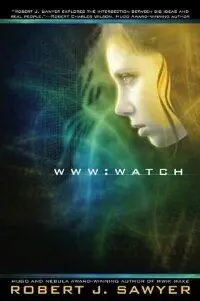
- Название:Watch
- Автор:
- Издательство:Ace Books
- Жанр:
- Год:2010
- ISBN:978-0-441-01818-5
- Рейтинг книги:5 / 5. Голосов: 1
-
Избранное:Добавить в избранное
- Отзывы:
-
Ваша оценка:
Watch: краткое содержание, описание и аннотация
Предлагаем к чтению аннотацию, описание, краткое содержание или предисловие (зависит от того, что написал сам автор книги «Watch»). Если вы не нашли необходимую информацию о книге — напишите в комментариях, мы постараемся отыскать её.
WATCH is convinced that Webmind represents a risk to national security and wants it purged from cyberspace. But Caitlin believes in Webmind’s capacity for compassion—and she will do anything and everything necessary to protect her friend.
Watch — читать онлайн бесплатно полную книгу (весь текст) целиком
Ниже представлен текст книги, разбитый по страницам. Система сохранения места последней прочитанной страницы, позволяет с удобством читать онлайн бесплатно книгу «Watch», без необходимости каждый раз заново искать на чём Вы остановились. Поставьте закладку, и сможете в любой момент перейти на страницу, на которой закончили чтение.
Интервал:
Закладка:
“Not everyone is going to like Webmind, are they? I mean, if the public ever finds out about him.”
She heard her take a deep breath, then let it out. “Probably not.”
“They’re going to compare him to Big Brother, aren’t they?”
“Certainly some people will, yes.”
“But we’re the ones guiding his development—you, me, Dr. Kuroda, Dad. Can’t we make sure it’s, you know, good?”
“Make sure?” said her mother. “Probably not—no more than a parent can make sure her child turns out well. But we can try our best.” She paused. “And sometimes it does turn out all right.”
Tony Moretti and Peyton Hume were back in Tony’s office. The colonel was swilling black coffee to keep going, and Tony had just downed a bottle of Coke. The Secretary of State was on the line again from Milan. “So,” she said, “this thing is called Webmind?”
“That’s what the Decter kid refers to it as, yes,” said Hume.
“We shouldn’t call it that,” said Tony. “We should give it a code name, in case any of our own future communications are compromised.”
Hume snorted. “Too bad ‘Renegade’ is already taken.”
Renegade was the Secret Service’s code name for the current president; the Secretary’s own—left over from her time in the White House—was Evergreen.
“Call it Exponential,” Hume suggested after a moment.
“Fine,” said the secretary. “And what have you determined? Is Exponential localized anywhere?”
“Not as far as we can tell,” said Tony. “Our assumption now is that it’s distributed throughout the Internet.”
“Well,” said the secretary, “if there’s no evidence that Exponential is located or concentrated on American soil, or for that matter, no evidence that its main location is inside an enemy country, do we—the US government—actually have the right to purge it?”
Colonel Hume’s voice was deferential. “If I may be so bold, Madam Secretary, we have more than a right—we have an obligation.”
“How so?”
“Well, one could technically argue that the World Wide Web is a European invention—it was born at CERN, after all—but the Internet, which underlies the Web, is, without doubt, an American invention. The decentralized structure, which would let the Internet survive even a nuclear attack on several major US cities, was our doing: the fact that the damn thing has no off switch was by design —by American design. This is, in a very real sense, an American-made crisis, and it requires an American-made solution—and fast.”
At 7:30 p.m. Saturday night—which was 9:30 a.m. Sunday morning in Tokyo—Dr. Kuroda came back online. He said that by the end of the day his time he hoped to have the codecs in place for Webmind to actually start watching movies.
That reminded Caitlin that she and her father had a date to watch a movie on her birthday, and, although it seemed perhaps frivolous to go through with that plan, she was exhausted from talking with Webmind.
In a normal IM session, there were delays of many seconds or even minutes between sending a message and getting a response, as the person at the other end composed their thoughts or took time out to do other things. But the freakin’ instant she hit enter— boom! —Webmind’s response popped into her chat window. She really did need to take a break; talking with him was like a marathon cross-examination session. Besides, one didn’t disrupt her father’s planned schedule lightly. And, anyway, her mother was going to spend the evening working with Webmind alongside Dr. Kuroda.
Her father did not do well in crowds, so Caitlin knew asking him to take her to a theater was out of the question. But her parents had a sixty-inch wall-mounted flat-screen TV, and that would do well enough, she thought.
Caitlin liked the symmetry: she was going to have her first real experience watching a movie at the same time that Webmind, thanks to Dr. Kuroda, was going to have his first taste of online video.
Professor Hawking was jet-lagged, and even under the best of circumstances couldn’t be overworked; Caitlin’s dad had gotten home about an hour ago. He was a typical math geek in a lot of ways. He had a collection of science-fiction films on DVD and Blu-ray discs, and although he said he’d seen most of them before, Caitlin was surprised to discover how many of the cases were still shrink-wrapped. “Why’d you buy them if you weren’t going to watch them?” she asked.
He looked at the tall, thin cabinets that contained the movies and seemed to ponder the question. “My childhood was on sale,” he said at last, “so I bought it.”
She understood: there had been Braille books, including Are You There God? It’s Me, Margaret and The Hobbit, that gave her pleasure to own even though it had been years since she’d turned to them.
“Your choice,” her father said.
“I have no idea,” said Caitlin. “Was there something you particularly liked when you were my age?”
His hand went immediately to a package on the bottom shelf. “This one,” he said, “came out the year I turned sixteen.” He held it up, and she peered at the box’s cover. She could only see with one eye, so flat images didn’t present any special challenge: it showed a teenage boy and a teenage girl looking at what she guessed after a second was an old-fashioned computer monitor with a curved display.
She tried to read the title: “W, a, um, r, c—”
“It’s a G,” her father corrected. “WarGames.”
“What’s it about?”
“A computer wiz. A hacker.”
“That girl?” asked Caitlin, excited.
“No. That’s Ally Sheedy. The love interest.”
“Oh.”
“The hacker is the boy, Matthew Broderick.”
“He got married to Sarah Jessica Parker,” Caitlin said, peering at his picture.
“Who’s that?” asked her dad.
She found herself not wanting to volunteer a familiarity with Sex and the City, so she just said, “An actress.” She paused. “Okay, let’s watch it.” But then she frowned. Her father hated it when her mother talked while he was watching TV. “I, um, might have to ask you some questions—about what’s on screen, I mean.” There were still so many things she had never seen.
“Of course,” said her Dad.
Caitlin wanted to hug him, but didn’t. She moved to the couch. He put the disc in a thing that had to be the Blu-ray player, and then joined her. She was pleased he didn’t sit quite the maximum possible distance from her.
Caitlin was surprised to see her dad change his glasses, swapping one pair for another; she’d had no idea that he had two different pairs. “Would you like closed captioning?” he asked.
“What’s that?”
“Subtitles. Transcriptions of the dialog. Might help you with your reading.”
Caitlin thought that was a great idea—and not just for herself. It would let Webmind follow the movie, too, as it watched the datastream from her eyePod; it didn’t hear anything from the real world, after all.
The film began. The opening had two men heading down into an underground missile silo to relieve two other men who had been on duty there. They were bantering among themselves about what she eventually realized was some marijuana one of them had smoked while they’d been away.
She looked sideways at her dad, wondering what his own experience, if any, with drugs was—but that was something she couldn’t ask him about. She’d have to be content with little revelations, like the fact that he had multiple pairs of glasses.
Suddenly, the mood in the film turned: the men received the launch order for their missile, but one of them—the pot smoker—was refusing to turn his firing key, and the other—
Читать дальшеИнтервал:
Закладка:
Похожие книги на «Watch»
Представляем Вашему вниманию похожие книги на «Watch» списком для выбора. Мы отобрали схожую по названию и смыслу литературу в надежде предоставить читателям больше вариантов отыскать новые, интересные, ещё непрочитанные произведения.


Обсуждение, отзывы о книге «Watch» и просто собственные мнения читателей. Оставьте ваши комментарии, напишите, что Вы думаете о произведении, его смысле или главных героях. Укажите что конкретно понравилось, а что нет, и почему Вы так считаете.