Donald Moffitt - Second Genesis
Здесь есть возможность читать онлайн «Donald Moffitt - Second Genesis» весь текст электронной книги совершенно бесплатно (целиком полную версию без сокращений). В некоторых случаях можно слушать аудио, скачать через торрент в формате fb2 и присутствует краткое содержание. Год выпуска: 1986, ISBN: 1986, Издательство: Del Rey / Ballantine, Жанр: Фантастика и фэнтези, на английском языке. Описание произведения, (предисловие) а так же отзывы посетителей доступны на портале библиотеки ЛибКат.
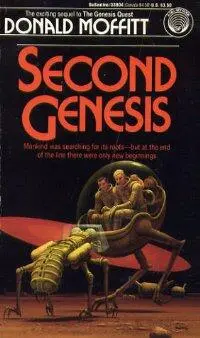
- Название:Second Genesis
- Автор:
- Издательство:Del Rey / Ballantine
- Жанр:
- Год:1986
- ISBN:0-345-33804-9
- Рейтинг книги:4 / 5. Голосов: 1
-
Избранное:Добавить в избранное
- Отзывы:
-
Ваша оценка:
Second Genesis: краткое содержание, описание и аннотация
Предлагаем к чтению аннотацию, описание, краткое содержание или предисловие (зависит от того, что написал сам автор книги «Second Genesis»). Если вы не нашли необходимую информацию о книге — напишите в комментариях, мы постараемся отыскать её.
Second Genesis — читать онлайн бесплатно полную книгу (весь текст) целиком
Ниже представлен текст книги, разбитый по страницам. Система сохранения места последней прочитанной страницы, позволяет с удобством читать онлайн бесплатно книгу «Second Genesis», без необходимости каждый раз заново искать на чём Вы остановились. Поставьте закладку, и сможете в любой момент перейти на страницу, на которой закончили чтение.
Интервал:
Закладка:
He stopped, out of breath.
“What’s happened to your rocky world at the center?” Bram asked.
“Oh, that? It’s smeared all over the faces of the disk. Some of it’s been flung out beyond the rim and fallen back, and we’re standing on it. And the rest of it’s a plug in the hole at the center of the disk, where the gravity is perpendicular to the disk surface. “It’s heavy there, that close to the center of gravity, I promise you!”
“What about it, Enry?” Bram said.
“It could be.” The geologist’s voice was muffled; he must have turned his head away from the helmet mike to check data. “I’ve got samples that could have come from the rocky core of a gas giant that broke up. Silicates that show signs of once having been under tremendous pressure. Millions of atmospheres worth—the kind of pressure that turns molecular hydrogen into metallic hydrogen. The paleomagnetism’s interesting. The orientation’s every which way. As if the samples originated elsewhere and were scattered all over the place.”
“What did I tell you?” Jao sounded smug.
“There’s something else,” Enry drawled.
“What?”
“The rocks show that there’s a steady leakage of gases from the interior of this … world. Oxygen, and carbon dioxide, and lighter gases like nitrogen and helium. The rim can’t hold on to an atmosphere, of course. But there could be a considerable amount of gas still trapped in the … cavities that Jao postulates.” There was a moment of silence with an unmistakable frown in it. “More than there ought to be, from the rate of leakage, after seventy million years.”
“The gases are subliming off the foamed surfaces,” Jao said quickly. “And maybe off the superfilament as well. Nitrogen, did you say? I’m going to have to rethink the chemistry of it. Plenty of oxygen, that’s for sure. Hey, we might be able to tap into it during our stay—take some of the load off Yggdrasil!”
“How far down would we have to drill to tap atmosphere?” Bram asked.
“I don’t know. It would take some pretty fancy mathematics to figure out the thickness of the crust, based on too many variables—the size of the original core, rate of spin-up, disk gravity gradients, surface friction affecting the dispersion of material … I think we’ll have to rely on Enry’s empirical methods. Theory falls in a case like this. It can’t be much, though.”
“Those bare paw prints,” Ame said. “Do you suppose…”
“Forget it, Ame. Any atmosphere belched out from the interior would instantly disperse. You’ll have to find another explanation.”
“There was life here within the last few million years—I’m certain of that,” she said stubbornly. “It’s…”
“What’s the matter, Ame?” Bram said.
She flashed her light around the base of the moonrope. “Look,” she said.
The tracks had been easy to miss in the permanent red twilight, especially when there was the awesome sight of that crystalline pillar drawing your eyes up instead of down. And the reflected light from directly above had tended to wash out the long, diffuse shadows cast by the horizon-filling sliver of the companion diskworld that rose above the brink.
But once you had noticed them, it was hard to see how the eye had skipped over them. Shallow as they were, they were perfectly plain, like inked thumbprints, a little smudged where the tiny paws had scrabbled in the dust. The myriad trails meandered a bit. But in the end pointed toward the soaring cable.
“They climbed it,” Ame said. “That’s where they went. They climbed to the moon.”
They had six hours to explore the central complex, Lydis told them. After that, they would begin to tax the walker’s ability to replenish their air supply. “I don’t want you to use your reserve bottles at all,” Lydis said. “That’s cutting it too close. I want you to come in with your reserve bottles intact. Understood?”
“Understood,” Bram told his daughter. He sighed. It had been five hundred years since she had been a little girl, but every once in a while it felt strange to be taking orders from her.
Ame was scrambling happily all over the mounds of rubble, leaving little electronic markers that would give off coded transponder signals when asked.
“Site number twenty,” she dictated to one of them. “Probable auditorium or lecture hall.” She followed with a series of dimensionless coordinates that would be fitted later into a triangulation grid by a computer.
“How can you tell it’s an auditorium?” Bram asked. “It’s just another dust pile, as far as I can see.”
“It’s fan-shaped,” she said, tossing him a grin over her shoulder. “We tend to think that public halls are supposed to be circular, with a stage in the center, because of the Nar influence. But this is a much more natural shape for human beings. And see, the focal point—abutting what might be classrooms or administrative offices—is at about the limit of distance from which a live lecturer or performer could be seen to any effect.”
Bram followed her around as best he could, climbing in and out of the walker, helping with the measurements, and operating the little portable thumper that located cavities beneath the surface.
“Libraries,” Ame exulted. “I’m sure of it. And museum warehouses and storehouses and depots and vaults for frozen samples. And all the support and recreational facilities you’d need for the population of millions that it would have taken to run this outpost—hydroponic farms, maybe even zoos! This will be a treasure trove for the archaeologists, Bram -tsu! And there’ll be middens—we’ll find seeds and organic refuse and bones…”
He didn’t like leaving her alone while he went off on his own side forays, and at one point he coaxed her into the walker for an excursion to the rim’s edge.
“Don’t go out any farther,” he warned. “I don’t know how secure this thing is.”
They were standing on the great skeleton arm of a gantry that extended out over the abyss—part of some sort of transport system that traveled an unknown distance down the face. Bram could see the stanchions that once might have supported an elevator or funicular dwindling with distance till they disappeared.
Hundreds—possibly thousands—of miles down the sheer face began a glittering fairy forest of tiny filaments that swept in a great arc until they could no longer be distinguished against the knife edge that cut the black night ninety million miles below.
“The feed array for the antenna system,” Bram said. “There must be others, equally spaced around the disk, aimed at a reflector at the hub.”
By this time they had worked themselves through to the opposite edge of the disk, facing the intergalactic night. The antenna complex was lit from above by ruddy moonlight.
The buried city, limned by mounded avenues of detritus, stretched all the way across the diskworld from rim to rim. And Jao had been right: There was another set of cables climbing to the moon on this side, too.
“So this,” Ame said, “was the voice of the human race?”
“Yes.” Bram dug through the centuries for an old memory. “My teacher, Voth, once said that humankind had learned to tame a sun’s power to shout across the gulf between the galaxies, but he couldn’t imagine how.”
He mused at the phased array, wondering at the scale that would allow its nearer ranks to be seen at such a distance. The elements must be miles high to be even remotely distinguishable—cantilevered or guyed against the topsy-turvy gravity. But that would have presented no problem to a race with moonrope at its disposal. And the gravity would be mild for the next few million miles, anyway. It would be a different story at the hub, where gravity would be crushing. Perhaps there were phase shifters installed at a safe radius. He would send an expedition down the face to see—in a space vehicle. And the physics would have to be carefully worked out so that the explorers would not find themselves slammed against a wall that had become a floor.
Читать дальшеИнтервал:
Закладка:
Похожие книги на «Second Genesis»
Представляем Вашему вниманию похожие книги на «Second Genesis» списком для выбора. Мы отобрали схожую по названию и смыслу литературу в надежде предоставить читателям больше вариантов отыскать новые, интересные, ещё непрочитанные произведения.






Обсуждение, отзывы о книге «Second Genesis» и просто собственные мнения читателей. Оставьте ваши комментарии, напишите, что Вы думаете о произведении, его смысле или главных героях. Укажите что конкретно понравилось, а что нет, и почему Вы так считаете.