Ben Bova - Moonwar
Здесь есть возможность читать онлайн «Ben Bova - Moonwar» весь текст электронной книги совершенно бесплатно (целиком полную версию без сокращений). В некоторых случаях можно слушать аудио, скачать через торрент в формате fb2 и присутствует краткое содержание. Год выпуска: 1997, ISBN: 1997, Издательство: Hodder & Stoughton, Жанр: Фантастика и фэнтези, на английском языке. Описание произведения, (предисловие) а так же отзывы посетителей доступны на портале библиотеки ЛибКат.
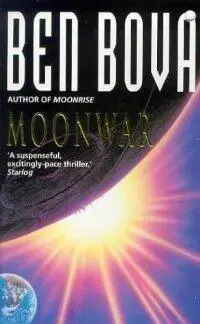
- Название:Moonwar
- Автор:
- Издательство:Hodder & Stoughton
- Жанр:
- Год:1997
- ISBN:0-340-68250-7
- Рейтинг книги:4 / 5. Голосов: 1
-
Избранное:Добавить в избранное
- Отзывы:
-
Ваша оценка:
Moonwar: краткое содержание, описание и аннотация
Предлагаем к чтению аннотацию, описание, краткое содержание или предисловие (зависит от того, что написал сам автор книги «Moonwar»). Если вы не нашли необходимую информацию о книге — напишите в комментариях, мы постараемся отыскать её.
Douglas Stavenger and his dedicated team of scientists are determined to defend their life’s work, but technology-hating factions on Earth want to close the flourishing space colony, Moonbase. Can a combination of military defence and political wisdom save the colony?
Moonwar — читать онлайн бесплатно полную книгу (весь текст) целиком
Ниже представлен текст книги, разбитый по страницам. Система сохранения места последней прочитанной страницы, позволяет с удобством читать онлайн бесплатно книгу «Moonwar», без необходимости каждый раз заново искать на чём Вы остановились. Поставьте закладку, и сможете в любой момент перейти на страницу, на которой закончили чтение.
Интервал:
Закладка:
Rashid must’ve phoned him, Joanna thought swiftly. Or maybe not. He’s got his own sources of information, certainly.
“I’ve decided that Moonbase isn’t worth the loss of more lives,” Joanna said, holding herself together with a conscious effort of will. “This war must end before more people are killed.”
Yamagata drew in a breath. “I sincerely regret what has happened. This was not of my doing.”
“I understand that,” Joanna replied, a slim tendril of doubt still in the back of her mind. But she pushed it away. “What kind of an agreement can we reach?”
Rubbing his chin in apparent perplexity, Yamagata said slowly, “The Peacekeepers are already attacking Moonbase. The battle has started.”
“I know that.”
“Within a few hours,” Yamagata said, “Moonbase will be under U.N. control.”
“I don’t know that,” Joanna replied coldly. “And neither do you.”
“Surely you do not believe that your people can hold out against several hundred trained Peacekeeper troops.”
Joanna allowed a ghost of a smile to curve the corners of her lips. “The Peacekeepers’ nuclear missile failed. And now their assault force is bogged down in the ringwall mountains. I’d say there is a fair chance that Moonbase will hold out quite well.”
Yamagata shook his head. “No. It is not possible. Despite their temporary successes, Moonbase will fall within a few hours.”
WODJOHOWITCZ PASS
Colonel Giap was in a frenzy of frustrated anger. Not only was his main assault force mired in this devilish blue muck that had hardened to the consistency of concrete, trapping his main assault force in the narrow defile of the mountain pass, but now Georges Faure was demanding that he get on with the conquest of Moonbase.
“It is unacceptable,” Faure was saying, his moustache bristling. “Entirely unacceptable.”
Giap glowered at the secretary-general’s pale image in the small screen of the laptop. The colonel was sitting atop his tractor, buttoned up in his spacesuit. A meter or so from him, where his sergeant still stood hopelessly imbedded, six Peacekeeper troops were chipping away at the hellish blue slime with makeshift implements from the tractor’s tool kit. Two of the troopers were even using the butts of their rifles to bash the sludge in their attempts to release the boots of their sergeant.
“I agree,” Giap said to Faure, tightly reining his anger. “It is unacceptable. But in battle the unacceptable is commonplace.”
Faure sat behind his desk, trembling with rage as he stared at the faceless image of the Peacekeeper colonel in his blank-visored spacesuit. How can a handful of rebels stop a fully-armed column of Peacekeeper troops? It is unthinkable, a farce, a disaster. Everyone will be laughing at me, unable to quash a tiny group of scientists and technicians, powerless to bring them under the rule of the law, impotent.
“I tell you this, mon colonel, ” Faure said, seething. “If you cannot take Moonbase, then you are to release the volunteers. Do you understand what I am saying?”
In three seconds, Giap replied harshly, “You would rather destroy Moonbase than see it repulse us.”
“Exactly!” Faure snapped.
While he waited for Faure’s reply to reach him, Colonel Giap turned slightly to watch the activity he had ordered. Troopers were placing metal panels scavenged from the marooned tractors’ flooring from the roof of one cab to the tail of the next tractor, forming a bridge across which they could march to the front of the column of stalled vehicles. From the leading tractor they slid more panels across the treacherous blue slime, to where the dusty gray regolith lay bare—and safe.
“Exactly!” Giap heard Faure’s reply.
Taking in a deep breath and then releasing it slowly, to calm himself, Giap said, “There is no need to call on the suicide volunteers as yet. I am extricating most of my troops from the pass. We will march down into the crater floor on foot.”
Faure’s image was a red-faced thundercloud with a quivering moustache.
Before the secretary-general could speak again, Giap went on, “We will meet our secondary force on the crater floor and march on Moonbase. Our numbers will be diminished by less than five percent.”
There, he thought, let the pompous little politician chew on that for three seconds. I am the military commander here. I will counter the enemy’s moves. It was I who insisted on splitting the force. Only a fool of a politician would send his entire force through a single mountain pass that could be guarded or blocked by the enemy so easily.
When Faure’s response came it was a little more restrained. But only a little. “And your equipment? Your missile launchers and other heavy weapons? Your men carry them on their backs, I presume.”
“No,” Giap said, bristling at Faure’s sarcasm. “We will not need them. If the rebels do not open their airlocks to us, we have enough firepower to blast them apart.”
Three seconds later, Faure asked, “Without the heavy missiles?”
“We have the shoulder-launched anti-tank rockets. They will knock down an airlock hatch, I assure you.”
The secretary-general seemed to fidget unhappily in his chair. He riddled with his moustache, smoothed his slicked-back hair, adjusted the collar of his shirt. Giap sat motionless atop the tractor cab, waiting.
“Well…” Faure said at last. “Perhaps you can carry it off, after all. I hope so, for your sake.”
Giap restrained a bitter reply.
Faure went on, “Remember the volunteers. If all else fails, use them! Moonbase must not survive this day!”
“They’re assembling on the crater floor.” Jinny Anson stated the obvious.
Anson, Gordette, O’Malley and several others were clustered around Doug’s console now, watching the screens over his shoulders. Command central, Doug thought. Wherever I am is the nerve center.
He punched up the imagery that Edith was sending out to Global News and saw the same view: a couple of dozen white Peacekeeper vehicles inching across the floor of the crater, each of them piled high with Peacekeeper troops who had marched down from Wodjo Pass.
“The invaders are moving cautiously,” Edith’s voice was saying. She sounded tense, edgy, her voice raw and strained. She ought to take a break, Doug thought. But I can’t spare anybody to relieve her.
Then his eye caught the screen still showing the crowd in The Cave. Maybe there’s somebody there who could take over for her for a while. But Doug immediately put that thought aside. He didn’t have time to go recruiting. And, knowing Edith, she’d sooner burn her vocal chords out entirely than surrender this once-in-a-lifetime chance to narrate a battle on the Moon.
“They’ll deploy around the main airlock,” Gordette said. “Ought to be knocking on our door in less than an hour.”
Doug nodded. “Okay, we’re ready for them. Right?”
Everyone nodded and murmured assent. Doug focused on O’Malley. His dust was going to be crucial.
“Remember,” Doug said, “all we have to do to win is survive. We don’t have to kill any of the Peacekeepers. We don’t have to drive them off the Moon. All we have to do is survive. Like the Confederacy in the American Civil War; they didn’t have to conquer the North, all they had to do was prevent the North from conquering them.”
With a grunt, Gordette shot back, “Which they failed to accomplish.”
The others stared at him. O’Malley looked downright hostile. Anson turned and walked away a few steps. Doug thought, Barn’s not winning any popularity contests.
But he admitted Gordette’s point with a shrug. Moonbase against the United Nations, he thought. That’s what it boils down to. Moonbase against the world.
Читать дальшеИнтервал:
Закладка:
Похожие книги на «Moonwar»
Представляем Вашему вниманию похожие книги на «Moonwar» списком для выбора. Мы отобрали схожую по названию и смыслу литературу в надежде предоставить читателям больше вариантов отыскать новые, интересные, ещё непрочитанные произведения.


Обсуждение, отзывы о книге «Moonwar» и просто собственные мнения читателей. Оставьте ваши комментарии, напишите, что Вы думаете о произведении, его смысле или главных героях. Укажите что конкретно понравилось, а что нет, и почему Вы так считаете.