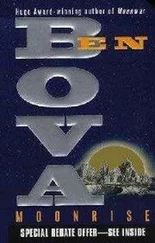
Ben Bova - Moonwar
Здесь есть возможность читать онлайн «Ben Bova - Moonwar» весь текст электронной книги совершенно бесплатно (целиком полную версию без сокращений). В некоторых случаях можно слушать аудио, скачать через торрент в формате fb2 и присутствует краткое содержание. Год выпуска: 1997, ISBN: 1997, Издательство: Hodder & Stoughton, Жанр: Фантастика и фэнтези, на английском языке. Описание произведения, (предисловие) а так же отзывы посетителей доступны на портале библиотеки ЛибКат.

- Название:Moonwar
- Автор:
- Издательство:Hodder & Stoughton
- Жанр:
- Год:1997
- ISBN:0-340-68250-7
- Рейтинг книги:4 / 5. Голосов: 1
-
Избранное:Добавить в избранное
- Отзывы:
-
Ваша оценка:
Moonwar: краткое содержание, описание и аннотация
Предлагаем к чтению аннотацию, описание, краткое содержание или предисловие (зависит от того, что написал сам автор книги «Moonwar»). Если вы не нашли необходимую информацию о книге — напишите в комментариях, мы постараемся отыскать её.
Douglas Stavenger and his dedicated team of scientists are determined to defend their life’s work, but technology-hating factions on Earth want to close the flourishing space colony, Moonbase. Can a combination of military defence and political wisdom save the colony?
Moonwar — читать онлайн бесплатно полную книгу (весь текст) целиком
Ниже представлен текст книги, разбитый по страницам. Система сохранения места последней прочитанной страницы, позволяет с удобством читать онлайн бесплатно книгу «Moonwar», без необходимости каждый раз заново искать на чём Вы остановились. Поставьте закладку, и сможете в любой момент перейти на страницу, на которой закончили чтение.
Интервал:
Закладка:
His face darkening, Faure plopped back onto his chair.
“How long can Moonbase hold out against the Peacekeepers?”
Joanna glanced sideways at Faure, then turned her attention back to the reporters. “Moonbase is physically self-sufficient. They grow enough food to feed themselves, and generate all the electrical power they need from solar cells built out of elements from the lunar regolith—”
“By nanomachines?”
“Yes. Nanomachines are essential to Moonbase. They produce the air we breathe and purify the water we drink. We use them to expand and maintain our solar-energy farms, and—of course—nanomachines build the Clipperships that we sell to the world’s commercial aerospace lines.”
“Are you saying that Moonbase can hold out indefinitely?”
“Yes, of course. Unless the base is attacked by overwhelming military force, which would probably kill most of the people in the base.”
“Mr Faure, will the U.N. attack Moonbase with overwhelming military force?”
Obviously struggling to maintain his self-control, Faure replied, “The United Nations has a responsibility to see that international law is enforced. The nanotechnology treaty forbids all work in nanomachines, yet as you have just heard from the mouth of Mrs Brudnoy, Moonbase insists on continuing its insidious use of nanotechnology.”
“There’s nothing insidious about it,” Joanna said to him. “We’ve been quite open about it.”
“The nanotechnology treaty is quite clear!” Faure snapped. “And it applies to all the nations of the world!”
Coolly, Joanna pointed out, “Moonbase is not on Earth, and the nanomachines we use there never leave the Moon. They are no threat whatsoever to anyone on Earth.”
“The law is the law!” Faure insisted, his moustache twitching slightly.
“And the law states that any nation that does not sign the nanotech treaty is not bound by its restrictions.”
“But Kiribati has signed the treaty.”
“And Moonbase has declared its political independence.”
One of the reporters jumped in with, “Could Moonbase survive without using nanomachines?”
“No,” said Joanna flatly.
“You see?” Faure made a dismissive gesture. “They refuse to abide by the law.”
“We are no threat to anyone on Earth,” Joanna repeated.
“How do we know that for certain?” Faure demanded. “How do we know what your scientists are doing, four hundred thousand kilometers away?”
“Send inspectors to Moonbase,” said Joanna. “We’ve offered to show U.N. inspection teams everything and anything they want to see. The offer still stands.”
A reporter called out from the rear, “You mean you’d allow U.N. inspectors to look over your nanotech operations?”
“Of course,” Joanna replied. “We made that offer at the very beginning. It still stands, if Mr Faure is willing to take us up on it.”
“What about it, sir?”
Faure brushed a fingertip across his moustache before answering. “Of course we have planned to send inspectors to Moonbase. Several of them will fly there on the mercy mission we have just agreed upon. But that does not change the fundamental situation. Moonbase must accede to the law!”
Joanna quickly added, “But if—or, rather, when—the World Court agrees that Moonbase is an independent nation, then the law allows Moonbase to continue using nanotechnology.”
The reporters weren’t interested in the legal fine points anymore. They had something new to deal with.
“You’re sending inspectors to Moonbase?”
“Does this mean some sort of compromise can be worked out?”
“Who will the inspectors be?”
“What are their names? What nations do they come from?”
Faure raised his hands to silence their questions. With a little smile of satisfaction that their attention was once more focused on him, he said, “Please! Please! I cannot divulge all the details at this moment.”
Joanna said to herself, Of course you can’t divulge all the details, you lying little fart. You just made up your mind to send inspectors on the evacuation flight, right here on the spur of the moment.
But she decided not to embarrass him further. Inspectors could be a step toward gaining Moonbase’s independence and she did not want to do anything that would interfere with that.
You’ve won a small victory, Joanna told herself. Be content with that. For now.
“That’s good news,” Jinny Anson said. “Isn’t it?”
Doug had asked Anson and Kris Cardenas to meet him in The Cave to discuss the latest news from Earthside over dinner. Edith sat at Doug’s side, the two other women across the table from them.
Leaning over his dinner tray, Doug said, “It’s good from the political aspect, I suppose.”
“It’s the first break in the deadlock,” said Edith, as she spooned up some chicken soup. It was almost a stew, it was so thick. But it tasted flat and bland to her. She longed for just one little jalapeno.
“I’ll be happy to show the U.N. inspectors our entire nanotech operation,” Cardenas said eagerly. “Of course, if they want to get into Willi’s lab they’ll be on their own.”
Doug almost grinned at the thought of strangers trying to talk Zimmerman into allowing them to inspect his laboratory. Then he thought, On the other hand, Zimmerman might be pleased to have other scientists see what he’s accomplished here.
“But will they be scientists?” he wondered aloud.
“What?” Cardenas asked.
“Will the U.N. inspectors really be scientists, or will they be spies for Faure?” he said.
“Both,” Edith replied immediately.
“Then how much do we really want to show them?”
Anson said, “Everything—except whatever you guys are doing to help defend the base.”
With a rueful smile, Cardenas admitted, “We can show them everything, then. We haven’t come up with anything that’s specifically military in nature.”
“Okay,” said Doug,’then the inspectors will be no trouble.”
“Not unless they rub Willi the wrong way.”
“Does he have a right way?” Anson jabbed.
Doug looked past his table companions. The Cave was almost filled with diners selecting meals at the dispensers, carrying trays to tables, meeting friends. The big rock chamber buzzed with dozens of conversations.
He forced his attention back to the problems at hand. “Jinny, how are you deciding who goes back Earthside on the evac flight?”
Anson shifted mental gears smoothly. “The ballet troupe, of course.”
“Their manager told me he’s going to sue the U.N. for all the dates they’ve missed,” Edith said.
“Lotsa luck,” said Anson.
“That leaves thirty seats on the evacuation ship,” Doug said.
Nodding, Anson replied, “We’re going by contract dates. People whose employment contracts ended the longest time ago get first priority on the evac.”
“Sounds reasonable,” said Doug.
“Plus, we’ve got one pregnant woman,” Anson said.
“Really?” Edith’s interest was immediate. “Who is she? How far along?”
“A couple of months, from what the medical report says.”
“I’d like to interview her before she leaves.”
I’ll set it up,” Anson said.
“What about the father?” Doug asked.
Anson shook her head. “His contract’s up, but there are too many people ahead of him. He’ll have to stay here.”
“Won’t somebody give up his seat so he can go with his wife?” Edith asked.
“They’re not married. Not yet, anyway. And if somebody gave up a seat I’d have to put the next guy in line in it, not the daddy.”
“How far down on the list is he?” Doug asked.
“Eighteenth.”
“You think they’ll get married Earthside?” Cardenas asked.
Читать дальшеИнтервал:
Закладка:
Похожие книги на «Moonwar»
Представляем Вашему вниманию похожие книги на «Moonwar» списком для выбора. Мы отобрали схожую по названию и смыслу литературу в надежде предоставить читателям больше вариантов отыскать новые, интересные, ещё непрочитанные произведения.


Обсуждение, отзывы о книге «Moonwar» и просто собственные мнения читателей. Оставьте ваши комментарии, напишите, что Вы думаете о произведении, его смысле или главных героях. Укажите что конкретно понравилось, а что нет, и почему Вы так считаете.