Ben Bova - Moonwar
Здесь есть возможность читать онлайн «Ben Bova - Moonwar» весь текст электронной книги совершенно бесплатно (целиком полную версию без сокращений). В некоторых случаях можно слушать аудио, скачать через торрент в формате fb2 и присутствует краткое содержание. Год выпуска: 1997, ISBN: 1997, Издательство: Hodder & Stoughton, Жанр: Фантастика и фэнтези, на английском языке. Описание произведения, (предисловие) а так же отзывы посетителей доступны на портале библиотеки ЛибКат.
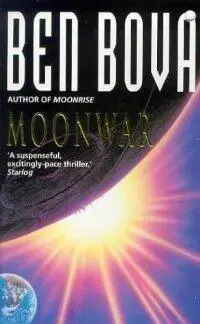
- Название:Moonwar
- Автор:
- Издательство:Hodder & Stoughton
- Жанр:
- Год:1997
- ISBN:0-340-68250-7
- Рейтинг книги:4 / 5. Голосов: 1
-
Избранное:Добавить в избранное
- Отзывы:
-
Ваша оценка:
Moonwar: краткое содержание, описание и аннотация
Предлагаем к чтению аннотацию, описание, краткое содержание или предисловие (зависит от того, что написал сам автор книги «Moonwar»). Если вы не нашли необходимую информацию о книге — напишите в комментариях, мы постараемся отыскать её.
Douglas Stavenger and his dedicated team of scientists are determined to defend their life’s work, but technology-hating factions on Earth want to close the flourishing space colony, Moonbase. Can a combination of military defence and political wisdom save the colony?
Moonwar — читать онлайн бесплатно полную книгу (весь текст) целиком
Ниже представлен текст книги, разбитый по страницам. Система сохранения места последней прочитанной страницы, позволяет с удобством читать онлайн бесплатно книгу «Moonwar», без необходимости каждый раз заново искать на чём Вы остановились. Поставьте закладку, и сможете в любой момент перейти на страницу, на которой закончили чтение.
Интервал:
Закладка:
“Did they take my broadcast chip?” she asked herself, wondering for the first time if Global would accept anything she sent from Moonbase.
She sank back in her chair, thinking hard. It was well past midnight at Moonbase. A few stabs at the keyboard on her desk brought up the information that it was 7:23 p.m. in Atlanta.
Manny’ll be home, knocking back his first cocktail of the evening, she thought. Good!
But how to get him, if neither the commsats nor Global’s private antennas were taking calls from the Moon?
She hated to call Doug and admit she couldn’t get through on her own, especially since the guy was probably asleep at this time of night. Yet she couldn’t think of anything else to do.
Doug’s face popped up on her smart wall immediately. He was wide awake, still dressed, at his desk.
He listened to her problem, then showed her how to route calls through Kiribati. Edith thanked him, keeping her face serious, strictly business. Yet she found herself feeling glad that he wasn’t in bed with someone else.
It took a few minutes more, but the wait was worth it once she saw Manny’s look of shock when he recognized who was calling him.
“Edie! You’re in Kiribati?”
“No, I’m still at Moonbase. How come y’all aren’t taking calls from here?”
In the three seconds it took for his reply to reach her, Manny’s surprised expression knitted into a frown. “That’s not my doing, kiddo. If it were up to me I’d keep a special link open to you twenty-four hours a day.”
“Well, put your drink down and get on it, then,” Edith said sternly.
“We’re getting everything you send,” he said, looking worried, guilty. “We’re just not allowed to acknowledge receiving your transmissions.”
“Not allowed? By who?”
For three seconds she waited, and got, “Whom.”
“Don’t smart-ass me, Manny. Who’s not allowing what?”
Manny took a long pull from the old-fashioned glass he was holding before replying. “Orders from the very top,” he said.
“McGrath himself?”
“That’s right. He wants us to cooperate in every way we can with the U.N.”
“You mean he won’t run the stuff I sent? Eyewitness report of the Peacekeeper’s death?”
Manny shrugged. “I’m trying to get it past the suits upstairs, Edith. Honest I am.”
“Honestly,” she muttered.
“Honestly,” he said, three seconds later.
“This is a weird situation,” Edith said.
“Tell me about it.”
For more than twenty-four tense hours, Joanna feared that the Peacekeepers were going to keep her and Lev in Corsica. When their Clippership landed at the Peacekeeper base, the two of them were shuffled through several layers of bureaucracy, including the most thorough medical examinations they had undergone in years.
“You will need a few days to adjust to terrestrial gravity,” the chief doctor told her and her husband, from behind his metal desk.
In truth, Joanna did feel the sullen weight of Earth more than she had expected. She had spent more time on the Moon than on Earth for a quarter-century now, but she always exercised every day while in Moonbase and never considered her returns to Earth as health-threatening.
“I’ll be fully adjusted in another few hours,” Joanna said. She glanced at Lev, who seemed blithely unaffected by the six-fold increase in gravity.
The doctor shook his head good-naturedly. “No, I am afraid it will take several days, at least.”
He was a smiling, plump, golden-skinned Chinese with many chins and rolls of fat showing at the open-necked collar of his short-sleeved Peacekeeper tunic. Joanna thought he might have been the model for statues of the happy Buddha that she had seen in gift shops. He spoke with a cultivated British accent, which sounded very strange coming from his round, almond-eyed Chinese face.
Joanna smiled back at him, coldly. “Doctor, have you found anything in the examinations your people have given us to indicate a health problem?”
“No,” he said, drawing the word out. “But still the effects of increased gravity must be taken into account.”
Sweetening her smile, Joanna asked, “You’re waiting for the results of our blood tests, aren’t you? You’re stalling for time until you learn whether or not there are nanomachines in our blood streams.”
The doctor’s fat-enfolded eyes widened for just a heartbeat. Then he folded his hands across his ample belly and admitted, “Just so. We must be extremely careful about allowing nanomachines into the terrestrial environment.”
Satisfied, Joanna replied, “We’re not harboring nanomachines.”
“We are not Trojan horses,” Brudnoy chipped in.
“But you have both undergone nanotherapy on the Moon, haven’t you?” the doctor asked.
“No,” Brudnoy replied simply. “I’ve never had to, although I admit as I get older the temptation grows stronger.”
“It does?”
Scratching at his beard, the Russian explained, “Each morning brings a new ache. My eyesight isn’t what it used to be. My prostate is growing.”
“That is natural,” said the doctor.
“Yes, but my nanotech friends tell me that they could bring my eyesight back to twenty-twenty and shrink my prostate back to normal and strengthen my poor old muscles, with nanomachines.”
Joanna looked at her husband with new eyes. Lev had never complained, she had never had an inkling that he felt his years. In bed he was as vigorous as men half his age. But if he feels old and creaky on the Moon, he must be in agony now, here. Yet he won’t show it, not even to me.
She reached out and grasped his hand. He looked surprised, then grinned sheepishly at her.
The doctor was oblivious to their byplay. He said to Joanna, “But you, Mrs Brudnoy, you have used nanomachines, haven’t you?”
Joanna nodded easily. “Many times. For cosmetic reasons, mainly, although I’ve had them scrub plaque from my arteries more than once.”
“You see?” the doctor said, as if she had just confessed to a crime. “We cannot take the risk of having nanomachines infect our terrestrial environment.”
“Doctor, I’m surprised to hear such nonsense from an educated man,” Joanna said.
“Nonsense?”
“Of course it’s nonsense. To begin with, there are no nanomachines in me. I underwent therapy and then the machines were flushed out, quite naturally.”
“How can you be sure—”
“They know the number of machines they put in,” Brudnoy explained, “and they count the number that come out. It’s quite simple.”
“But they could multiply inside the body, couldn’t they?”
“Only if they’re programmed to do so,” said Brudnoy.
Before the doctor could reply, Joanna went on, “Second, and more important, is that nanomachines are machines. They are not alive. They cannot mutate and change. What if there were a few nanomachines left in my bloodstream? What harm could they do, even if they got loose into your environment?”
“That depends on what they were designed to do, I should think.”
“Yes.” Joanna’s smile returned. “If a few got into you, for example, they might remove some of the fat you’ve accumulated.”
For an instant she did not know how the doctor would respond. He stared at her as he digested her words. Then his round pudgy face opened into a hearty laughter.
“Nanomachines could make me slim!” he gasped. “I could eat whatever I like and still become thin!”
Joanna leaned back in the stiff metal chair, thinking that she had won the man over.
But his laughter died away. “All this may be very true, but suppose you are carrying nanomachines that are harmful?”
“Harmful?”
Leaning his heavy forearms on his desk, the doctor said, “You are assuming that the specialists who treated you with nanomachines are benign people. Suppose they are not? Suppose they put into you nanomachines that can…” he fished for an appropriate subject.
Читать дальшеИнтервал:
Закладка:
Похожие книги на «Moonwar»
Представляем Вашему вниманию похожие книги на «Moonwar» списком для выбора. Мы отобрали схожую по названию и смыслу литературу в надежде предоставить читателям больше вариантов отыскать новые, интересные, ещё непрочитанные произведения.

Обсуждение, отзывы о книге «Moonwar» и просто собственные мнения читателей. Оставьте ваши комментарии, напишите, что Вы думаете о произведении, его смысле или главных героях. Укажите что конкретно понравилось, а что нет, и почему Вы так считаете.