Ben Bova - Moonwar
Здесь есть возможность читать онлайн «Ben Bova - Moonwar» весь текст электронной книги совершенно бесплатно (целиком полную версию без сокращений). В некоторых случаях можно слушать аудио, скачать через торрент в формате fb2 и присутствует краткое содержание. Год выпуска: 1997, ISBN: 1997, Издательство: Hodder & Stoughton, Жанр: Фантастика и фэнтези, на английском языке. Описание произведения, (предисловие) а так же отзывы посетителей доступны на портале библиотеки ЛибКат.
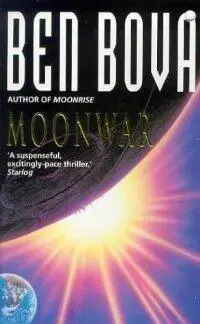
- Название:Moonwar
- Автор:
- Издательство:Hodder & Stoughton
- Жанр:
- Год:1997
- ISBN:0-340-68250-7
- Рейтинг книги:4 / 5. Голосов: 1
-
Избранное:Добавить в избранное
- Отзывы:
-
Ваша оценка:
Moonwar: краткое содержание, описание и аннотация
Предлагаем к чтению аннотацию, описание, краткое содержание или предисловие (зависит от того, что написал сам автор книги «Moonwar»). Если вы не нашли необходимую информацию о книге — напишите в комментариях, мы постараемся отыскать её.
Douglas Stavenger and his dedicated team of scientists are determined to defend their life’s work, but technology-hating factions on Earth want to close the flourishing space colony, Moonbase. Can a combination of military defence and political wisdom save the colony?
Moonwar — читать онлайн бесплатно полную книгу (весь текст) целиком
Ниже представлен текст книги, разбитый по страницам. Система сохранения места последней прочитанной страницы, позволяет с удобством читать онлайн бесплатно книгу «Moonwar», без необходимости каждый раз заново искать на чём Вы остановились. Поставьте закладку, и сможете в любой момент перейти на страницу, на которой закончили чтение.
Интервал:
Закладка:
Faure made a visible effort to calm himself. “Madame Brudnoy, you know and I know that this so-called declaration of independence is nothing more than the smoke screen, the camouflage to disguise the fact that you wish to continue using nanotechnology and evade the conditions of the treaty.”
“But you intend to continue using nanotechnology once you’ve taken over Moonbase,” Joanna said.
Once he heard her words, Faure’s face went from red to white, as if someone had slapped him.
He took a deep breath, then said evenly, “What makes you think that?”
Smiling, Joanna replied, “Don’t you think I have contacts inside Yamagata Corporation? Several of the board members of Masterson Corporation are also on Yamagata’s board.”
Faure sat in silence for several moments. Then he made a little shrug and admitted, “It is entirely possible that we will allow some work on nanomachines to continue, once we have taken over operation of Moonbase.”
“Moonbase will continue to supply water to Nippon One,” Joanna said flatly, not making a question of it.
Reluctantly, Faure nodded.
“And Moonbase will continue to manufacture spacecraft using nanomachines,” she added.
“Only temporarily,” Faure replied once he heard her words. “You have contracts with various international transport companies. The United Nations will see that those contractual obligations are fulfilled.”
“Of course,” said Joanna graciously. “And by the time all our backlog orders have been filled, the United Nations will find that nanomanufacturing can be quite profitable. And not harmful in the slightest. Right?”
Faure leaned tensely toward the camera. “Madame Brudnoy, the nanotechnology treaty exists because of the fears that nanomachines have created. Your own husband was killed by nanomachines, was he not?”
Joanna kept herself from flinching. I should have expected that, she told herself.
Without pausing, Faure went on, “Nanotechnology can produce insidious weapons, deadly weapons. Nanomachines can kill, as you well know. A mistake, an error, and runaway nanomachines could devour everything in their path, like those armies of ants in South America that devastate entire landscapes and leave nothing alive in their wake.”
His moustache bristling with fervor, Faure continued, “We cannot have nanomachines on Earth! No matter what glorious benefits they promise, we cannot take the risk that they present to us.”
“But we’re not on the Earth. You could allow nanomanufacturing here on the Moon,” said Joanna.
He replied, “I am willing to allow it on a temporary, experimental basis—under United Nations’ control.”
With sudden understanding, Joanna said, “Because Yamagata insisted on it. And if Yamagata didn’t go along with you, then the Japanese government would oppose your takeover of Moonbase and you can’t afford to have them against you.”
She realized that that was the truth of it. If Japan opposed Faure’s plans, a whole bloc of opposition would arise in the U.N.
“You are very perspicacious,” Faure said. He leaned back in his chair, seemed to relax. “But the facts are that Japan supports my efforts and the Peacekeepers will be landing at Moonbase in less than twenty hours. Fait accompli!”
“And who’s going to run Moonbase after the Peacekeepers land?”
Once Faure heard her question, he smiled like the Chesire cat. “Why, who else but specialists from Yamagata Corporation?”
Joanna could not have been more stunned if Faure had leaped across the quarter-million miles separating them and punched her. She simply sat in her armchair, mouth hanging open, while Faure smiled his widest at her.
TOUCHDOWN MINUS 17 HOURS 38 MINUTES
Dr Hector Montana was not known for his bedside manner. He was a brusque, no-nonsense physician who had spent most of his career dealing with factory workers, construction crews, and industrial accidents. He was a capable surgeon and, thanks to Moonbase’s electronic communications systems, he could consult and even work with virtually any physician on Earth.
Until the war sprang up.
Now he scowled openly at the young couple sitting tensely before his desk. He was a slim, pinch-faced man with graying hair combed straight back off his low forehead. His skin was the color of sun-dried adobe. His profile looked as if it had been carved by an ancient Mayan: high cheekbones, prominent nose.
“Pregnant.” He made the word sound like an accusation.
“Yes,” said Claire Rossi. “There’s no doubt about it.”
“I’m not an obstetrician.”
“Yes, but we thought you should know.”
O’Malley spoke up, “I want to make sure she gets the best medical attention possible.”
“Then you should’ve taken some precautions beforehand,” Dr Montana snapped. “We don’t have facilities for this sort of thing here.”
Nick bulled his shoulders forward slightly, matching the physician’s frown with one of his own. “We don’t need facilities, for God’s sake. I just want to see that she gets the proper care.”
“I can’t even get in touch with other medical centers back on Earth,” Montana grumbled. “We’ve been blacked out.”
“Surely this emergency will be over with soon enough for me to go back Earthside,” said Claire. As chief of the personnel department, she knew Moonbase’s policy perfectly well. Pregnant women were shipped back Earthside before their pregnancies became so advanced that rocket flight was not recommended.
“And what if it isn’t?” Montana snapped.
“Then you’ll have to take care of her,” O’Malley said, with more than a hint of belligerence in his voice. “You’re a doctor, aren’t you?”
“You want my considered medical advice? Abort it. Get rid of it now, to be on the safe side. There’s no telling how long this stupid blockade is going to last.”
“We can’t!” O’Malley said.
“You’re young enough to have a dozen babies. This one is bad timing, that’s all.”
“I won’t,” Claire said quietly.
“You’re both Catholic, is that it?” Montana’s voice softened slightly. “I am too. The Church won’t—”
“We’re not going to have an abortion,” O’Malley said, his voice darkening. “And that’s final.”
Montana huffed at him. “Well, maybe the Peacekeepers will take over the base and send us all back home.”
TOUCHDOWN MINUS 12 HOURS 22 MINUTES
Doug stood atop a house-sized boulder and watched the drivers park their tractors on the three unoccupied landing pads of the rocket port. The half-built Clippership that had been towed onto the fourth pad gleamed in the starlight.
Jinny Anson, recognizable by the bright rings of butter yellow on the arms of her bulky spacesuit, stood beside him.
“Okay,” her voice said in his helmet earphones, “we clutter up the landing pads so they can’t use ’em. But they can still put down on the crater floor just about anywhere they want to.”
Doug nodded inside his helmet. Jinny was right. Alphonsus’s floor was flat enough for a Clippership to set down. The ground was cracked with rilles, pockmarked with small craters and strewn with rocks, but there were plenty of open spaces where a good pilot could make a landing.
“All you’re doing is forcing ’em to sit down a kilometer or so farther away from our main airlock,” Anson went on. “What good’s that going to do?”
“Maybe none,” Doug admitted. “But I sure as hell don’t intend to let them use our landing pads.”
He sensed Anson shrugging inside her suit.
“Jinny, it’s just about the only chance we’ve got, other than just folding up and surrendering.”
Читать дальшеИнтервал:
Закладка:
Похожие книги на «Moonwar»
Представляем Вашему вниманию похожие книги на «Moonwar» списком для выбора. Мы отобрали схожую по названию и смыслу литературу в надежде предоставить читателям больше вариантов отыскать новые, интересные, ещё непрочитанные произведения.


Обсуждение, отзывы о книге «Moonwar» и просто собственные мнения читателей. Оставьте ваши комментарии, напишите, что Вы думаете о произведении, его смысле или главных героях. Укажите что конкретно понравилось, а что нет, и почему Вы так считаете.