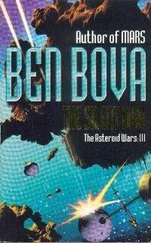
Ben Bova - Moonwar
Здесь есть возможность читать онлайн «Ben Bova - Moonwar» весь текст электронной книги совершенно бесплатно (целиком полную версию без сокращений). В некоторых случаях можно слушать аудио, скачать через торрент в формате fb2 и присутствует краткое содержание. Год выпуска: 1997, ISBN: 1997, Издательство: Hodder & Stoughton, Жанр: Фантастика и фэнтези, на английском языке. Описание произведения, (предисловие) а так же отзывы посетителей доступны на портале библиотеки ЛибКат.

- Название:Moonwar
- Автор:
- Издательство:Hodder & Stoughton
- Жанр:
- Год:1997
- ISBN:0-340-68250-7
- Рейтинг книги:4 / 5. Голосов: 1
-
Избранное:Добавить в избранное
- Отзывы:
-
Ваша оценка:
Moonwar: краткое содержание, описание и аннотация
Предлагаем к чтению аннотацию, описание, краткое содержание или предисловие (зависит от того, что написал сам автор книги «Moonwar»). Если вы не нашли необходимую информацию о книге — напишите в комментариях, мы постараемся отыскать её.
Douglas Stavenger and his dedicated team of scientists are determined to defend their life’s work, but technology-hating factions on Earth want to close the flourishing space colony, Moonbase. Can a combination of military defence and political wisdom save the colony?
Moonwar — читать онлайн бесплатно полную книгу (весь текст) целиком
Ниже представлен текст книги, разбитый по страницам. Система сохранения места последней прочитанной страницы, позволяет с удобством читать онлайн бесплатно книгу «Moonwar», без необходимости каждый раз заново искать на чём Вы остановились. Поставьте закладку, и сможете в любой момент перейти на страницу, на которой закончили чтение.
Интервал:
Закладка:
Inside was nothing but carnage, a smoking wreckage of pipes and pumps, water gushing out into a crater ripped into the rock floor. Water! Being wasted, sloshing around across the floor, running out of pipes blasted loose and dangling from shattered supports.
Coughing as she advanced into the smokey ruins, Anson saw that the blast had dug a crater into the rock floor and water from the broken pipes was rushing into it.
“Get those pipes shut off,” she said to the maintenance team. “Turn off that water flow.”
“Water could leak into the tunnel below,” one of the men said.
Anson shook her head. “Doesn’t look like the crater’s deep enough. The blast didn’t penetrate into the lower level.”
A woman engineer pointed out, “Maybe so, but the water’s flowing into the piping and conduits between levels. Could short out the electrical lines.”
“Jesus on jet skis!” Anson growled. “If water seeps into the main distribution station…”
“Blackout,” said the engineer.
“First thing is to stop the incoming flow,” she said, pointing to the maintenance crew already working on the ends of the shattered pipes.
This water’s come all the way from the south pole, Anson told herself. And some brain-dead geek has to blast the factory apart and splash it all over the base. It was sacrilegious to her, to any of the old-time Lunatics, to waster precious water.
“How can we remove the water that’s already pooling in the crater?” the engineer asked. “It must be seeping along the conduits already.”
Anson’s answer was immediate. “We vacuum it out!”
“Huh?”
Doug sat frozen in front of his console, his mind spinning. Suicide bombers. Religious fanatics. How do we stop them? They’ve already knocked out the water factory and Zimmerman’s lab. The EVC and the electrical center and the farm are farther inside the base; the kamikazes haven’t had time to reach that far yet. But the colonel said one of them is supposed to hit the control center. Why isn’t he here yet?
“Bam,” he said, turning to Gordette. “Get teams of people to guard the EVC—”
“And the other points, I know,” Gordette replied. “We can use the guns we captured. Shoot the bastards soon’s they open the ceiling vents.”
“If you can do that without setting off their explosives.”
Gordette shrugged. “Don’t make that much never-mind, one way or the other, does it?”
Reluctantly, Doug admitted, “No, I guess not. But we’ve got to try something.’
“True enough,” Gordette agreed.
A comm tech’s voice in his earphone called, “Urgent call from Anson at the water factory.”
“What is it, Jinny?” Doug asked.
There was no video from the water factory, only Anson’s tight, excited voice.
“You’ve got to open the plasma vents to vacuum,” she said, without preamble. “That’s the only way to suck the loose water out of here. Otherwise it’s going to seep down to the electrical distribution station and short out the whole goddamned base, I betcha.”
“Open the vents to vacuum?”
“Right.”
“But you’ve got people in the water factory.”
“We’ll be outta here in five minutes, tops. The place is a complete wreck. Got a team turning off the incoming stream but there’s a crater filling up with water and it’s seeping into the pipes and conduits between levels.”
Doug glanced at the big electronic schematic of the entire base on the wall above him. The water factory was dark, and he saw that one section of living quarters on the lower level had already blacked out.
“We’re getting shorts in residential tunnel two,” he said.
“Open the vents!” Anson urged. “Before the whole damned base shorts out!”
“Will do,” he said, adding silently, If the controls still work.
“Give me five minutes to get my people out of here,” Anson added.
“Will do,” Doug repeated.
It took almost that long to call up the ancient program that operated the plasma vent baffles. There were two out at the mountain face, and single baffles spaced almost haphazardly along the old vents, hinged to flap open in one direction only—outward—like the valves in a human body’s arteries.
He remembered that many of those partitions had been very tough to open when he’d crawled through the vents, seven years earlier. Hinges caked with lunar dust, almost welded shut. Will their motors work? Will they respond to the program commands?
A shadow fell across him and he looked up. Gordette was standing over him with an assault rifle held across his chest.
Before Doug could ask, Gordette smiled grimly and said, “I’m guarding the control center. Security’s sent teams out to the other areas to guard them. They told me to stay here with you; they didn’t want me with them.”
Doug didn’t have time to worry about Gordette’s feelings.
Blinking with a sudden idea, he said, as much to himself as to Gordette, “If we open all the plasma vents we might flush out any of the kamikazes crawling through them.”
Gordette’s brows rose a half-centimeter, but he said nothing.
“Especially if we start pumping high-pressure air into the far end of each of the vents,” Doug muttered. “We’ll turn those old vents into wind tunnels!”
He called Vince Falcone over to him, hurriedly explained what he wanted, and then hunched over his keypad and began banging away at it.
PLASMA VENT TUNNEL
It was easy to become disoriented in the dark, empty plasma vent tunnels. Crawling along inside a spacesuit with a hundred kilos of explosive strapped to your waist did not make the job any simpler.
But I’ll get there, Amos Yerkes told himself. I have the most difficult assignment, but I’ll carry it out. They gave me the farthest target, the hardest one to reach, because they know I’m the best of the batch. The others needed drugs to buck up their courage but I’ve never touched them. I’m better than they are and they know it. That’s why they’ve entrusted me with the most demanding task: blowing up their environmental control center.
Yerkes was twenty-two and considered himself a failure as a son and as a man. But this is one thing I will not fail at. “Nothing in my life,” he slightly misquoted Shakespeare, “will so become me as my leaving of it.”
In the light of his helmet lamp he saw another of those dreadful partitions. It had taken him far longer to open the last few than he had thought it would. Hours, it seemed. They were all stuck fast, and he had been sweating inside his spacesuit before he could pull them down on their creaking hinges. Then, once he had crawled over them, they had each snapped shut again with a startling clang that could probably be heard over the length and breadth of the base.
This partition was no different: a thin baffle of metal, hinged on the bottom. Stuck fast with caked dust. Yerkes brushed doggedly at the dust with his gloved fingers, wishing he could open his visor and blow the stuff out of his way. But he had been ordered to keep his spacesuit sealed, just in case the vent tunnels did not hold air as they believed.
As he worked, sweat stinging his eyes, he pictured the services that would be held in his honor back in Atlanta. General O’Conner himself will give the eulogy, he thought. My parents will cry and wish they had treated me better.
Vince Falcone was grateful for the Moon’s low gravity as he and six other men trundled heavy cylinders of oxygen down the corridor toward the environmental control center.
Doug’s idea was wild, Falcone thought, but he couldn’t think of anything better.
This had better work, he told himself. Otherwise we’ll all be dead in another half-hour or so.
Читать дальшеИнтервал:
Закладка:
Похожие книги на «Moonwar»
Представляем Вашему вниманию похожие книги на «Moonwar» списком для выбора. Мы отобрали схожую по названию и смыслу литературу в надежде предоставить читателям больше вариантов отыскать новые, интересные, ещё непрочитанные произведения.







Обсуждение, отзывы о книге «Moonwar» и просто собственные мнения читателей. Оставьте ваши комментарии, напишите, что Вы думаете о произведении, его смысле или главных героях. Укажите что конкретно понравилось, а что нет, и почему Вы так считаете.