Ben Bova - Exiled from Earth
Здесь есть возможность читать онлайн «Ben Bova - Exiled from Earth» весь текст электронной книги совершенно бесплатно (целиком полную версию без сокращений). В некоторых случаях можно слушать аудио, скачать через торрент в формате fb2 и присутствует краткое содержание. Год выпуска: 1971, ISBN: 1971, Издательство: E. P. Dutton, Жанр: Фантастика и фэнтези, на английском языке. Описание произведения, (предисловие) а так же отзывы посетителей доступны на портале библиотеки ЛибКат.
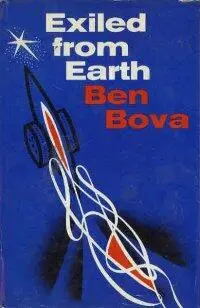
- Название:Exiled from Earth
- Автор:
- Издательство:E. P. Dutton
- Жанр:
- Год:1971
- ISBN:0-525-29425-2
- Рейтинг книги:5 / 5. Голосов: 1
-
Избранное:Добавить в избранное
- Отзывы:
-
Ваша оценка:
Exiled from Earth: краткое содержание, описание и аннотация
Предлагаем к чтению аннотацию, описание, краткое содержание или предисловие (зависит от того, что написал сам автор книги «Exiled from Earth»). Если вы не нашли необходимую информацию о книге — напишите в комментариях, мы постараемся отыскать её.
Exiled from Earth — читать онлайн бесплатно полную книгу (весь текст) целиком
Ниже представлен текст книги, разбитый по страницам. Система сохранения места последней прочитанной страницы, позволяет с удобством читать онлайн бесплатно книгу «Exiled from Earth», без необходимости каждый раз заново искать на чём Вы остановились. Поставьте закладку, и сможете в любой момент перейти на страницу, на которой закончили чтение.
Интервал:
Закладка:
The Chairman listened patiently to their story, nodding and rocking in his big leather chair, steepling his fingers from time to time, even smiling once or twice. Then Lou finished talking.
For a long moment, the Chairman said nothing. Finally, “Your ingenuity amazes me, in a way. And yet, somehow, I am not truly surprised that you have come up with an amazing idea.” He looked at the three of them, his dark eyes clear despite his many other signs of age.
“I will not presume to comment on why you want to leave our world entirely,” the Chairman said. “I suppose that even death among the stars is preferable to you than a long life of exile.” He laughed, softly, to himself. “I never expected to be faced with such a decision. I never expected man’s first attempt to reach the stars would be made under conditions such as we find ourselves in.”
“Then you’ll allow us to go?” Lou asked eagerly. “You’ll help us, you’ll give us the engines and …”
The Chairman silenced him with a spindly upraised finger. “You say that there are many among you who are opposed to this idea… many who do not wish to fly toward the stars.”
“Yes,” Lou admitted. “Our work to date has simply shown that it’s physically possible for us to make the journey. Dr. Kaufman and many of the others—especially the older people—don’t want any part of it.”
The chairman sighed. “You realize, of course, that it all comes down to a question of money. Everything does, it seems. Sooner or later.”
“Money?”
Nodding, the Chairman explained, “It will take billions to outfit your satellite for a journey to the stars—”
“We’ve figured that out,” Lou said. “It’s expensive, but still cheaper than keeping us in orbit indefinitely. This way, you pay one big bill and we’re gone. If you keep us, you’ll have to feed us, doctor us, everything—”
“I feel like Pharaoh arguing against Moses,” the Chairman complained. “I would be perfectly willing to spend what must be spent and help you on your way, if that is what you wish. But—what of those who don’t wish it? I cannot keep some of you in orbit and still spend the money necessary to send the rest of you out to the stars. It must be one or the other. It cannot be both.”
“Then we’ll have to vote on it,” Lou said.
“Yes,” said the Chairman. “I suppose you will.”
So they left the Chairman’s office, went back down the whispering elevator and into the car that took them back through the semitropical seaside farms of Sicily, toward the rocket field. But now the grass and sunshine and cottages were cruelties, sadistic reminders that the satellite, was real and permanent and they were only visitors in this beautiful world; their prison awaited them.
They rode in the back of the open turbocar in silence, eyes wide and all senses alert to drink in every sight and sound and fragrance that had been commonplace all their lives but now were small miracles that they could never expect to experience again.
A second car followed a discreet distance behind them, and somewhere overhead a helicopter droned lazily. They were prisoners, no doubt of it.
As they got close enough to the rocket field to see the stubby shuttles standing in a row, Bonnie turned to Lou.
“You shouldn’t have brought me with you today, Lou. You shouldn’t have.”
Surprised, “What? Why not?”
“Because I’m not as strong as you are,” she said, shouting over the wind and turbine whine. “I… Lou, I can’t leave all this, not permanently. It’s bad enough in the satellite, when you can see the Earth outside the viewports. But to leave forever… to go out into that blackness… Lou, I can’t do it. If they vote for going to the stars, I’ll come back to Earth.”
“But I thought…”
Even Kori, sitting on the other side of Bonnie, looked shocked.
“I’m sorry, Lou… I can’t help it. I checked this morning. The government will still let me return, if I want to. I can’t leave Earth forever, Lou. I just can’t!”
“But… I love you, Bonnie. I can’t leave without you.”
She put her head down and cried.
22
Lou sat tensely in front of the Tri-V cameras. Next to him sat Dr. Kaufman, in an identical sling chair that creaked under his weight.
They were in the special compartment that had been turned into a Tri-V studio. Everyone in the satellite was watching them as they explained their positions on Lou’s starship proposal.
As Dr. Kaufman spoke in his vigorous, emphatic manner, driving points home with the accusatory thrusts of a stubby forefinger, Lou’s mind was far away.
He kept seeing Bonnie’s stricken face when she admitted that she would never go with him to the stars. Kept seeing the green countryside, the lemon orchards and vineyards, the safe blue sky and friendly sea that he would never visit again.
“I can’t leave Earth forever, Lou. I just can’t!”
Can I? he wondered. Can any of us? Turn our backs on the whole world, on a billion years of evolution? Is that what I want them to do? Is it what I want to do?
Dr. Kaufman was saying, “It is desperately important that we all realize exactly what is involved here. No one has ever built a manned starship. No one has even attempted to. You all know that we get supplies from Earth, every week. Even though we have closed-cycle air and water systems, we still need replenishments of air and water at least once a month.
“As long as we remain in orbit around the Earth we can get those supplies and replenishments whenever we need them. But if we leave Earth, if we try this foolhardy scheme for going to the stars, we must have air and water and food systems that are absolutely foolproof. Now, I realize that manned missions to Jupiter and Saturn have used closed-cycle systems, and they’ve worked quite well for periods of up to six years.
“But this star-roving we’re talking about will take decades! Perhaps a century or even more! Why, none of us are even sure that a truly Earth-like planet exists out among the stars.”
Kaufman shook his head, making a lock of his gray mane tumble over his forehead. “No, this star-roving idea is too risky, even on purely technical grounds. We just don’t know how to build a starship. And even if the best engineers on Earth were assigned by the government to help us, we wouldn’t be able to keep the ship in working order, once we left Earth. We wouldn’t be able to repair it and maintain it. How many engineers are there among us? A handful. We’re research scientists, not grease monkeys!”
Lou was listening with only half his mind. The other half was remorselessly reminding him: Life is ruled by the laws of thermodynamics, just as all physical processes are. You can’t get anything without paying the price. Not anything. If you want the stars, you must leave Bonnie behind. If you want Bonnie, the price is perpetual imprisonment.
What’s the difference? he asked himself. Would it be so different, pushing this beryllium nuthouse toward the stars? We’re all going to spend our lives inside this shell, wherever it’s going.
He answered himself, Don’t try to cop out. Heading for the stars gives everybody an aim, a purpose. Staying here is riding an orbital merry-go-round for the rest of your life, without hope, without anything but that big blue world hanging in front of your eyes, reminding you every minute of what’s been taken away.
“And remember,” Kaufman was saying, “that as long as we stay in orbit here, there’s always the chance that the government will have a change of heart, that we’ll be freed. Once we break away, once we start out for the stars, there can be no turning back. It’s an irrevocable step. None of us will live to see us reach our destination. Our children will age and die aboard this vehicle. Perhaps our grandchildren may find a world they can live on. Perhaps. That’s a very thin hope on which to hang the lives of every man, woman, and child among us.”
Читать дальшеИнтервал:
Закладка:
Похожие книги на «Exiled from Earth»
Представляем Вашему вниманию похожие книги на «Exiled from Earth» списком для выбора. Мы отобрали схожую по названию и смыслу литературу в надежде предоставить читателям больше вариантов отыскать новые, интересные, ещё непрочитанные произведения.

Обсуждение, отзывы о книге «Exiled from Earth» и просто собственные мнения читателей. Оставьте ваши комментарии, напишите, что Вы думаете о произведении, его смысле или главных героях. Укажите что конкретно понравилось, а что нет, и почему Вы так считаете.