Mack Reynolds - Equality - In the Year 2000
Здесь есть возможность читать онлайн «Mack Reynolds - Equality - In the Year 2000» весь текст электронной книги совершенно бесплатно (целиком полную версию без сокращений). В некоторых случаях можно слушать аудио, скачать через торрент в формате fb2 и присутствует краткое содержание. Год выпуска: 1977, ISBN: 1977, Издательство: Ace Books, Жанр: Фантастика и фэнтези, на английском языке. Описание произведения, (предисловие) а так же отзывы посетителей доступны на портале библиотеки ЛибКат.
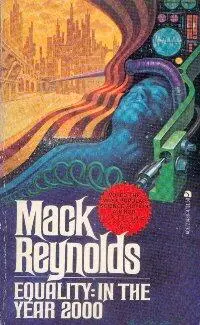
- Название:Equality: In the Year 2000
- Автор:
- Издательство:Ace Books
- Жанр:
- Год:1977
- ISBN:0-441-21430-4
- Рейтинг книги:3 / 5. Голосов: 1
-
Избранное:Добавить в избранное
- Отзывы:
-
Ваша оценка:
Equality: In the Year 2000: краткое содержание, описание и аннотация
Предлагаем к чтению аннотацию, описание, краткое содержание или предисловие (зависит от того, что написал сам автор книги «Equality: In the Year 2000»). Если вы не нашли необходимую информацию о книге — напишите в комментариях, мы постараемся отыскать её.
Equality: In the Year 2000 — читать онлайн бесплатно полную книгу (весь текст) целиком
Ниже представлен текст книги, разбитый по страницам. Система сохранения места последней прочитанной страницы, позволяет с удобством читать онлайн бесплатно книгу «Equality: In the Year 2000», без необходимости каждый раз заново искать на чём Вы остановились. Поставьте закладку, и сможете в любой момент перейти на страницу, на которой закончили чтение.
Интервал:
Закладка:
“All the old virtues are topsy-turvy,” Sean muttered. “For instance, anybody at all can dial as much pornography as he wants from the International Data Banks. You should see some of it. A six-year-old kid can look at it if he wants.”
Julian was looking thoughtful. “I’ve argued some of this with Academician Leete and his family. What he points out is that with this new system of the International Data Banks, it’s the best people, those with the highest Aptitude Quotient, who wind up running the country. The rest aren’t needed.”
“Ah?” Harrison said triumphantly. “Who says they’re the best? A bunch of machines! There are some things, Mr. West, a machine can’t measure.”
“The whole idea rather turned me off at the beginning,” Julian admitted. “But Academician Leete has some strong arguments and I don’t have much material to base my disagreements on. Whom can’t the computers measure?”
Harrison, in his enthusiasm, was on his feet. “Whom can’t they measure? The men who count most. The men who have counted most down through the centuries. Men with the dream, with the urge for power, with ruthless ambition, men of aggression, of charisma. The men whose ambition is such that the whole world is pushed forward as a result of their efforts.”
“Such as whom?” Julian said, his voice skeptical.
Harrison nodded at the validity of the question. “Do you know that Alexander the Great was the despair of his tutors, that Winston Churchill was a third-rater in school, that Ulysses S. Grant graduated twenty-first in a class of thirty-nine at West Point? Hitler was a high school dropout and failed his entrance examination to the art academy. Charlemagne couldn’t read or write. Caesar wrote Latin inadequately, much to the embarrassment of Latin teachers to this day. Lord Nelson received only a summary education and at the age of twelve went to sea as a midshipman. Lincoln had less than a year’s schooling. Washington had little formal learning; his biographer says, ‘His chief education was received from practical men and outdoor occupations, not from books.’ Thomas Edison had exactly three months of education and at the age of twelve became a newsboy on the railroads. Dickens had a vocabulary of twenty-five hundred words, and Shakespeare was spurned by most of the literati of his day because he never went to university.
“I could go on and on. Tell me, Mr. West, do you imagine for a moment that any of these men would be selected at Muster Day for even the meanest of positions in the present so-called Republic of the Golden Rule?”
The other men laughed scornfully.
Julian said slowly, “No. From what 1 understand about the computers and the Aptitude Quotient, I suppose none of them would be selected.” He thought a moment. “I suppose the same thing applies to women. No reason why not.”
Dave Woolman said, “Catherine the Great of Russia, one of the most famous women of all time, couldn’t sign her name until she became Empress when she was past the age of forty.”
Julian was listening intently.
Bert Melville spoke now. “Look at yourself, Jule. One of the most successful young men I’ve ever met. You doubled the fortune your father left you before you were thirty. In the Asian war, you went in as a shavetail lieutenant, though God knows you could have pulled strings in Washington. But you came out a major with a fist full of medals. When you found out you were a sick man you had the guts to undertake a dangerous experiment. Not one person in a thousand at the time thought you’d come through.”
“What will happen to you under this society, Mr. West?” Harrison urged.
Julian slumped in his seat. “After I’ve learned the language and studied up a bit, I’ll leave Leete’s tutelage and be off on my own. My Aptitude Quotient will obviously not be such that I will be selected on Muster Day for a job—any job. One of the Leetes suggested that I might give some talks to the younger people, explaining day by day life in the old times before I went into stasis.”
The aged Bert Melville snorted in deprecation. “Not much of a life for a man of your guts and ambition, Jule.”
Julian growled at him, “So, what’s the alternative? The fact of the matter is I understand that the man in the street likes what he’s getting. He’s secure, living the life of Riley. Here we are, five men sitting around beefing that the race has lost its dynamite, that wishy-washy people without the dream butwith the ability to run up high Aptitude Quotients are at the country’s helm. What can five men do?”
Once again there was silence, and once again it was Harrison who finally spoke up. “There are more of us than five, Julian.”
“You mean you’ve got an organization?”
“Yes, of course. Nationally. And potentially a much larger one.”
“Recruited from where, and from what elements?”
Bert Melville grunted at that. “There were a few billionaires and several thousand millionaires when this change took place, Jule; they and their families. There were also hundreds of thousands of Americans who felt they were on their way up, men and women on the make, as we used to call it; all these and their families.”
“You can’t figure on all of them.”
“No, of course not. But wouldn’t you have fought the change, had you been awake at the time it took place?”
“Undoubtedly,” Julian answered. “Who else?”
Sean O’Callahan said, “There were a few thousand military, general and admiral rank, when the phasing out of the army, navy, and air corps took place. Not to mention tens of thousands of majors, lieutenant-colonels, and their equivalent ranks in navy and air force. Anybody who selects the military as his career sees it as a lifetime job. Practically none of these people were selected by the computers for positions in the new society.”
“Who else?”
“There were other fields that almost completely disappeared,” Dave Woolman said seriously. “The professionally religious, for instance. Priests, nuns, ministers, rabbis, preachers, evangelists, missionaries. A large number of them were in despair when they saw religion withering away.”
“I can imagine,” Julian said. “Who else doesn’t like the present way?”
Harrison said somewhat impatiently, “Can’t you see how many people there must be who can’t adapt to this fast-changing world? Conservatives: those who liked the old ways; those who dragged their feet at the changes that applied to almost every aspect of our way of life. Suppose you were a mediumly successful farmer in Mississippi or Idaho. Your grandfather had settled your land, your father had improved it, you were born and raised on it. One day the representatives of the Republic of the Golden Rule come along and tell you that your method of farming is out—antiquated or whatever. That all farmland is being amalgamated so that it can be turned over to the latest automated farm machinery, operated largely by computers. How would you feel?”
Sean said, “All these are potential followers of ours when the break comes.”
Julian eyed him. “What break?” Those they had mentioned coincided with the malcontents Edith and her father had named.
Harrison said, his voice smooth, “We can hardly tell you that, Julian, until we know that you’re completely with us.”
“I see. Of what use could I be to you? I’m out of my depth in this world. I don’t know the ropes. I can’t even speak the language very well as yet.”
Sean said, “Jule, you’re the type we don’t have much of any more. You’re a combat man, an aggressive, ambitious, tough fighter.”
“I’ve seen combat,” Fredric Ley grumbled.
Sean looked at him. “Over a third of a century ago. Jule was in combat, killing men, winning medals, a few months ago.” He turned back to Julian. “We need your type. You’re the leader material we need so badly. You don’t have to know how to program a computer, or pilot a spaceship. We can locate lots of people to do that.”
Читать дальшеИнтервал:
Закладка:
Похожие книги на «Equality: In the Year 2000»
Представляем Вашему вниманию похожие книги на «Equality: In the Year 2000» списком для выбора. Мы отобрали схожую по названию и смыслу литературу в надежде предоставить читателям больше вариантов отыскать новые, интересные, ещё непрочитанные произведения.



Обсуждение, отзывы о книге «Equality: In the Year 2000» и просто собственные мнения читателей. Оставьте ваши комментарии, напишите, что Вы думаете о произведении, его смысле или главных героях. Укажите что конкретно понравилось, а что нет, и почему Вы так считаете.