Philip Palmer - Debatable Space
Здесь есть возможность читать онлайн «Philip Palmer - Debatable Space» весь текст электронной книги совершенно бесплатно (целиком полную версию без сокращений). В некоторых случаях можно слушать аудио, скачать через торрент в формате fb2 и присутствует краткое содержание. Жанр: Фантастика и фэнтези, на английском языке. Описание произведения, (предисловие) а так же отзывы посетителей доступны на портале библиотеки ЛибКат.
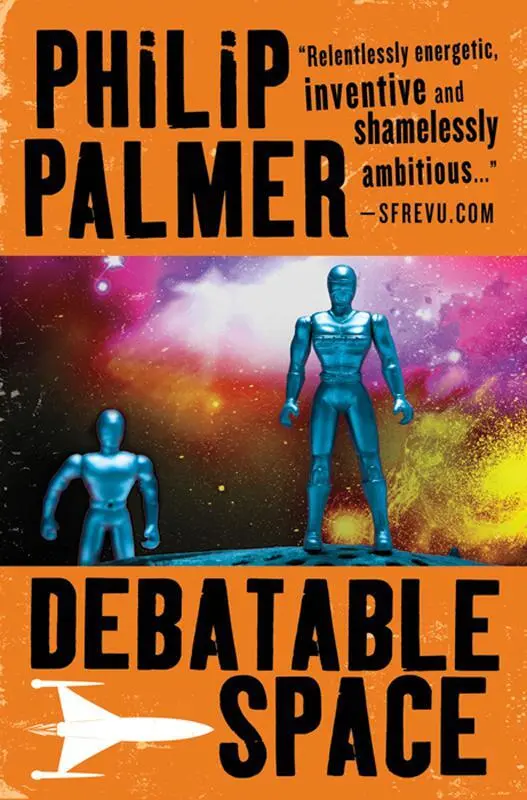
- Название:Debatable Space
- Автор:
- Жанр:
- Год:неизвестен
- ISBN:нет данных
- Рейтинг книги:4 / 5. Голосов: 1
-
Избранное:Добавить в избранное
- Отзывы:
-
Ваша оценка:
Debatable Space: краткое содержание, описание и аннотация
Предлагаем к чтению аннотацию, описание, краткое содержание или предисловие (зависит от того, что написал сам автор книги «Debatable Space»). Если вы не нашли необходимую информацию о книге — напишите в комментариях, мы постараемся отыскать её.
Debatable Space — читать онлайн бесплатно полную книгу (весь текст) целиком
Ниже представлен текст книги, разбитый по страницам. Система сохранения места последней прочитанной страницы, позволяет с удобством читать онлайн бесплатно книгу «Debatable Space», без необходимости каждый раз заново искать на чём Вы остановились. Поставьте закладку, и сможете в любой момент перейти на страницу, на которой закончили чтение.
Интервал:
Закладка:
So much has happened to me in my long long life. The details are still clear, but the overall story seems vague. I did this, then that, then many other things – but why? What was my purpose? What was my journey? Do I have an arc? The truth is: I simply do not know.
But I did love my son. I did. Grant me that. Despite all his sins.
I loved him.
I was lonely on Rebus.
Rebus was an archive planet, which specialised in the collation and dissemination of data on every conceivable subject. We were encyclopaedists on a grand scale. We savoured every decade in human history. We created video time lines which allowed one to sensually experience life in any given period of fully recorded history. You could sit in a virtual-reality helmet and hear the sounds, smell the smell, see the sights of whatever date or place one chose. With a combination of cctv camera footage, smell data banks, live music archives, police camera footage and the data from Mass Observation video diaries, we could recreate the experience of being anywhere on the planet Earth in any day in any year for the past few centuries.
You could watch Death Star live in concert at the Hammersmith Dance Emporium, even though the band themselves died of electroshock overdoses long ago. You could see Karel Mzniv conduct the New York Philharmonic in a concert performance of La Boheme, with Anne Mitchell making her first public performance. You could be one of the crowd in the Trafalgar Square riots of 2222, fired upon by police, whilst also being pelted with acid bombs by anarchist infiltrators.
You could experience the Rage Riots of 2032, which tore apart the city of San Francisco; and you could watch the astonishing end of Karl Mistry, the leader of the cult New Millennium group. You could watch as a mushroom cloud floated above the city of San Francisco, and feel what it was like to fear that the world is about to end.
With our newer virtual chip technology, you could have sex with the most beautiful men or women in the world. You could fornicate with whores from the planet Eros, five at a time; or build your own perfect lover from scratch.
We also had comprehensive pre-historical archives, with raw film and television footage from the twentieth century, and books, magazines and archaeological records from all the preceding centuries. We had a DVD-Rom of life in Ancient Egypt which combined archaeology with sensory reproduction and would allow you to feel what it was like to be a Pharaoh, or participate in every gory stage of the process of mummification.
This was, indeed, Nerd Heaven.
Rebus was led by a collegium of professors with radical views about the power of information. And our wealth came from selling our data and archive techniques. On a regular basis we were visited by merchant ships bearing untold glorious gifts of a kind that we found it difficult to reproduce in our Space Factory – honey, perfumes, vintage wine, carpets, works of modern and ancient art. And in payment for these, we sold facts.
I was welcomed into the community of scholars on Rebus, because of my academic background, and because of the iconic value of my You Are God books. But I quickly learned that I had a clearly defined place and position in this hierarchy of scholars. It wasn’t an especially low place and position but it was rigidly insisted upon. Decisions filtered down from above; bright, vivid, positively expressed suggestions were passed upwards to the senior academics via the Bulletin Board. In fairness these suggestions were always carefully considered and often heeded. But we were ruled, there was no doubt about that.
I found it soul-destroying. I was trapped into being one person, one role, one place in the hierarchy. And though the work was challenging, I felt I was going back in time. I was becoming the person I used to be, the young Lena. Shy, bookish, intense, solitary, lonely. All my colleagues had a dry, ironic sense of humour. None of them feared me. None of them adored me. None of them, frankly, had much respect for my tenure as the most important politician in the Universe.
I did manage an intermittent love affair with the head of the archive, Professor McIvor. He had silky old skin, weary with lines, and a bassoon voice that he could modulate at will. I flattered him artfully and invited him to share in my dreams of greatness. I argued that we should, together, create a Universal Archive that offered a commentary on all human knowledge from Plato to Schwegger. He humoured me for a while.
But nothing ever came of my plan. Because McIvor’s real passion was for the sorting of existing facts. He could arrange knowledge alphabetically, thematically, and chronologically. But he had no new thoughts to offer on anything. His lovemaking too was confident, and based on tried and trusted techniques for stimulation. But he never lost himself in the heat of passion. He never just was.
I felt that every second I spent with McIvor sucked an ounce of passion out of my spirit. He was rarely boring, always courteous; but somehow he managed to create an aura of order and calm that enveloped all those in his presence, like a pillow over one’s mouth.
Most evenings when we were together we sat and read, or played computer games. The physical proximity satisfied a primal need in my body to be near the sound of another person’s breath, to share in the beating of their heart. But to all intents and purposes, we might as well have spent our evenings alone. We dined, and as we dined we discussed. We made love, and as we did so, and after we had done so, we made pleasant and flattering comments to each other. Then we retreated into our own private mental islands until it was time to sleep.
My dreams at that time were, by the way, extraordinary. I dreamed of worlds in which flesh was liquid and oozed and slithered along earth that was ribbed and ridged and tore at one’s body delectably. I dreamed of having eyes like stalks that turned and burrowed into my ear passages until they entered my brain and saw my thoughts unfolding like a movie. I dreamed of swimming in my own womb, suckling at my own breast, I dreamed of shrinking and dissolving until I became a drop of spittle on my baby’s mouth.
In one dream Tom was alive. We were having supper in a boozer on the Old Kent Road, he was wearing his leather bomber jacket, and all around us were the hanged corpses of the villains we had put away. Occasionally, a waiter would come and serve us a plate of still wriggling flesh from some blagger’s body. Professor McIvor was playing the piano, but he had no flesh on his hands, so we could hear the clicking of his finger bones on the ivory keys.
Every dream ended with me sitting in a chair and being strapped in for my behaviour modification therapy – the brain-frying. At this point, the dream would end, because I had schooled myself to stab my own leg with a pin strapped to my finger whenever the horror of the brain-frying threatened to return. This, I suppose, is why my dreams were so vivid. Because every time I started to re-enter the nightmare universe of the brain-frying, I stabbed myself, and woke, and remembered my dreams, then fell asleep, and dreamed anew.
Each morning my sheet was dank with blood, and my legs were spotted and sore. But I kept the nightmares at bay.
Rebus was, frankly, a drab planet. The gravity was light, and the settlers had populated it with birds, but no land animals. The skies were often thick with eagles and sparrows and vultures and parrots and genetically modified mock-orcs. But the land was flat and featureless and uniformly planted with crops and medicine-synthesising oak and elm trees.
It did, have, however, an amazing air vortex: a permanent typhoon like Jupiter’s Red Spot which stalked the planet like a serial killer. Underground shelters were placed in every populated area for humans to hide from these savage tornados. When the vortex struck, all the birds in the sky hurtled downwards and huddled on the earth in terror and despair. The winds would sweep across the land like scythes of air, ripping up trees and hills and occasionally even denting the supposedly invulnerable human living quarters.
Читать дальшеИнтервал:
Закладка:
Похожие книги на «Debatable Space»
Представляем Вашему вниманию похожие книги на «Debatable Space» списком для выбора. Мы отобрали схожую по названию и смыслу литературу в надежде предоставить читателям больше вариантов отыскать новые, интересные, ещё непрочитанные произведения.








Обсуждение, отзывы о книге «Debatable Space» и просто собственные мнения читателей. Оставьте ваши комментарии, напишите, что Вы думаете о произведении, его смысле или главных героях. Укажите что конкретно понравилось, а что нет, и почему Вы так считаете.