Philip Palmer - Debatable Space
Здесь есть возможность читать онлайн «Philip Palmer - Debatable Space» весь текст электронной книги совершенно бесплатно (целиком полную версию без сокращений). В некоторых случаях можно слушать аудио, скачать через торрент в формате fb2 и присутствует краткое содержание. Жанр: Фантастика и фэнтези, на английском языке. Описание произведения, (предисловие) а так же отзывы посетителей доступны на портале библиотеки ЛибКат.
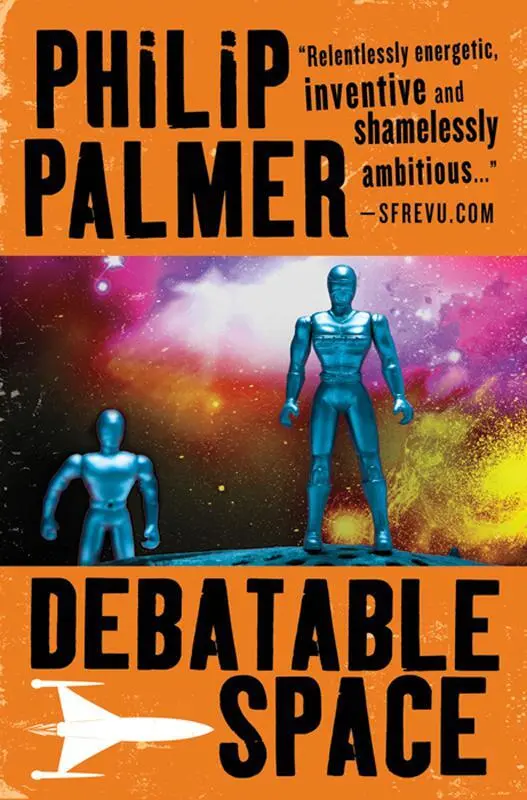
- Название:Debatable Space
- Автор:
- Жанр:
- Год:неизвестен
- ISBN:нет данных
- Рейтинг книги:4 / 5. Голосов: 1
-
Избранное:Добавить в избранное
- Отзывы:
-
Ваша оценка:
Debatable Space: краткое содержание, описание и аннотация
Предлагаем к чтению аннотацию, описание, краткое содержание или предисловие (зависит от того, что написал сам автор книги «Debatable Space»). Если вы не нашли необходимую информацию о книге — напишите в комментариях, мы постараемся отыскать её.
Debatable Space — читать онлайн бесплатно полную книгу (весь текст) целиком
Ниже представлен текст книги, разбитый по страницам. Система сохранения места последней прочитанной страницы, позволяет с удобством читать онлайн бесплатно книгу «Debatable Space», без необходимости каждый раз заново искать на чём Вы остановились. Поставьте закладку, и сможете в любой момент перейти на страницу, на которой закончили чтение.
Интервал:
Закладка:
Then, after about twenty years, the look changed. I became more severe, more forbidding. As my policies became more liberal, my look became more starched. I wore stiff suits and disapproved of nudity in television commercials. I became Nanny – fair, firm, but innately puritanical and moralistic. That worked, too, for a good while.
Then I appointed a good-looking Vice President and for ten years or so, it was assumed that he was the power behind the throne. It was rumoured we were lovers, and that I was going to stand down in favour of him. I can’t, for the life of me, remember his name. I can easily look it up, but I choose not to. When my policies started to run into difficulties, he became my fall guy. He left, I stayed. Life carried on.
Of course, each nation on Earth had its own ruler; and each country was sovereign, and powerful. My role in “Presiding” over the Council of Humanity was simply to coordinate and liaise. But the reality was, leaders of nation states came and went. They lost at elections, they were assassinated, they died of heart failure. But I stayed – constantly reinventing myself, and my role. And in this way, I became for a period almost all-powerful.
At first, I travelled constantly. But as time went by I relied heavily on my vidscreens in my office in Brussels (and, latterly, in an annexe of the Houses of Parliament in London.) I was, of course, spending every night in the virtual reality of Hope, inhabiting the bodies of Doppelganger Robots as a frontier was tamed, and a planet was terraformed. So when my days began, my head was pounding with memories of sandstorms and appalling deaths and great heroism. But I developed a knack of effortlessness that allowed me to glide through paperwork and answer phenomenal numbers of emails. I vidphoned a hundred messages a day and buzzed them out in batches. It was rare for me to have actual conversations. I preferred people to pitch me proposals by email, so I had time to simmer on them; and then I announced my decisions.
And so we savoured the twenty-third century, the period in which the human race changed for ever. Microchip brain implants became standard and so virtually every human being had access to all the knowledge of all the ages. Bodies and faces could be changed like suits, with the vagaries of fashion. The first genetically engineered humans appeared – the “gillpeople”, who could breathe in oxygen through water, and who were eventually evolved into the Dolphs. There was a whole new generation of 100 Plusers, wars were unheard of, the distant planets were being colonised. Boxing was outlawed. Prostitution was taxed at a higher tax band. Children were maturing faster, learning faster; teenagers were force-fed knowledge, but in their twenties the new generation of “twoers” experienced the sheer joy of a gap decade before entering the world of work.
The famines in Africa were a thing of the past. After the catastrophic climate disasters of the late twenty-second century, the climate was now in a state of stable homeostasis, no longer oscillating between global warming and Ice Age. Music was, frankly, shit; even by my standards. Popular and classical alike, music was well and truly up itself. But painting had entered a renaissance, and wall murals of staggering beauty by the world’s greatest artists covering whole city blocks and skyscrapers could be found in every capital city.
And the problems of the human race were being solved. They were being solved. Problems have solutions; you just have to find them.
The pressure on me was, however, phenomenal, and my workload was crippling. And after nearly ninety years in power, I began planning my retirement. But first, I ushered in my repeal of the penal laws – which meant the eradication of prison in favour of electronic and behaviour-modifying torture as a punishment for offences. The “brain-frying” of armed robbers and murders proved to be chillingly effective. Crime plummeted; and those who used to be career criminals lived their lives in a state of semi-fear, haunted by memories of the excruciating pain generated by our cortex-searers and imagination-burners.
This, too, whatever later critics have said, was a solution to a problem: namely, how to stop criminals committing crime. One solution is to incarcerate them at vast expense for long periods of wasted life. The other is to hurt and terrify them so badly they are physically unable to sin again. Under my scheme anyone who committed a serious crime – murder, rape, kidnap, paedophilia, grievous bodily harm, armed robbery, or malicious extortion – would experience brain-frying. And anyone who became a repeat offender would be brain-fried daily, until either redemption or brain damage was achieved.
It was cruel; but it worked. And, coupled with advances in forensic and thought-exploration technology which made wrongful convictions a thing of the past, it was fair.
This was my brave new world. Mock it if you like; but I lived a long long time in the old world. And my world is, trust me, a billion times better.
It was a strange and wonderful period. But looking back, I wish I had found myself some friends. People who could stand up to me, defy me, argue with me. Instead, I had legions of loyal acolytes. Eager beavers who were young and anxious to cling to my coat-tails. None of them were over the age of forty; all of them secretly plotted to take my job.
But there was power enough for all of us. I hired one young man, Matt Evans, who called himself Mat X, after hearing his rap lyric on an album I downloaded on to my earpiece. He had such energy, such wit, such coruscating irony. So I called him into my office and quizzed him on what he would do to solve the problems of the world. He was an angry and passionate black man who spoke, angrily and passionately of course, about the shit that is dealt to blacks and mixed-race communities in today’s fucked-up society.
So I made him Coordinator for Africa. His mission was to make Africa into the richest, coolest nation on Earth. He had the resources, he had the staff. And he had no fucking idea how to run an office or do a job; even getting up in the morning was a strain for him.
But he learned, fast. He was streetwise, smart, a great people person. He sat down with African dictators and he visited mass graves created as a result of the frequent genocidal wars that were still taking place on a regular basis. He invoked the spirit of Mandela, but he also brought a young new energy to things. Secretly, I controlled his every move; but I used his charisma, his youth, his rap-artist credibility, to win hearts and minds. Billions of young blacks who hated authority idolised Mat X. They listened to his words; they admired his style; and they marvelled that he released his official Manifesto for African Redevelopment in the form of a ninety-minute rap single.
And as a result, we got Africa in shape. It became what it should always have been; a fertile land rich in ideas and culture, in which cooperation between disparate tribes is ingrained in the heart of every native-born ’frican. We called it “the ’frican way”; it was not quite a religion, not quite a philosophy, but it became a way of life for billions.
China was tougher. Eventually, I found a young woman who was abnormally empathetic; her ability to seemingly read minds and predict behaviour allowed her to introduce democracy and reform Chinese social practices. She later became a Demi-Goddess, revered by entire nations; and of course, by that point she was no longer returning my phone calls. Her name was Xan (you see, she even copied her silly name from me). Ungrateful bitch! Sorry. Moving on…
Problems have solutions. It was my creed, my Machiavellian code. Yet the curious thing is: amnesia is the driving principle of all human behaviour. When things are bad, everyone will yearn for them to get better. But when things are good, it’s all taken for granted. And so entire generations grew up in my world assuming this was the natural order of things. Full employment, barely any disease, long lives, few wars, a warm and emotionally invigorating architectural environment – big deal! The world was still shit, and adults like me were arseholes and fossils to be mocked and despised.
Читать дальшеИнтервал:
Закладка:
Похожие книги на «Debatable Space»
Представляем Вашему вниманию похожие книги на «Debatable Space» списком для выбора. Мы отобрали схожую по названию и смыслу литературу в надежде предоставить читателям больше вариантов отыскать новые, интересные, ещё непрочитанные произведения.











Обсуждение, отзывы о книге «Debatable Space» и просто собственные мнения читателей. Оставьте ваши комментарии, напишите, что Вы думаете о произведении, его смысле или главных героях. Укажите что конкретно понравилось, а что нет, и почему Вы так считаете.