Greg Egan - Quarantine
Здесь есть возможность читать онлайн «Greg Egan - Quarantine» весь текст электронной книги совершенно бесплатно (целиком полную версию без сокращений). В некоторых случаях можно слушать аудио, скачать через торрент в формате fb2 и присутствует краткое содержание. Год выпуска: 1999, ISBN: 1999, Жанр: Фантастика и фэнтези, на английском языке. Описание произведения, (предисловие) а так же отзывы посетителей доступны на портале библиотеки ЛибКат.
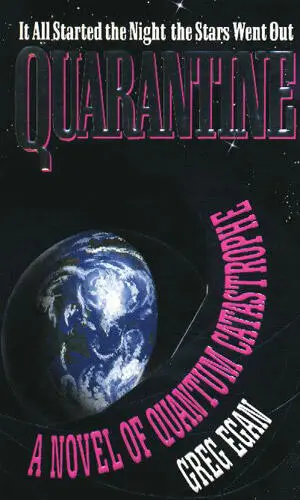
- Название:Quarantine
- Автор:
- Жанр:
- Год:1999
- ISBN:1 85798 590
- Рейтинг книги:5 / 5. Голосов: 1
-
Избранное:Добавить в избранное
- Отзывы:
-
Ваша оценка:
Quarantine: краткое содержание, описание и аннотация
Предлагаем к чтению аннотацию, описание, краткое содержание или предисловие (зависит от того, что написал сам автор книги «Quarantine»). Если вы не нашли необходимую информацию о книге — напишите в комментариях, мы постараемся отыскать её.
Some see the bubble as the revenge of an insane God. Some see it as justice. Some even see it as protection. But one thing is for certain — now there is the universe, and the earth. And never the twain shall meet.
Or so it seems. Until a bio-enhanced PI named Nick Stavrianos takes on a job for an anonymous client: find a girl named Laura who disappeared from a mental institution by the most direct possible method — walking through the walls.
Quarantine — читать онлайн бесплатно полную книгу (весь текст) целиком
Ниже представлен текст книги, разбитый по страницам. Система сохранения места последней прочитанной страницы, позволяет с удобством читать онлайн бесплатно книгу «Quarantine», без необходимости каждый раз заново искать на чём Вы остановились. Поставьте закладку, и сможете в любой момент перейти на страницу, на которой закончили чтение.
Интервал:
Закладка:
Or is it? I can hold my virtual selves to ransom only if, after each collapse, I remain in control — and the truth is, I have no way of knowing what the eigenstate mod will be used for: to choose the state of the dice, or to choose my own state of mind. At the next collapse, I might find that a state has been selected in which I've simply given up on the experiment… or given up on the true Ensemble. Every time I smear, all the rules of the game are being thrown into the air, alongside the dice. I can only hope that they're harder to sway.
I pocket the dice generator seconds before Lee Hing-cheung arrives to relieve me. The program in my head — running much more slowly under von Neumann than it would on any decent hardware — scours the accumulated data with ever more sophisticated and obscure tests in the hope of detecting an effect, but spits out its final, unsurprising conclusion as I step off the homebound train:
[null hypothesis unchallenged.] I turn up for duty expecting to find that Po-kwai has been granted a rest day, but my orders are to report to Room 619. When I get there, Lee explains. 'She says it doesn't tire her any more; there's no reason to hold up the work.'
I stand guard with single-minded vigilance, as if to compensate for my nocturnal dereliction. I blank out the chatter of the scientists, and suppress any sense of anticipation. P3distils me into a pure observer — wired to respond in an instant to any contingency, but until that moment, utterly passive.
When Po-kwai emerges from the ion room, an hour later, they call it a day. In the elevator, heading for the restaurant, I ask, 'How's it going?'
'Good. We've had useful data all afternoon.'
'Already?'
She nods happily. 'I think I've crossed some kind of threshold; everything's just getting easier and easier. Well… you know what I mean. I do nothing, as always. I take no credit — but it certainly looks like the smeared Po-kwai has finally mastered Ensemble.'
For a moment, I'm tempted to ask her to repeat what she said, but there's no need; I heard her perfectly, and the meaning is unambiguous. And if she's never named the mod before, no doubt she was explicitly instructed not to — by Leung, perhaps — with sufficient emphasis for the message to sink in more fully than all the other 'security bullshit'.
I see no reason to admonish her for the slip.
I sit through dinner with infinite patience, nodding politely while Po-kwai complains about how boring the food has become.
I sit in the anteroom, listening to her moving about the apartment, wondering what difference, if any, this information will make.
At one a.m. I deprime, and my joy is no longer constrained. The true Ensemble is the mod named Ensemble — and this perfect equation, this electrifying symmetry, is the final confirmation of everything I believe. A revelation, yes — but in retrospect it seems impossible that it could have been otherwise. And what greater inspiration could I hope for, to guide and encourage the virtual selves who remain loyal to my mission?
I take out the dice generator, invoke the mods, begin.
The dice fall at random, again and again, but I'm not discouraged. My smeared self can't be expected to perform instant miracles, however fervently he's pursuing the task … least of all when I annihilate him by collapsing, every six seconds, and he has to begin again, picking up the threads from whatever hologrammic traces of his experience are preserved in my brain.
Must I collapse so often — after every throw? It's true that Po-kwai succeeded with this approach — and collapsing after each ion would have given her the simplest possible goal: amplifying one of just two possibilities. Her task and mine aren't identical, though; Ensemble is in her skull, not mine. Maybe I need to smear for a longer time, to generate versions of myself capable of influencing the mod. How long was I smeared when Karen appeared, unbidden? I have no way of knowing; the process was out of my control.
Now, that's no longer true.
I tick the ON switch.
On the table beside me, the dice generator sends the images of the cubes spinning into the air. They look almost solid — even glinting convincingly as they pretend to catch the ambient light — and they fall to the surface with a faint simulated click.
Snake's eyes, two ones — my target.
I twitchily suppress the by now instinctive third step of the routine, and, leaving the Hypernova menu untouched, enter this first result into the analysis program — thinking: each time I do this, von Neumann will smear into multiple versions, with copies of the program which have been fed every possible combination of results so far. I don't have to think about individual throws; all I have to do is choose an eigenstate in which the analysis program eventually declares success. Surely I can manage a task as simple as that — with the help of the true Ensemble.
Snake's eyes for a second time. And a third.
What if I collapsed right now, before the program gives a verdict? What will this have been — a fluke? A coincidence? A rare — but insignificant — run of good luck? Or am I already witnessing the proof that I will remain smeared beyond that point?
Snake's eyes, for a fourth time. At one chance in thirty-six each toss, the probability of a run of four or more — just once in all the thirty thousand tosses, the ten nights' worth of data that I have so far — is already down to 1.7 per cent.
A fifth time… at 0.048 per cent. Having crossed its arbitrary one per cent threshold, the program starts flashing messages of triumph.
Six … at 0.0013 per cent.
Seven… at 0.000037 per cent.
Eight… at 0.0000010 per cent.
I stop feeding data into the program, and just stare at the dice landing the same way again and again, like some cheap, looping advertising hologram. Maybe the generator has malfunctioned, that's all. Malfunctioned how, though? And why? Do I think I've 'willed' a change of circuitry that biases the thing? Am I going to crawl back to some cosy idea of telekinesis, by method unknown? I'm not even trying to influence the device; I'm just watching everything happen. Po-kwai was right: the smeared self does all the work.
I'm going to have to swallow the whole truth: I'm living through a pattern of events that will be (or has been) plucked from a few quadrillion possibilities, by the collective effort of a few quadrillion versions of me … most of whom I am about to slaughter (unless I already have).
I tick the OFF switch.
The dice keep falling: A three and a four. A two and a one. A pair of sixes. I wipe the sweat off my face; shaken, elated, giddy with success and fear.
I reach down and grip the seat of the chair; the cool, smooth metal is as solid as ever. It doesn't take long to calm myself. I've come through unharmed, unchanged, haven't I? And I have less to fear than ever; there'll be no more mod failures, no more hallucinations. I'm in control now.
And whatever bizarre metaphysical convolutions I'm going to have to come to terms with, one simple truth remains: in the end, when I pull the plug, hit the OFF switch, collapse the wave… it still all adds up to normality.
10
In the spirit of the Canon, Lui sets the agenda for my conquest of the mod without ever suggesting that my own instincts on the matter could be anything but flawless. With his prompting, I move on to more elaborate dice tricks: cycles of two, three or four different outcomes; totals that are always prime numbers; dice that always agree. The objective odds against these conditions being met by pure chance are no more spectacular than those of my first success — and in some cases are far less stringent — but nevertheless, identifying and amplifying the eigenstates for these complex patterns seems like it ought to be more of a challenge.
Читать дальшеИнтервал:
Закладка:
Похожие книги на «Quarantine»
Представляем Вашему вниманию похожие книги на «Quarantine» списком для выбора. Мы отобрали схожую по названию и смыслу литературу в надежде предоставить читателям больше вариантов отыскать новые, интересные, ещё непрочитанные произведения.








Обсуждение, отзывы о книге «Quarantine» и просто собственные мнения читателей. Оставьте ваши комментарии, напишите, что Вы думаете о произведении, его смысле или главных героях. Укажите что конкретно понравилось, а что нет, и почему Вы так считаете.