Mitchell Smith - Kingdom River
Здесь есть возможность читать онлайн «Mitchell Smith - Kingdom River» весь текст электронной книги совершенно бесплатно (целиком полную версию без сокращений). В некоторых случаях можно слушать аудио, скачать через торрент в формате fb2 и присутствует краткое содержание. Жанр: Фантастика и фэнтези, на английском языке. Описание произведения, (предисловие) а так же отзывы посетителей доступны на портале библиотеки ЛибКат.
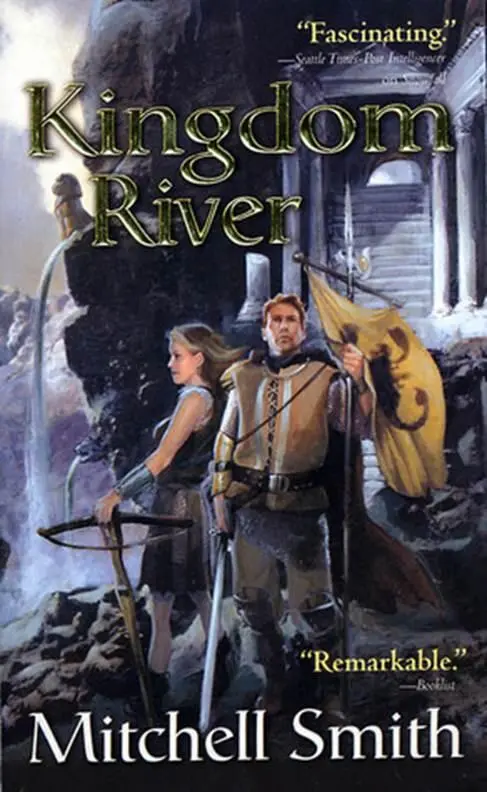
- Название:Kingdom River
- Автор:
- Жанр:
- Год:неизвестен
- ISBN:нет данных
- Рейтинг книги:3 / 5. Голосов: 1
-
Избранное:Добавить в избранное
- Отзывы:
-
Ваша оценка:
Kingdom River: краткое содержание, описание и аннотация
Предлагаем к чтению аннотацию, описание, краткое содержание или предисловие (зависит от того, что написал сам автор книги «Kingdom River»). Если вы не нашли необходимую информацию о книге — напишите в комментариях, мы постараемся отыскать её.
Toghrul Khan, leader of the Khanate, wants Kingdom's lucrative trade and lush farmlands. To get them, Sam Monroe knows, the Khan's forces will march right over his people's small towns and precious homesteads. His country's only hope is an alliance with Kingdom-but the far larger Kingdom may simply swallow them up. Unless…
Sam's proven ability in the field attracts the attention of Queen Joan, who rules Kingdom with a heart as cold as the Colorado ice where she was raised. But if she gives Sam Monroe command of Kingdom's forces, her loyal generals and admirals may feel a lot less loyal. Unless…
Young, bookish princess Rachel is the key. A marriage between Sam and the princess unites both their nations and their fighting forces and gives the commanders a way to save face.
Has the alliance been made in time? The Khan's armies are sweeping east in a rush, threatening both sides of the vast Mississippi River. Kingdom's large army and navy move excruciatingly slowly. Sam's people are fleet but greatly outnumbered. And there are other dangers Sam Monroe is just beginning to comprehend. The technologically advanced people of New England, who breed monsters in women's wombs and have learned to levitate, are watching the growing conflict between the Khan and Kingdom and more important, watching Sam as he learns not just to command but to rule.
Kingdom River — читать онлайн бесплатно полную книгу (весь текст) целиком
Ниже представлен текст книги, разбитый по страницам. Система сохранения места последней прочитанной страницы, позволяет с удобством читать онлайн бесплатно книгу «Kingdom River», без необходимости каждый раз заново искать на чём Вы остановились. Поставьте закладку, и сможете в любой момент перейти на страницу, на которой закончили чтение.
Интервал:
Закладка:
"No, ma'am," Dearborn said. "We cannot. Those men are frozen already – stuck hard in blood and ice. We'd be hours getting any aboard, and very few to live."
"My boys… my boys." The Queen was weeping, tears odd down a furious face. "Del …" she said, a name Martha didn't know.
The Mischief, which knew no regrets, no losses, sailed on over the dead and dying at great speed, only shrugging where they'd fallen thick.
Though no officer, no sailor, said so, there was relief as the ship left that field, and sketched its way again over ice bare of anything.
The Queen turned from the rail, wiping her eyes with her sleeve. "Martha, we'll go below, and you'll arm me."
"Majesty," Dearborn said, "I swear not necessary!"
"Then," the Queen said, "I will be disappointed."
… They ran and ran into afternoon, the sails handled for the wind, and saw dead here and there. The Queen, cloaked in her lynx, the ends of a blood-red scarf flowing with the wind, stood on the Mischief's high poop full-armed in mail, leather, and boots, her light steel helmet hanging by its laces down her back. She watched near the scorpions with two assags in her hand, her long Trapper knife at her belt. And though standing at the ship's stern, she seemed a figurehead of war.
They heard the battle before the raven's-nest saw it. There was a sound as if distant different songs, sung by many people, were echoing over the ice.
Dearborn called an order, and sailors climbed fast to set a triangular canvas. "Staysail," he said to Martha as they watched the sailors work above them, the winter sun blazing over their shoulders.
"Ship!" the lookout called, and as they sailed into those battle sounds – coming clearer, harsher now on a bitter wind – a ship appeared on the ice horizon. Mischief approached fast off what Martha had learned was starboard, and soon they could see that the ship was not a ship any longer. Once, judging from the massive side-skates and smaller steering blades still boomed out for a turn, it had been Mischief's size. Now it lay burned to the ice, stuck in a lake melted by fire then frozen again, its charred timbers and charcoaled masts absolutely black against a world so white. Many smaller things, the size of persons, had burned with the ship. And others, dead men and dead horses, unburned, sprinkled the ice around it.
First Officer Neal stared as they passed. "It's the Chancy."
"Perhaps not, Jim," the captain said.
"I know the ship. Steer-skates always rigged elbow off the beams…" Neal turned away and went down the ladder to the main deck.
"Has a brother on her," Dearborn said. "… Had a brother on her. Younger brother."
Now, as if the burned Chancy had been an introduction, they could see the battle.
It stretched, like a great shifting black-and-gray serpent, as far as could be seen from the Mischief's decks. More than a mile… almost two miles away, huge rectangles of bannered infantry in East-bank's green armor formed and reformed on the ice – nine, ten of them, and each, it seemed to Martha, made of maybe a thousand men. These formations stood offset, some slowly turning, wheeling ponderous as barges – but barges in a flood of horsemen that shifted and flowed about them as if to wear their ranks away as fast water wore stone. The distant infantry seemed coated by a sort of glittering fur, that Martha thought must be bristling pikes – and long, swift shadows fleeted away from them over the ice.
"What are the shadows?" Martha said.
"Bolts volleyed from their crossbows." The Queen set one of her assags against the rail, and stretched to ease her muscles. "If you have to pee, dear, do it now."
"I don't have to."
"A lot of Kipchaks," Dearborn said, looking out over the ice. "Thousands."
"But not thirty thousand," said the Queen. "The fucking Khan has gone south, and taken half his savages with him!"
Martha heard a trumpet, and saw another great ship skating, sailing fast enough to port to draw even with the Mischief. Though far across the ice, the men aboard her must have seen the Queen's banner at the mast-head. Tiny figures waved from her rigging. Martha heard them cheering.
"The Ill Wind." Captain Dearborn smiled. "Old Teddy Pelham…"
The Queen stood clear at the poop's port rail, raised an assag's gleaming head, and waved the weapon in great sweeping strokes. The cheers came even clearer then. And Martha saw, past that ship, another… then a third came skating to run side by side across miles of ice. And more ships, and more distant, came sailing up and abreast, port and starboard, until there were warships skating in a massive line of stripe-painted hulls and hard-bellied white heights of sails, sun-flashing skates and bright banners. Drums, drums were thundering along the line of great ships stretching so far to the left and right that they diminished into distant, seeming-toys, bright as jewelry.
"My darlings," the Queen said – the first time Martha'd heard that copybook word used. "My Fleet!"
Captain Dearborn said, "Ladies, step away," and called, "Fighting stands!… Fighting stands!"
That cry was taken up by officers, bosuns, and rattling shaman drums – and the Mischief's decks, which had looked to Martha busy enough before, suddenly stirred as ground wasps stirred in summer's last week. Sailors snatched pole-arms and axes from chain-loops at the masts, as marines, in band armor enameled half-blue, half-green, marched to their places along the rail, or climbed rope ladders to the fighting tops, and the huge crossbows waiting there.
Sailors came jostling up the two narrow ladders to the poop, saying, "Pardon… pardon," as they shouldered Martha and the Queen aside, then bent to winches and began to wind the two scorpions' giant steel bows slowly back… and back, the machines' captains calling, "Faster – faster!"
Two men unfolded tall, hinged mantelets – stood the heavy rectangles of linden-wood in four places to shield the scorpions' crews – then fastened them by thick steel hooks to thicker steel rings set into Mischief's deck.
"Back from these bows!" One of the machine captains hustled Martha and the Queen forward, past the mantelets and against the poop's railing, paying no attention to majesty. Martha saw the Queen enjoyed it, and went where she was told, perhaps pleased by moments of not being a queen at all.
She and Martha stood watching as the great steel arcs were drawn back to a final solid clack, so the machines lay fully cocked – both already loaded with five slender steel javelins, each a little longer than a man was tall.
Now the noise of battle, no longer odd and distant, sounded near, hammered from shouts and screaming.
Martha was looking down the line of ships, racing, trailing long plumes of powdered ice behind their runners – and saw men galloping small horses right between Mischief and the nearest ship, the Ill News, but going in the other direction. Twenty, perhaps thirty horsemen, galloping over the ice.
"Look!" Martha called – and the Queen and one of the sailors looked – but the riders were gone, and no one seemed to have noticed, or shot at them.
"Kipchaks," Martha said. "I saw them."
"More where those came from," the sailor said, and pointed forward along the port rail. The Queen and Martha leaned out to see along the ship's side. The ice lying a distance before the Mischief's bow was not white, but as deep a stirring gray as storm clouds.
Horsemen.
The ship jolted, then ran on, and Martha saw a great ball of blazing pitch heave up from the Mischief's bow catapult, and rise… rise into the air.
Читать дальшеИнтервал:
Закладка:
Похожие книги на «Kingdom River»
Представляем Вашему вниманию похожие книги на «Kingdom River» списком для выбора. Мы отобрали схожую по названию и смыслу литературу в надежде предоставить читателям больше вариантов отыскать новые, интересные, ещё непрочитанные произведения.







Обсуждение, отзывы о книге «Kingdom River» и просто собственные мнения читателей. Оставьте ваши комментарии, напишите, что Вы думаете о произведении, его смысле или главных героях. Укажите что конкретно понравилось, а что нет, и почему Вы так считаете.