David Brin - Existence
Здесь есть возможность читать онлайн «David Brin - Existence» весь текст электронной книги совершенно бесплатно (целиком полную версию без сокращений). В некоторых случаях можно слушать аудио, скачать через торрент в формате fb2 и присутствует краткое содержание. Жанр: Фантастика и фэнтези, на английском языке. Описание произведения, (предисловие) а так же отзывы посетителей доступны на портале библиотеки ЛибКат.
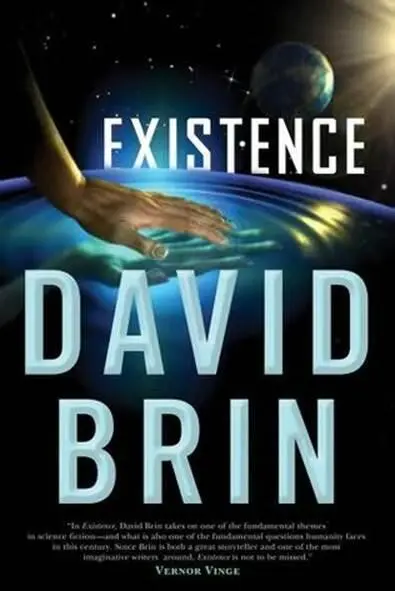
- Название:Existence
- Автор:
- Жанр:
- Год:неизвестен
- ISBN:нет данных
- Рейтинг книги:4 / 5. Голосов: 1
-
Избранное:Добавить в избранное
- Отзывы:
-
Ваша оценка:
Existence: краткое содержание, описание и аннотация
Предлагаем к чтению аннотацию, описание, краткое содержание или предисловие (зависит от того, что написал сам автор книги «Existence»). Если вы не нашли необходимую информацию о книге — напишите в комментариях, мы постараемся отыскать её.
Astronaut Gerald Livingstone grabs a crystal lump of floating space debris. Little does he suspect it's an alien artifact, sent across the vast, interstellar gulf, bearing a message.
"Join us!" – it proclaims. What does the enticing invitation mean? To enroll in a great federation of free races?
Only then, what of rumors that this starry messenger may not be the first? Have other crystals fallen from the sky, across 9,000 years? Some have offered welcome. Others… a warning!
This masterwork of science fiction combines hard-science speculation and fast-paced action with the deeply thoughtful ideas and haunting imagery that David Brin (best-selling author of Earth and The Postman) is known for in more than twenty languages.
Existence — читать онлайн бесплатно полную книгу (весь текст) целиком
Ниже представлен текст книги, разбитый по страницам. Система сохранения места последней прочитанной страницы, позволяет с удобством читать онлайн бесплатно книгу «Existence», без необходимости каждый раз заново искать на чём Вы остановились. Поставьте закладку, и сможете в любой момент перейти на страницу, на которой закончили чтение.
Интервал:
Закладка:
“As Plato taught, stable governance requires a broad base that narrows steeply to a small but superqualified ruling class, born and raised for leadership. The mode that postagricultural civilizations adopt, ninety-nine percent of the time. Even under so-called Soviet Communism, power soon consolidated in a few hundred families of the nomenklatura caste-a classic feudal society, despite all its superficial egalitarian rhetoric.”
Hamish wondered, Does she imagine I don’t know this? While lazily nodding and maintaining eye contact, he sampled other conversations. Behind him, a Brazilian fertilizer magnate rehashed conjectures about the Alien Artifact that had become tiresome hours ago.
Meanwhile, across the table, a boffin from Tenskwatawa’s think tank was discussing probability-weighted responsibility -the notion that scientists and innovators should have to buy insurance or bonds to cover possible bad outcomes, ensuring they would pause and consider before charging ahead with risky experiments. A version of the Precautionary Principle-demanding that a burden of proof fall on those bringing change. An interesting alternative to the proposed Science Juries, this would let risk markets carry the burden of regulating progress, instead of policing it with a bureaucracy.
Clever, but a nonstarter, now that top families of the First Estate were joining renunciation. Tomorrow’s oligarchs wouldn’t use market methods. Bureaucracy was easier to control.
“So all signs point to reversion, back to a pyramid-shaped class structure. But which kind of social pyramid will it be?” asked the sociologist, thinking she had Hamish’s undivided attention.
She’s definitely flirting with me, Hamish decided
“Well, yes, that’s a good question,” he replied, realizing that his tongue felt a bit thick. The wine is too good. Honor it by sipping, not gulping.
“Indeed!” She nodded vigorously, which jangled her gold (plated) necklaces. Her toothy smile seemed impossibly white and she was trying too hard, but Hamish started to find it, well, a bit endearing as she hurried on.
“Does our rising aristocracy really want to repeat the mistakes that drove common folk to rebel in 1789 France and 1917 Russia? What’s it worth, to capture all the money and power, if it ends in a tumbrel ride to the chopping block?”
Hamish had an answer to that.
“Louis XVI and Czar Nicholas were inbred, mentally-deficient fools. Also, they didn’t possess tomorrow’s tools. The proliferation of microcameras, throughout the world. Or unbeatable lie detectors.”
Or -his inner voice added, without voicing it- the arrival of true artificial intelligence. But let’s not mention that third item, ensuring top-down control.
“Well, you’re right about that,” she conceded. “Though at present, the cameras and truth machines are often as annoying to the First Estate as they are useful, shining light inconveniently upward as often as down.”
“Yes, but all that’s needed is to break reciprocity, ” he answered. “By controlling information, making sure it flows one way. Take over the databases. Trump up panic situations, so the public will support paternalistic ‘protections.’ Make sure lots of privacy laws get passed, then bribe open some back doors, so elites can see it all anyway, and ‘privacy’ only protects them.
“Of course there’s more to the program than that,” Hamish continued, gaining momentum. “The smarty-pants knowledge castes will see what’s happening and complain. So you propagandize a lot of populist resentment against the scientists and other professionals, calling them ‘smug elites.’ Finally… when the civil servants and techies have lost the public’s trust, just cut the other estates out of the information loop, take complete control over the cameras and government agencies and voilà! A tyranny that lasts millennia!”
The woman stared at Hamish.
“Well, I wouldn’t put it quite that-”
“The point is, when those at the top can see absolutely everything-how would any Lenin or Robespierre ever get started?”
While grinning and taking another drink, Hamish felt flush from his sudden, passionate spill of words. In truth, it had felt like delivering a movie plot pitch to some producer, spinning-in a matter of seconds-a wonderful, nefarious scheme that would make perfect sense on-screen. One that meshed with human nature and history, and that… well… in fact most of it was already underway in the modern world.
The sociologist blinked rapidly a few times.
“I’m not sure that ‘tyranny’ is the word Plato would use.”
Oops. Hamish was suddenly aware that others had turned to watch his outburst. Damn. I got so into story mode, I wound up portraying the clade aristos as villains! My next step would have been to explain how a trio of quirky heroes might proceed to bring the whole edifice crashing… in less than ninety minutes of view-time.
He worked at his plate while thinking. How to get out of this?
“No, of course not,” he murmured after chewing and swallowing. “In fact, such perfect security would likely lessen the harshness of future rulers. No need for the iron-boot cruelty portrayed in that George Orwell novel. Why bother? Perfect rulers, all knowing and secure, would scarcely need brutality. They would, in fact, try for platonic paradise.
“But please,” he urged, “go back to your point about how a pyramidal social order will be improved by Confucian ways.”
She nodded, clearly as eager to get on track as he was to be quiet a while.
“As I was saying, Mr. Brookeman-”
With his most disarming smile, he reached over to touch her hand.
“Call me Hamish.”
“Very well… Hamish.” Her fine complexion changed hue and she smiled shyly, charmingly, before hurrying on. “Way back in the twentieth century leaders of Singapore and Japan, and then Great China, pondered non-Western ways to manage a complex modern society. Finding the occidental enlightenment far too brash and unpredictable, they cleverly designed methods to incorporate technology and science-along with limited aspects of capitalism and democracy-into a social order that also remained traditional and essentially pyramidal, without the chaos, friction, and unpredictability found in America or Europe. Much of their inspiration came from Asian history, which had much longer stretches of stable and noble governance than the West.”
Yeah, sure, he thought while she kept talking. But will any of this really matter when brainiac machines burst upon the scene? They’ll have priorities. And first will be a humanity that is well ordered. Predictable. They won’t try to exterminate or enslave us, though I’ve exploited that cliché many times, in books and films. No, they’ll want us calm and ruled by our own kind, in ways they can easily model and guide.
It had taken Hamish years to reach this conclusion, after decades spent loathing and resisting the notion of artificial minds. Only recently did he accept the inevitable. Especially when he realized- Whatever logic applied to other elites will apply to the new AI lords. They’ll want us to tithe resources to support their passions and goals. Beyond that, they’ll want their human vassals to be content. Happy. Perhaps even imagining we’re still in charge.
Illusions like the one being spun by the alluring sociologist, who talked on-as a palate-clearing salad was consumed and cleared away, making room for the main course of farm-raised realbeef, deliciously tender and rare-about how the East Asian version of aristocratism was so much better than any other feudal order.
Читать дальшеИнтервал:
Закладка:
Похожие книги на «Existence»
Представляем Вашему вниманию похожие книги на «Existence» списком для выбора. Мы отобрали схожую по названию и смыслу литературу в надежде предоставить читателям больше вариантов отыскать новые, интересные, ещё непрочитанные произведения.







Обсуждение, отзывы о книге «Existence» и просто собственные мнения читателей. Оставьте ваши комментарии, напишите, что Вы думаете о произведении, его смысле или главных героях. Укажите что конкретно понравилось, а что нет, и почему Вы так считаете.