David Brin - Existence
Здесь есть возможность читать онлайн «David Brin - Existence» весь текст электронной книги совершенно бесплатно (целиком полную версию без сокращений). В некоторых случаях можно слушать аудио, скачать через торрент в формате fb2 и присутствует краткое содержание. Жанр: Фантастика и фэнтези, на английском языке. Описание произведения, (предисловие) а так же отзывы посетителей доступны на портале библиотеки ЛибКат.
- Название:Existence
- Автор:
- Жанр:
- Год:неизвестен
- ISBN:нет данных
- Рейтинг книги:4 / 5. Голосов: 1
-
Избранное:Добавить в избранное
- Отзывы:
-
Ваша оценка:
Existence: краткое содержание, описание и аннотация
Предлагаем к чтению аннотацию, описание, краткое содержание или предисловие (зависит от того, что написал сам автор книги «Existence»). Если вы не нашли необходимую информацию о книге — напишите в комментариях, мы постараемся отыскать её.
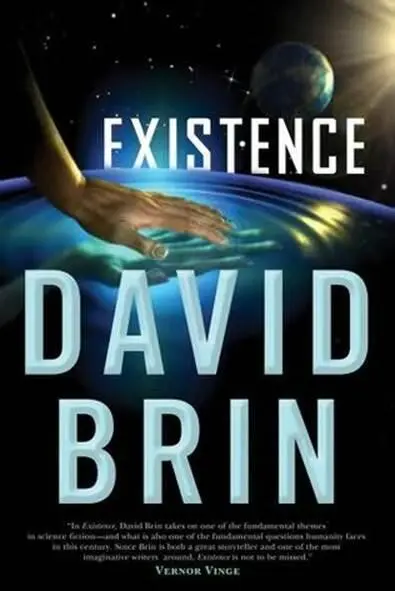
Astronaut Gerald Livingstone grabs a crystal lump of floating space debris. Little does he suspect it's an alien artifact, sent across the vast, interstellar gulf, bearing a message.
"Join us!" – it proclaims. What does the enticing invitation mean? To enroll in a great federation of free races?
Only then, what of rumors that this starry messenger may not be the first? Have other crystals fallen from the sky, across 9,000 years? Some have offered welcome. Others… a warning!
This masterwork of science fiction combines hard-science speculation and fast-paced action with the deeply thoughtful ideas and haunting imagery that David Brin (best-selling author of Earth and The Postman) is known for in more than twenty languages.
Existence — читать онлайн бесплатно полную книгу (весь текст) целиком
Ниже представлен текст книги, разбитый по страницам. Система сохранения места последней прочитанной страницы, позволяет с удобством читать онлайн бесплатно книгу «Existence», без необходимости каждый раз заново искать на чём Вы остановились. Поставьте закладку, и сможете в любой момент перейти на страницу, на которой закончили чтение.
Интервал:
Закладка:
“I see,” Lacey ventured. “But when a virus invades a cell, it hijacks every resource to make unlimited self-copies, even risking the host’s life, then compels the host organism to spew them toward more potential hosts. Like a flu victim, coughing upon neighbors.”
“Except,” mused a cyber-psychologist from Capek Robotics, “here the viral invader is a physically passive crystal, that does nothing, interacting only via information. And the host is human civilization.”
Lacey shook her head. “Wow, that comparison is sure to win friends.”
Henri seemed impervious to sarcasm. “Madam Donaldson-Sander, the parallel-while not perfect-appears apt. Only instead of injecting new genetic instructions, this kind of self-replicating machine utilizes persuasion. The enticement of adventure. An allure of personal immortality. The temptation of new technology… all of it augmented by a threat of impending species extinction. Each of these appear to be effective selfish memes.”
“They must have already been effective,” interjected Ram Nkruma, a bio-informatics specialist from Ghana. “A hundred previous organic species were talked into participating, adding their own twists. Refining the message.”
“You mean, earlier copies of this-space virus-managed to get those other races to sneeze more crystal envoys onward, into space.”
Lacey motioned toward the thick glass separating their advisory group from the main contact commission. Right now, Gerald Livingstone and other team members were gathered in a corner, arguing. Some distance away, schematics scrolled across the ovoid’s inner face while technicians recorded ream after ream of documents and animations. Tutorials aimed at teaching humanity how to make more crystal messengers.
“But surely these things have one trait that distinguishes them, crucially, from viruses?”
“What trait is that, madam?”
“They’re technological! Someone, millions of years ago, designed and built the first of them. Why?”
“Perhaps they were dying,” suggested Mercedes Luagraha, an ethnologist from Malta. “Aren’t you all being awfully cynical? Have you considered the possibility that these visitors are telling the truth?”
“Indeed,” commented the group’s mobentity image. Hermes was still a golden-haired deity; only now the ersatz aivatar wore a business suit and glasses, toning down the irritating Greek-god schtick. It still sifted the Mesh for them, gathering worthwhile insights, offering them almost like a full member. “Take the story told by the alien image called ‘Oldest Member.’ The grim news that all tech-civilizations fail. There is much that is consistent about it. These probes may have once upon a time started with good intentions.”
“Such as?”
“Preserving as much of every civilization as possible. For several generations they might have crammed in data about each parent society, its cherished arts and philosophical riches… the sort of treasures that humans might stuff into a time or space capsule, hoping to show others who we were and what we were like.
“Some contents might even aim to be helpful-methods or advice so the next race would stand a better chance. Clues to help solve the Riddle of Existence.”
Lacey blinked at the strong illusion that Hermes was a person, instead of a program designed to seem that way. “Only then?” Ram prompted.
“Over time, new forces came into play. The twin engines of selection and reproduction rewarded those crystal-machines that traded altruism for influence and efficiency.”
Ram nodded. “And this grew compelling when competition broke out among varieties of chain-letter devices.”
“When we finally have other crystals to compare, I expect they’ll offer competing features,” Henri said. “Take that trait of efficiency. Shall we construct a million complex emissaries… or billions of slimmed-down models… or even trillions of super tiny envoys? I’ve seen proposals for interstellar probes the size of a fingernail! There must be some trade-off between numbers and capability-finally balancing out with the size we’ve seen.
“Still, there’d be enormous selective pressure to reduce stored content, jettisoning lots of history and culture stuff, until you’re down to the basic sales pitch. Appeal to fundamental drivers: vanity, personal survival, fear of extinction. Aim your message at the local tribe’s controlling elites, who can order factories and launchers built.”
Lacey felt both entranced and disgusted. “So the trait of being truly helpful would be… selected against.”
Lacey tried not to shed tears, envisioning the older type of envoy probe. The explorers. How wonderful to discover one of those, packed with distilled treasures. Perhaps the coming space missions might find some.
She coughed to clear her throat. “Of course the real issue is now obvious.”
“Oh?” asked Hermione Radagast, from the Rowling Foundation. “What is it, Madam Donaldson-Sanders?”
Lacey wished her personal counselor, Professor Noozone, were here instead of waging battle across the airwaves, combating the insidiously attractive-but-ridiculous Hamish Hoax. If he were present, the rastascience showman would shout the obvious. “We need to learn whether interstellar viruses are actively lethal to their hosts.”
Those at the conference table pondered in silence, until Hermes summed it up.
“In other words, the story we are told by the alien figures… that all organo-technic civilizations fail, and our sole path is to escape as individuals… that tale may be backward . It could be that organo-technic civilizations fail because they come into contact with infectious, interstellar fomites.”
A definition popped into Lacey’s POV, describing a fomite as any object or substance that conveys sickness upon contact.
Contact, she thought. How I used to love that word. It felt cozy, intimate, hopeful. Not at all like rape.
“The world of the bat-helicopter beings blew themselves up while dispatching copies,” said Henri. “The timing-”
“-may be coincidence,” Hermione interjected. “Or their nuclear spasm could have been a struggle over who got lifeboat seats. But you two see something even darker?”
Henri pondered. “Well… people hurry to the boats if they feel the ship is sinking. Could some of our modern pessimism and despair come from reprogramming by outsiders?”
“I wonder,” Ram added, “if earlier episodes of lost confidence may also have been inflicted on us. Like the whole first decade of the twenty-first century…”
“In which case,” Hermione demanded, “why taste this fruit at all! Instead of recording all these technical schematics”-she gestured at the scene beyond the glass-“let’s stuff the damned thing in a hole!”
“Millions want that,” Henri answered. “But we don’t dare. People will suspect that someone’s getting all the knowledge anyway, in secret, from this Artifact or another. There’s no surer path to war. This way, there’s some accountability. Everybody shares and gets to criticize each physical use of the technologies. Furthermore, just because we gain the knowledge, that doesn’t mean we have to build giant virus factories!”
“Sure,” Nkruma commented, in a calmer tone. “Some sapient races may make that choice. Refusing the offer. We’ll never know of them, because they sent no crystals! But turn down free technology completely? That won’t happen here on Earth. We’ll find a million excellent uses for new methods and tools. Moreover, as we advance, even swearing not to build chain letters, our rising technology will keep making it easier to change our minds.”
Читать дальшеИнтервал:
Закладка:
Похожие книги на «Existence»
Представляем Вашему вниманию похожие книги на «Existence» списком для выбора. Мы отобрали схожую по названию и смыслу литературу в надежде предоставить читателям больше вариантов отыскать новые, интересные, ещё непрочитанные произведения.

Обсуждение, отзывы о книге «Existence» и просто собственные мнения читателей. Оставьте ваши комментарии, напишите, что Вы думаете о произведении, его смысле или главных героях. Укажите что конкретно понравилось, а что нет, и почему Вы так считаете.