Stephen Baxter - Ark
Здесь есть возможность читать онлайн «Stephen Baxter - Ark» весь текст электронной книги совершенно бесплатно (целиком полную версию без сокращений). В некоторых случаях можно слушать аудио, скачать через торрент в формате fb2 и присутствует краткое содержание. Жанр: Фантастика и фэнтези, на английском языке. Описание произведения, (предисловие) а так же отзывы посетителей доступны на портале библиотеки ЛибКат.
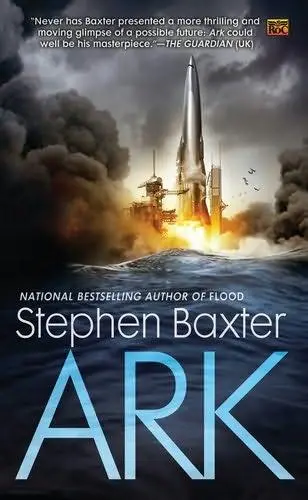
- Название:Ark
- Автор:
- Жанр:
- Год:неизвестен
- ISBN:нет данных
- Рейтинг книги:3 / 5. Голосов: 1
-
Избранное:Добавить в избранное
- Отзывы:
-
Ваша оценка:
Ark: краткое содержание, описание и аннотация
Предлагаем к чтению аннотацию, описание, краткое содержание или предисловие (зависит от того, что написал сам автор книги «Ark»). Если вы не нашли необходимую информацию о книге — напишите в комментариях, мы постараемся отыскать её.
Ark — читать онлайн бесплатно полную книгу (весь текст) целиком
Ниже представлен текст книги, разбитый по страницам. Система сохранения места последней прочитанной страницы, позволяет с удобством читать онлайн бесплатно книгу «Ark», без необходимости каждый раз заново искать на чём Вы остановились. Поставьте закладку, и сможете в любой момент перейти на страницу, на которой закончили чтение.
Интервал:
Закладка:
But she saw, too, that Zane’s proposal had been greeted with immediate approval. If they split up, Kelly would be able to get away from Wilson. Thomas Windrup would be free of Jack Shaughnessy and his scars. Their future, and maybe the future of all mankind, was going to be determined by the fact that after a decade on the Ark they were all sick of each other.
Mike Wetherbee growled, “You realize what’s happened. The craziest man on the ship just determined our whole damn future. And he did it by turning us all into a kind of mirror of his own fractured self. Jeez! He should be giving us therapy, not the other way around.”
73
November 2052
It took nearly a year to implement the Split.
They broke up the warp generator, under Zane Glemp’s uneven leadership, and used spares to rebuild it as two copies of itself. Kelly and Wilson thrashed out which subgroup would take which hull; it was decided that it was fairer for Kelly’s crew, with their shorter journey back to Earth, to take Seba, the fire-damaged hulk, while Wilson took Halivah. That decision seemed logical, but Holle wondered to what extent personal politics had again played their part. And they equipped a single shuttle glider to take Elle’s crew down to Earth II, with a share of tools and raw materials and seed stock from the store bequeathed to the project long ago by Nathan Lammockson.
They began to say their goodbyes, first to the colonists of Earth II. Wilson arranged a kind of ceremony, in which each of the colonists was given a small stainless-steel globe of their new planet, manufactured in the Ark’s machine shop. Holle found it almost impossible to say good-bye to the Candidates, like Cora and Thomas and Elle, with whom she’d grown up, and shared a common mission all her life, and with whom she’d expected to grow old. Now she’d never see them again.
The two hulls were still linked by the tether, still wheeling around their common center of gravity over the steel ocean of Earth II, when the colony shuttle was released. Everybody left aboard the Ark followed the little craft’s progress as it cut into the new world’s tall, thin atmosphere, and created a shining contrail of incandescent plasma that dipped down toward its landing place on the Belt.
Then came the final sorting-out between the twin hulls, Seba and Halivah, the last transfer of materials, the last handshakes. Holle hated to let go of the Shaughnessys, who she had worked closely with since the launch at Gunnison. But they wanted to go home.
And then, for the second time since Jupiter, the tether was cut by its explosive guillotine, and the hulls drifted apart.
Seba was to be the first of the hulls to create its warp bubble. From Halivah, Holle watched curiously from the cupola, beside Venus. It happened as Seba was crossing the face of Earth II, from Holle’s point of view. A whole section of the planet, a rough disc, seemed to crumple as if crushed by an invisible fist, the colors of land and sea running like wet paint. But then it rebounded, and Seba was gone.
It was only then that Wilson discovered that Kelly Kenzie had kidnapped Mike Wetherbee, the only doctor, and taken him away to Earth. Wilson’s rage endured for days.
Five
74
July 2059
It was Boris Caistor, thirteen-year-old Boris with his sharp young eyes, who first noticed the new light in the sky, a spark sailing through the deeper dark between the banks of cloud.
“Thea saw it too,” he told Thandie Jones. “She says she can see a shape. Sort of long and thin, a splinter.”
Thandie, sitting on a surging raft in the middle of the ocean, looking up at a cloud-choked sky, frowned. “Surely two splinters, end to end, connected by a thread…”
“Nope. Just one. Of course she might be lying. Thea lies all the time, or makes stuff up anyhow. Once she said she saw this whale which-”
“Never mind!”
Thandie was pretty sure Boris didn’t understand what he had seen, not really, nor did he grasp its possible significance. And, worse, she was also sure he didn’t give a damn about it. Thandie had followed Lily Brooke’s lead in trying to maintain some kind of education program for the kids on the raft. But astronomy was about all you could manage, the changing starry sky the only show in town, all that would actually hook these kids’ interest in something other than food and swimming games and each other’s pretty bodies. Thandie suspected Boris’s brain was dissolving like those of the rest of his generation.
But he was a loyal kid, and he was kind to his honorary aunt Thandie, just as when she’d first met him in a cluster of rafts over the drowning relic of Everest and she’d seen him indulge the whims of another elderly lady, his great-great-aunt Lily Brooke. Boris was also bright and observant, and even though the seeing was always so phenomenally bad on this new, stormy ocean world he had been able to recognize the new light in the sky as something special, and maybe it was what Thandie had told him she had been expecting to see, for a year already.
If Boris had seen it so had others. So Thandie took one of her precious handhelds from within its brine-proof layers of plastic sheeting and let the solar cells power up the internal battery. She posted Boris’s sighting up to the hearth, and she sent out queries for other observations, especially of the thing’s first appearance in Earth orbit.
But she needed to see it for herself, and maybe get some idea of its orbital elements.
After that, for one night, two, then three, hell, as long as it was going to take, she sat on the raft’s deck in her old, much-traveled fold-out bucket chair, with a blanket wrapped over her legs, waiting for the clouds to clear. She kept drifting in and out of sleep. At seventy-three, and after a pretty hard life, she was blessed with reasonable health, but she felt the damp, and spent a lot of time asleep.
The raft was a big one, by the standards of those that had survived twenty years or more on an ocean patroled by the Spot and its offspring storms. It was constructed on pontoons of plastic oil drums and barrels, covered by sheets of slippery tarpaulin lashed down with orange cable. Once, this had been reinforced by a base of gen-enged seaweed, an AxysCorp product, a substrate that would feed on sunlight and the produce of the sea and grow and self-repair. This miracle substance, which Nathan Lammockson had hoped would be the saving of a waterlogged mankind, had turned out to have some fatal genetic flaw. After it had blackened and crumbled away, Thandie’s raft community had been able to scavenge replacement materials from the wrecks of other, even less fortunate rafts, all of its garbage recycled from the drowned civilization beneath their keels.
On this base sat a kind of floating shantytown, constructed of sheets of plastic and corrugated iron, proofed against the weather and the salty air of the sea. People lived off fish and other sea creatures, and birds’ eggs and processed seaweed, and they gathered their drinking water from the rain in upturned buckets. There was a farm, of sorts, in the middle of the raft, a heap of topsoil detached from the Andean hillside where the raft had first been constructed. Spindly crops grew, lovingly tended by old folk. There were even chickens, in a big plastic cage strapped to a wall. For power, a small bank of windmills stood over the farm, and there were panels of bright green AxysCorp solar energy panels, self-cleaning and self-repairing, almost like living things themselves. It was a constant battle to maintain all this, as the salt water forever poisoned the soil and withered the crops, and corroded electrics and any metal parts.
The younger generations helped out reluctantly. They didn’t care about farms. They didn’t even care about artificial light. They made fish-oil lamps, but rarely used them. If the skies were clear there was moonlight and starlight, and the luminescence of living things in the sea. And besides, who needed light at night? You didn’t need light to sleep or screw. So while the last of the land-born veterans struggled to keep all this junk going, the youngsters, Boris and his generation, went diving off the side of the raft into the endless ocean.
Читать дальшеИнтервал:
Закладка:
Похожие книги на «Ark»
Представляем Вашему вниманию похожие книги на «Ark» списком для выбора. Мы отобрали схожую по названию и смыслу литературу в надежде предоставить читателям больше вариантов отыскать новые, интересные, ещё непрочитанные произведения.






Обсуждение, отзывы о книге «Ark» и просто собственные мнения читателей. Оставьте ваши комментарии, напишите, что Вы думаете о произведении, его смысле или главных героях. Укажите что конкретно понравилось, а что нет, и почему Вы так считаете.