Arthur Zagat - The Golden Age of Science Fiction Volume IX
Здесь есть возможность читать онлайн «Arthur Zagat - The Golden Age of Science Fiction Volume IX» весь текст электронной книги совершенно бесплатно (целиком полную версию без сокращений). В некоторых случаях можно слушать аудио, скачать через торрент в формате fb2 и присутствует краткое содержание. Год выпуска: 2010, Издательство: Halcyon Press Ltd., Жанр: Фантастика и фэнтези, на английском языке. Описание произведения, (предисловие) а так же отзывы посетителей доступны на портале библиотеки ЛибКат.
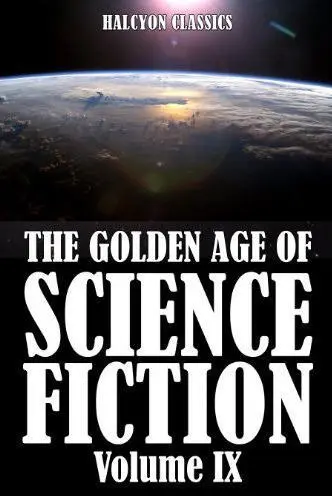
- Название:The Golden Age of Science Fiction Volume IX
- Автор:
- Издательство:Halcyon Press Ltd.
- Жанр:
- Год:2010
- ISBN:нет данных
- Рейтинг книги:4 / 5. Голосов: 1
-
Избранное:Добавить в избранное
- Отзывы:
-
Ваша оценка:
The Golden Age of Science Fiction Volume IX: краткое содержание, описание и аннотация
Предлагаем к чтению аннотацию, описание, краткое содержание или предисловие (зависит от того, что написал сам автор книги «The Golden Age of Science Fiction Volume IX»). Если вы не нашли необходимую информацию о книге — напишите в комментариях, мы постараемся отыскать её.
Included within this work are stories by H. Beam Piper, Murray Leinster, Poul Anderson, Mack Reynolds, Randall Garrett, Robert Sheckley, Stanley Weinbaum, Alan Nourse, Harl Vincent, and many others.
This collection is DRM free and includes an active table of contents for easy navigation.
The Golden Age of Science Fiction Volume IX — читать онлайн бесплатно полную книгу (весь текст) целиком
Ниже представлен текст книги, разбитый по страницам. Система сохранения места последней прочитанной страницы, позволяет с удобством читать онлайн бесплатно книгу «The Golden Age of Science Fiction Volume IX», без необходимости каждый раз заново искать на чём Вы остановились. Поставьте закладку, и сможете в любой момент перейти на страницу, на которой закончили чтение.
Интервал:
Закладка:
“I am sorry to hear that,” remarked John, “for even if I stayed here, I should not be likely to live long enough to see the next transit. Possibly you may do so, Merna; you are so much younger than I am.”
“Yes,” Merna replied, “it is not unlikely that I may see another such transit, for the average length of our lives on Mars is about equal to one hundred and thirty of your years, so that leaves me an ample margin of time.”
I then went on to remark that as another result of the thinness of the Martian atmosphere twilight is much shorter than on the earth, the light being less diffused when the sun is below the horizon, and refraction also considerably less than we experience.
In this connection, I mentioned to M’Allister that we can often see the sun and the moon apparently above the earth’s horizon when they are, in fact, below it. This is caused by the refractive power of our dense atmosphere, which has the effect of making both the sun and the moon appear a little higher up than they really are.
“That is something new to me, Professor,” exclaimed M’Allister; “and I cannot say I quite understand how refraction, as you term it, has the effect you mention.”
“It may help you, then,” I answered, “if I tell you that water acts very much in the same way; and there is a simple and fairly well-known experiment you might try for yourself, which would make the matter perfectly clear to you. It is as follows:—
“Take a teacup and place a shilling at the bottom of it, then move back until you quite lose sight of the coin. Ask some one to pour some clean cold water gently into the cup, and, as it fills, the refraction of the water will apparently reduce the depth of the cup, and thus bring the coin fully into view. In much the same way the refraction of the atmosphere enables us to see the sun or the moon when those bodies are actually below the horizon.”
“Thank you, Professor,” said M’Allister; “I will try that little experiment at the first opportunity.”
I then told him that at the time when the moon is just full it may rise towards the east just as the sun sets towards the west. Both orbs cannot be wholly above the horizon at the same time on such occasions, but, owing to refraction, we are able to see them both.
The sun and moon both appear flattened or oval-shaped just as they are rising or setting, in consequence of the effects of atmospheric refraction. These effects are usually most noticeable near the horizon, because the object is seen through the densest layers of air. But we never see a star in its true place in the sky, because the rays of light which come to us from the star are bent or refracted as they pass through our atmosphere, just as a stick appears to be bent when thrust down into a deep pool of clear water.
All these effects, however, add to the work of astronomers, because they must be taken into account in connection with their calculations.
As the time passed on, I day by day became more interested in Merna’s relations with Eleeta.
“All the world loves a lover,” and we elderly people are always pleased to note the progress of young folks’ love affairs, especially if either of them is a relative of ours. In them we seem to renew our youth, for their entrancements seem to carry us back to the halcyon days when we ourselves were young. When “Love took up the glass of time and turned it in his glowing hands” everything seemed of a roseate hue, and we dwelt in the seventh heaven of delight, at peace with all the world and envying no one—for were we not the most happy and fortunate of mortals!
And then, to look upon a Martian courtship! To see the rich flushes mount to the cheeks of the lovers—their softly glowing luminous eyes, their absorbed attention in each other, and their mutual deference and response to the most slightly indicated wish! Ah, it was indeed a scene to gladden the heart of the father of one of them!
Eleeta’s beauty, the sweetness of her disposition, and most charming and lovable ways endeared her so to me that I did not wonder Merna found them so attractive and satisfying; and my most fervent aspirations ascended for their happiness, both now and in the future.
With the Martians there is no false modesty about their courtships; all is natural, proper, and dignified; every one may see and every one enters into the true spirit of the thing. Mere flirtations, such as we are so familiar with, are quite unknown, as they would be contrary to all the natural instincts of the people. Everything upon Mars is honest, true, and straightforward—open and above-board. This must necessarily be so, in consequence of the Martians’ powers of intuition, for any attempt at imposition or deceit would at once be detected.
I had an illustration of this when I asked Merna, “How they dealt with their criminals?”
“We have none to deal with,” he replied, “and you will understand why, when I tell you, that if any one committed a crime, however small, and it was desired to find out the offender, it would be impossible to escape detection. He might fly to the other side of our world, but the intuitions of our experts would at once make them aware of his hiding-place; besides, he could not conceal what was on his mind from any one with whom he associated.
“In the earlier times when only a small proportion of the Martians were endowed with these powers to any large extent, there were occasional crimes; but as they were always detected, crime soon ceased to exist.
“Thus you will see that, quite apart from their high standard of morality, the Martians soon found that crime was a folly.”
There was another love affair apparently developing which did not afford me so much satisfaction as that to which I have just alluded.
I noticed that John and Siloni were very frequently together; and, whatever might be the case with the latter, I had very little doubt that John was smitten with his companion’s charms. It was, perhaps, nothing to be wondered at, for Siloni was indeed a very nice girl, with beautiful features, dark hair, and dark eyes; whilst John was well-built, fully six feet in height, with black hair and moustache, and very good-looking; altogether a fine and attractive man, and it had often been a matter of surprise to me that he had never married.
Still, such a complication as this had never entered my mind when I came to Mars, and I was rather perplexed to know how best to deal with the situation. However, I thought it would be well to wait a little while and see how the matter shaped itself before taking any action.
CHAPTER XXII
CELESTIAL PHENOMENA SEEN FROM MARS—M’ALLISTER RECEIVES A PRACTICAL LESSON IN GRAVITATION
Mars is really an ideal world for an astronomer to live in, its skies being so clear, the air so thin and pure, and the stars shining so brilliantly.
Besides these advantages, the rapid movements of the two satellites of the planet result in a constant succession of celestial phenomena which afford very frequent opportunities for most interesting observations. Changes in the phases of the two moons, eclipses, occultations, transits, &c., are constantly occurring, so there is nearly always something to attract our attention to the Martian sky.
We have already seen several of these phenomena, and I will now describe what we have observed.
Early one evening when we were out with Merna, we looked up at the sky and saw the two moons a considerable distance apart, but approaching each other from opposite directions, Phobos appearing to move very rapidly. Both were near the full phase, Deimos being more nearly full than Phobos; and we watched them drawing closer and closer together till Phobos passed right in front of Deimos so as to hide it entirely. This is termed an occultation; and both the satellites had become full when the occultation occurred; but when they were again clear of each other both were beginning to wane.
Читать дальшеИнтервал:
Закладка:
Похожие книги на «The Golden Age of Science Fiction Volume IX»
Представляем Вашему вниманию похожие книги на «The Golden Age of Science Fiction Volume IX» списком для выбора. Мы отобрали схожую по названию и смыслу литературу в надежде предоставить читателям больше вариантов отыскать новые, интересные, ещё непрочитанные произведения.



Обсуждение, отзывы о книге «The Golden Age of Science Fiction Volume IX» и просто собственные мнения читателей. Оставьте ваши комментарии, напишите, что Вы думаете о произведении, его смысле или главных героях. Укажите что конкретно понравилось, а что нет, и почему Вы так считаете.