Gregory Benford - Jupiter Project
Здесь есть возможность читать онлайн «Gregory Benford - Jupiter Project» весь текст электронной книги совершенно бесплатно (целиком полную версию без сокращений). В некоторых случаях можно слушать аудио, скачать через торрент в формате fb2 и присутствует краткое содержание. Город: Berkley, Год выпуска: 1980, ISBN: 1980, Издательство: Berkley Book, Жанр: Фантастика и фэнтези, на английском языке. Описание произведения, (предисловие) а так же отзывы посетителей доступны на портале библиотеки ЛибКат.
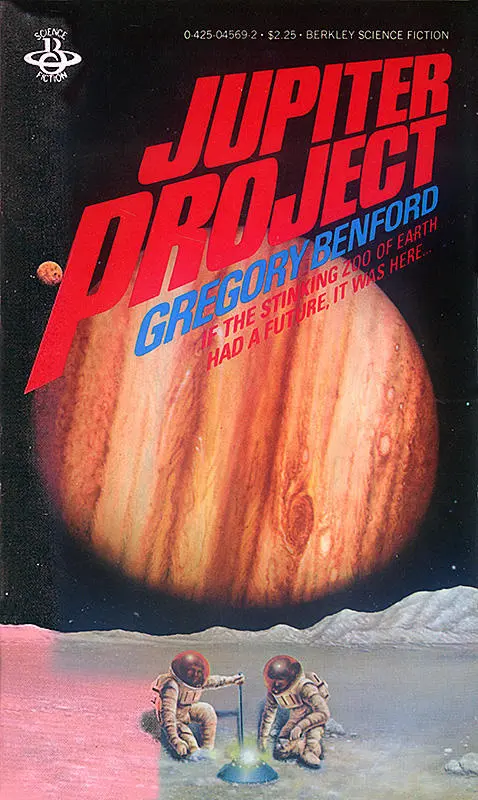
- Название:Jupiter Project
- Автор:
- Издательство:Berkley Book
- Жанр:
- Год:1980
- Город:Berkley
- ISBN:0-425-04569-2
- Рейтинг книги:4 / 5. Голосов: 1
-
Избранное:Добавить в избранное
- Отзывы:
-
Ваша оценка:
Jupiter Project: краткое содержание, описание и аннотация
Предлагаем к чтению аннотацию, описание, краткое содержание или предисловие (зависит от того, что написал сам автор книги «Jupiter Project»). Если вы не нашли необходимую информацию о книге — напишите в комментариях, мы постараемся отыскать её.
man did get to feel a bit squeezed, growing up in a tin can 600 million klicks from Mother Earth…
But the International Space Administration was losing its patience with the slow advance of science. There was talk of closing down the lab. The Earthside pols wanted publicity, adventure and profits—and not necessarily in that order.
So Matt had a bright idea. He figured he’d steal a spacesuit. Grab a spare shuttlecraft. And discover life on Jupiter…
Jupiter Project — читать онлайн бесплатно полную книгу (весь текст) целиком
Ниже представлен текст книги, разбитый по страницам. Система сохранения места последней прочитанной страницы, позволяет с удобством читать онлайн бесплатно книгу «Jupiter Project», без необходимости каждый раз заново искать на чём Вы остановились. Поставьте закладку, и сможете в любой момент перейти на страницу, на которой закончили чтение.
Интервал:
Закладка:
“Yes, that’s Sagdaeff. He has good political connections Earthside. I don’t understand politicians—never learned to smile without meaning it—but I think Sagdaeff wants to parley the rearrangement, if it happens, into a promotion for himself. Maybe he’s fishing for Aarons’ job.”
“Interesting,” I said thoughtfully. “Do you think there’s really going to be a scaledown, Dad?”
“I gave up reading tea leaves long ago,” he said. “I shouldn’t have told you this gossip, either. Back to the guitar, son.” He gave me a slap on the back. I realized he was probably trying to distract me from thinking about Yuri. So I started plucking and strumming again, and pretty soon I was immersed in the music.
Dad came back an hour later, whistling, to remind me that it was time to dress. I put on the only formal clothes I have: a black suit with broad lapels, cut back severely in the style of five years ago. Mom had let out the seams as much as possible but the inevitable had caught up with me; the pants pinched, my stockings showed stretches, and she’d had to piece the shoulders so I wouldn’t lose blood circulation in my arms. It didn’t matter much that the suit was hopelessly out of fashion on Earth—everybody else in the Lab was in the same boat, and anyway I liked the sequins on the cutaway lapels of the jacket.
Dad and I walked to the central auditorium, me lugging my guitar case. People were already filling the bowl of seats. Jenny was waiting outside. She squeezed my hand and wished me good luck and I made small talk. I didn’t want to tell anybody about the Ganymede trouble and at the same time I couldn’t think of anything else, so I must have sounded like a dodo. After a few minutes of monosyllables from me Jenny gave up and went to find a seat.
Backstage was a hubbub with people carrying props and sets around, women touching up their makeup and a few trying to learn their lines at the last minute. I found a corner to wait in and sat down.
I could hear Commander Aarons introducing the program; his deep voice boomed out over the crowd without need of a microphone. Almost everyone in the Can was there. The auditorium is pretty far inward toward the axis, so gravity there is only a small fraction of a g.
The first act used that fact to advantage: it was a family team I’d watched before, performing ballet feats that would be impossible on Earth. They leaped and whirled and threw each other high in the air. It made you feel light and carefree yourself, just looking at them.
Mr. and Mrs. Bhadranin went on next. She plays tabula while her husband performs on the sitar, an Indian instrument. It was beautiful. Mr. Bhadranin let me fool around with his sitar once and I came away impressed; compared to it the guitar is a kazoo. Mastering the sitar is impossible—men simply devote their lives to it and try to achieve as much as possible. It’s not an instrument for a dabbler like me.
A bunch from Maintenance followed. They did an involved skit about how messy the other divisions of the Lab were. The skit ended with everybody being forced to live outside the Can because the interior was crammed with garbage. I suppose it was funny, because people laughed a lot. I wasn’t paying attention; I was going on next.
The skit ended. I picked up my guitar—I’d tuned it during the bursts of laughter—and stopped at the edge of the curtain for Commander Aarons to introduce me.
The Commander is a big, stocky man with a grizzled moustache and a lot of smile lines around his mouth. He keeps up his ruddy tan and always looks like he’s in perfect health. That’s why I noticed the difference this time. He was standing off to the side of the stage, talking to one of the Lab officers. The officer was still in uniform, as though he had just left the bridge. The Commander was scowling. His face had turned pale. He asked the officer a question, listened, and then looked across the stage at me.
He made a gesture for me to stay put. The Commander walked to the center of the stage and held up a hand. The crowd quieted.
“I am afraid the rest of tonight’s program will not be presented,” he said. There was a questioning hum from the audience.
“Tonight, while on duty and conducting satellite maintenance. Ishi Moto was killed by a small meteoroid. His death was instantaneous. The chunk of rock that struck him was only the size of a dime, but it was moving very fast.
“Ishi was a fine boy. I do not think it appropriate that we continue this program. Good evening.”
Chapter 9
There isn’t much to say about the rest of that night. At first I could not believe it: as soon as the curtain was drawn I rushed over to Commander Aarons and asked, disbelieving, if I had heard him correctly. Hadn’t it been someone else, somebody with a name that sounded like Ishi?
Even as I said it I knew I was trying to run away from the truth, cover it up, pretend it wasn’t there. I turned away from the Commander and automatically, mechanically put my guitar back in its case. The air seemed heavy and warm.
I remember making my way out of the auditorium. I met my parents. I talked to Jenny. She was crying and I suddenly found that I was, too. Jenny and I stood in the middle of the crowd, crying and sobbing and holding each other, almost without knowing what we were doing. It was incredible. Ishi, gone. Forever.
After a few moments I recovered a bit. Zak was there; I hadn’t seen him before. He took Jenny away and I left with my parents. Suddenly I wanted to get away from that place and away from people.
We said nothing during the walk home. The terrible thing was that there was nothing to do. I guess there never is. Our society has no required ritual for friends and relatives of someone who has died. Instead, they sit and stare at each other and feel awkward, useless. They have no way to take the edge off their grief. I thought about that for a while until I realized that I was using the idea as a way to avoid thinking about Ishi, because that was too painful. And, of course, that thought made me feel even more rotten.
When we got home I went to my room. There didn’t seem to be anything to say to my parents, or to anybody, Ishi’s job had been one of the dangerous ones, sure, but the computed chances of a man ever being hit were infinitesimal. His death was a fantastic piece of bad luck. Space suits provide some protection against low-velocity meteoroids, but there isn’t much that can be done about a pebble traveling faster than a rifle bullet.
The Lab does what it can. We’ve searched out the dust clouds and small swarms of gravel orbiting Jupiter. When a shuttle goes out, the trajectory is programmed to keep the craft moving in the same direction as the matter around it, so that most of the tiny debris isn’t zipping by the shuttle. The best insurance is a fast trip, so the pilot spends as little time possible outside the Can.
All these things are fine, but they can’t add up to absolute safety. We don’t know enough about the junk circling Jupiter and we never will—radar won’t pick up small chips of rock.
So I laid in bed and thought about these things. And remembered Ishi. And wondered how many times in my life I would say good-bye to a friend, suspecting nothing, and then never see him again. It took me a long time to get to sleep.
The next morning our family went to extend condolences to Ishi’s family. We sat on the floor and conversed, almost whispering. Most of our talk was of inconsequential things: flower arranging, the comings and goings of people we both knew, the subtlety of watercolor prints. We spoke only briefly of Ishi.
We attended the service for Ishi together. His body was returned to the life cycle of the Can by breaking it down and distributing the elements to the chemical vats. Preserving the body and things of that sort are barbaric.
Читать дальшеИнтервал:
Закладка:
Похожие книги на «Jupiter Project»
Представляем Вашему вниманию похожие книги на «Jupiter Project» списком для выбора. Мы отобрали схожую по названию и смыслу литературу в надежде предоставить читателям больше вариантов отыскать новые, интересные, ещё непрочитанные произведения.





Обсуждение, отзывы о книге «Jupiter Project» и просто собственные мнения читателей. Оставьте ваши комментарии, напишите, что Вы думаете о произведении, его смысле или главных героях. Укажите что конкретно понравилось, а что нет, и почему Вы так считаете.