Gregory Benford - Jupiter Project
Здесь есть возможность читать онлайн «Gregory Benford - Jupiter Project» весь текст электронной книги совершенно бесплатно (целиком полную версию без сокращений). В некоторых случаях можно слушать аудио, скачать через торрент в формате fb2 и присутствует краткое содержание. Город: Berkley, Год выпуска: 1980, ISBN: 1980, Издательство: Berkley Book, Жанр: Фантастика и фэнтези, на английском языке. Описание произведения, (предисловие) а так же отзывы посетителей доступны на портале библиотеки ЛибКат.
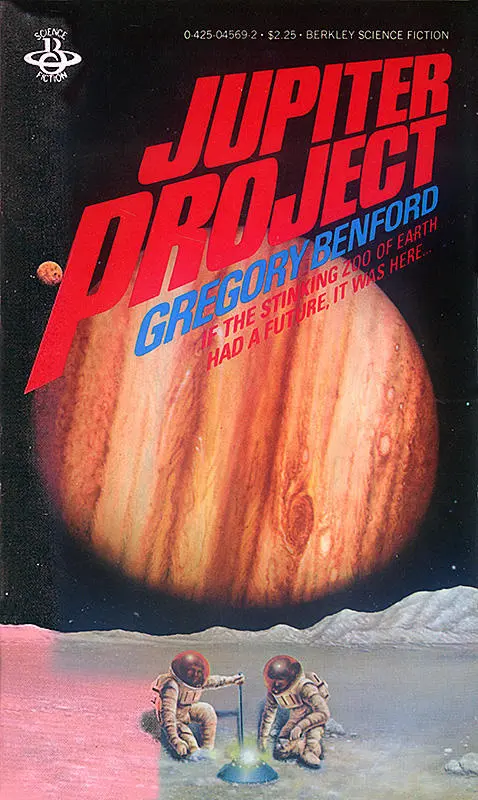
- Название:Jupiter Project
- Автор:
- Издательство:Berkley Book
- Жанр:
- Год:1980
- Город:Berkley
- ISBN:0-425-04569-2
- Рейтинг книги:4 / 5. Голосов: 1
-
Избранное:Добавить в избранное
- Отзывы:
-
Ваша оценка:
Jupiter Project: краткое содержание, описание и аннотация
Предлагаем к чтению аннотацию, описание, краткое содержание или предисловие (зависит от того, что написал сам автор книги «Jupiter Project»). Если вы не нашли необходимую информацию о книге — напишите в комментариях, мы постараемся отыскать её.
man did get to feel a bit squeezed, growing up in a tin can 600 million klicks from Mother Earth…
But the International Space Administration was losing its patience with the slow advance of science. There was talk of closing down the lab. The Earthside pols wanted publicity, adventure and profits—and not necessarily in that order.
So Matt had a bright idea. He figured he’d steal a spacesuit. Grab a spare shuttlecraft. And discover life on Jupiter…
Jupiter Project — читать онлайн бесплатно полную книгу (весь текст) целиком
Ниже представлен текст книги, разбитый по страницам. Система сохранения места последней прочитанной страницы, позволяет с удобством читать онлайн бесплатно книгу «Jupiter Project», без необходимости каждый раз заново искать на чём Вы остановились. Поставьте закладку, и сможете в любой момент перейти на страницу, на которой закончили чтение.
Интервал:
Закладка:
Before we bedded down I connected the air and water hoses from the Walker, clicked a toggle switch on the control board over to FILLING MODE, and forgot about it.
Monday morning the sun was a third of the way across the black sky and Jupiter’s banded crescent resembled a Cheshire cat’s grin. Yuri fixed a quick-heating breakfast and we set out.
Our route now ran due north. We wove through wrinkled valleys of tumbled stone and pink snowdrifts, keeping an eye open for anything unusual. We were heading for the edge of the “tropical” zone of Ganymede—the belt around the equator where the rock is exposed. Beyond that band lie the blue ice fields. The temperature drops steadily as you leave the equator. If the Walker would take us that far (and if we were crazy) we could have found mountain passes near the north pole nearly two hundred degrees centigrade below freezing.
Slowly, steadily, man is pushing the “tropical” zone toward the poles. Ganymede is warming up.
We avoided the areas near the fusion plants. The big reactors throw out heat and gas at an enormous rate. The ice around them melts and forms churning rivers. The warm water carries heat to neighboring areas and they start melting, too.
There’s a limit to the method, though. If you’re not careful, your fusion plants will melt their way into Ganymede and get drowned. Ganymede is a big snowball, not a solid world at all. It’s mostly water. There’s an ice crust about seventy klicks thick, with rock scattered through it like raisins in a pudding. Below that crust Ganymede is slush, a milkshake of water and ammonia and pebbles. There’s a solid core, far down inside, with enough uranium in it to keep the slush from freezing.
So the fusion plants don’t sit in one place. They’re big caterpillars, crawling endlessly outward from the equator. Their computer programs make them seek the surest footing over the outcroppings of rock—only they run on tracks, not feet. We saw one about midday, creeping over a ridgeline in the distance, making about a hundred meters in an hour, sucking in ice and spewing an ammonia-water creek out the tail. It carried a bright orange balloon on top. If it melts its surroundings too fast and gets caught in a lake, it will float until a team can come to fish it out.
Given half a century, they’ll give us a thick atmosphere and burn away the toxic gases. Another twenty years and there will be Earth-style air and crops and people on Ganymede. I might live to see that—or maybe by that time I’ll be in a Walker on Titan. Saturn’s huge moon.
Not that Ganymede was all that cozy now. Our cabin heater ran constantly to fight off the chill that seeped in. Halfway through Monday morning we stopped in a narrow valley and I suited up; the sensor package I had to check out was a klick away, halfway up the side of a hill. The path was too dangerous for the Walker.
I was glad to get the exercise. Ammonia fog boiled up from the valley and wreathed the peaks ahead. I got so interested in the view I almost missed the package. It was a metal box with scoops and nozzles sticking out in all directions. I opened it up and took out the set of test tube samples I was to carry back. The map had carried a red tag at this one, so I looked it over.
The water collector had a pebble caught in the middle. Probably it had lodged there during one of the pint-sized quakes Ganymede has: tidal strains keep the rock and ice sheets butting each other. I replaced a defective bleeder valve in the oxygen sampler and hiked back to the Walker.
After I unsuited I made the mandatory hourly radio call back to the base. A familiar voice answered.
“Zak!” I said. “Don’t tell me you’re holding up your literary career to stand radio watch.”
“Funny man. There isn’t anything else to do, with a bum ankle. How are you and Yuri making out?”
“Okay. Say, would you monitor that package I just fixed?”
“Sure, just a minute. Yes, she’s sending an all clear now.”
We talked for several minutes. There wasn’t any important news from the Can and Zak seemed a little bored.
Yuri nudged me. “You guys going to talk forever?”
“Signing off, Zak. ” I said, and replaced the mike. “What’s bugging you, Yuri?”
“Nothing. I just don’t think you guys should jam up the airwaves with idle chatter,” he said, not looking at me.
It seemed to me he was put out because Zak didn’t ask to speak to him. Even Yuri wanted to have some friends; there’s nothing like a few days out in the Ganymede wastelands to make you feel lonely.
We stopped several times that day to check out sensor packages. Most of them were at least a few hundred meters from any spot a Walker could reach. They’re set up high to keep them out of the gully-washers that sometimes come pouring down the valleys from some distant fusion caterpillar. Yuri and I took turns going out to them; somebody has to stay with the Walker at all times.
I found one package that had been the victim of a quake. The soil under one of its legs had dropped two feet and the package was teetering on the edge of a hole. All its sample tubes had broken.
The third time Yuri went out he came back empty-handed. He couldn’t find his package. I violated regs a little—the site was only a city block away from the Walker—and walked out to it with him.
“You know, I remember this spot,” I said. “We came by here a few years ago. The package is right around this ledge.”
“Well, it’s not here now,” We were standing by a shelf of yellow rock with boulders scattered around.
“What did the map say was wrong with it?”
Yuri looked around impatiently. “It stopped transmitting a few months ago. That’s all they know.”
I turned to go. “Well, there’s—wait a minute! Isn’t that a Faraday cup?”
I bent down and picked up a little bell-like scrap of metal that was lying in the dust. “One of these is usually attached to the top of a sensor package.”
I looked at the nearest boulder. It must have weighed a ton, even on Ganymede. “I bet I know where our package is.”
We found one other piece of metal wedged under the edge of boulder. I hiked back and got a replacement package. It took a while to set up and this time we put it away from any overhang.
Getting the package’s radio zeroed in on the base was a little tricky since we were down in a low trough and had to relay the signals from base through the Walker’s radio at first. It took a big chunk out of the day. The next package to be checked was a mile walk from our planned way station for the night. We elected to leave it for morning, but then I got restless and said I would walk out to the site myself.
Jupiter’s eclipse of the sun was just ending as I set out. I took a break to watch the sun slip out from behind Jupiter. Suddenly the planet had a rosy halo; we were looking through the outer fringes of the atmosphere. The Can was a distant twinkle of white. I walked along a stream bed and in a way it was like early morning on Earth—as the sun broke out from behind Jupiter things brightened, and the light changed from dull red to a deep yellow. Everything had a clean, sharp look to it. The sun was just a fierce, burning point and there were none of the fuzzy half-shadows you’re used to on Earth. Ganymede’s man-made atmosphere is still so thin it doesn’t blur things.
I felt a pop. I stopped dead. I stood still and quickly checked my suit. Nothing on my inboard monitors. My lightpipe scan showed nothing wrong on my back. Suit pressure was normal. I decided it must have been a low-energy micrometeoroid striking my helmet; they make a noise but no real damage.
The micrometeoroid was probably some uncharged speck of dust, falling into Ganymede’s gravity well. If it had been charged, the superconductor threads woven into my suit would have deflected it. Superconductors are a marvel. Once you run a current through them, they keep producing a magnetic field—forever. The field doesn’t decay because there’s no electrical resistance to the field-producing currents. So even a one-man suit can carry enough magnetic shield to fend off the ferocious Van Allen sleet. And inside the suit there’s no magnetic field at all to disturb your instrumentation, if the threads are woven in right. The vector integrals involved in showing that can get messy, especially if you don’t know Maxwell’s equations from a mud puddle. But the stuff works, and that’s all I needed to know.
Читать дальшеИнтервал:
Закладка:
Похожие книги на «Jupiter Project»
Представляем Вашему вниманию похожие книги на «Jupiter Project» списком для выбора. Мы отобрали схожую по названию и смыслу литературу в надежде предоставить читателям больше вариантов отыскать новые, интересные, ещё непрочитанные произведения.





Обсуждение, отзывы о книге «Jupiter Project» и просто собственные мнения читателей. Оставьте ваши комментарии, напишите, что Вы думаете о произведении, его смысле или главных героях. Укажите что конкретно понравилось, а что нет, и почему Вы так считаете.