Sam Weller - Shadow Show
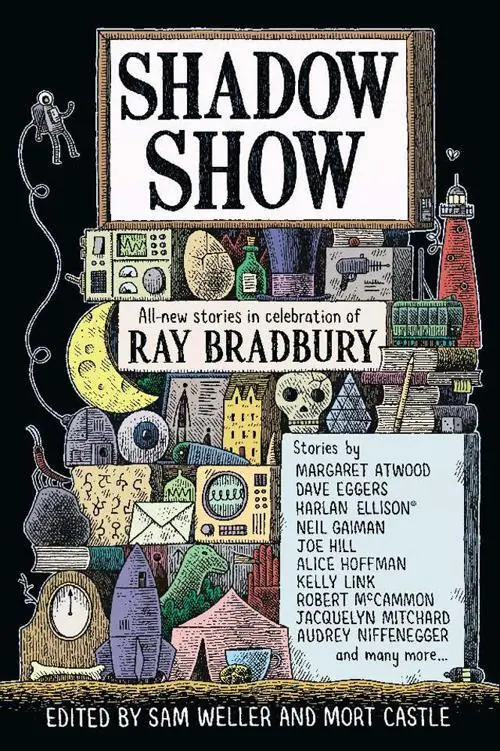
Здесь есть возможность читать онлайн «Sam Weller - Shadow Show» весь текст электронной книги совершенно бесплатно (целиком полную версию без сокращений). В некоторых случаях можно слушать аудио, скачать через торрент в формате fb2 и присутствует краткое содержание. Город: New York, Год выпуска: 2012, ISBN: 2012, Издательство: William Morrow, Жанр: Фантастика и фэнтези, Ужасы и Мистика, Фэнтези, на английском языке. Описание произведения, (предисловие) а так же отзывы посетителей доступны на портале библиотеки ЛибКат.
- Название:Shadow Show
- Автор:
- Издательство:William Morrow
- Жанр:
- Год:2012
- Город:New York
- ISBN:978-0-06-2122681
- Рейтинг книги:5 / 5. Голосов: 1
-
Избранное:Добавить в избранное
- Отзывы:
-
Ваша оценка:
Shadow Show: краткое содержание, описание и аннотация
Предлагаем к чтению аннотацию, описание, краткое содержание или предисловие (зависит от того, что написал сам автор книги «Shadow Show»). Если вы не нашли необходимую информацию о книге — напишите в комментариях, мы постараемся отыскать её.
.
Ray Bradbury—peerless storyteller, poet of the impossible, and one of America's most beloved authors—is a literary giant whose remarkable career has spanned seven decades. Now twenty-six of today's most diverse and celebrated authors offer new short works in honor of the master; stories of heart, intelligence, and dark wonder from a remarkable range of creative artists.
Shadow Show — читать онлайн бесплатно полную книгу (весь текст) целиком
Ниже представлен текст книги, разбитый по страницам. Система сохранения места последней прочитанной страницы, позволяет с удобством читать онлайн бесплатно книгу «Shadow Show», без необходимости каждый раз заново искать на чём Вы остановились. Поставьте закладку, и сможете в любой момент перейти на страницу, на которой закончили чтение.
Интервал:
Закладка:
“Oh!” the man suddenly said. His eyebrows went up. “Yes, I do!” He went back amid the dead electronics, and he bent down to a cardboard box on the floor. “It doesn’t work, of course, but—”
“ None of that works,” said the woman, feeling like he thought her a fool.
“It doesn’t need wires,” he told her. “Or didn’t need wires, I mean. Take a look at this .”
What he brought her looked like a brushed-aluminum urn, pointed at the top and flat at its base, with a small black hole at its center and a crank handle on its side.
“Do you know what it is?” the man asked.
“Somebody’s ashes in there? Or is it an oversized pepper grinder?”
The man gave her a lopsided smile. “It’s a bedtime machine,” he said.
“Bedtime machine,” the woman repeated.
“Sure is. I’ve only seen pictures in a magazine—a long time ago—but I remember my granddad telling me about them. He was a big…” The man paused, calling up a half-forgotten phrase. “Computer geek,” he announced.
“You must have a good memory,” the woman said. Her blue eyes were examining the object. There were no seams. Just the small black hole and the hand crank. “It doesn’t look like much to me. Can you open it up and use it as a planter?”
“No.” He’d almost laughed on that one. Then his voice became serious. “Hey… this was created for just your problem.”
“My problem? What problem?”
“Insomnia,” said the man. “You’ve never heard of a bedtime machine?”
“Never.”
“Well,” he began, as he turned the object between his hands and also eyeballed the surface, “I think I remember. They were created mostly for people in the cities. They were very expensive. Only rich people could afford them. I’m talking millions of euros. They were… like… magic lamps, in a way.”
“Magic lamps,” she repeated, thinking he needed to stay out of the sun for a few days.
“Yeah. You turned the crank. See?” The brushed-metal crank did turn, smoothly and soundlessly. “That builds up the electrical energy. Then… I guess when it’s ready, it switches itself on.”
“And does what?” She corrected herself: “ Did what?”
“Showed you something that was programmed just for you. A hologram, is what it was. You know about holograms, right?”
“I’m old but I’m not stupid.”
“Okay, no offense meant. It showed a hologram that was designed at the tech plant just for its owner. That’s why it was so expensive. The holograms—I remember my granddad saying this—were supposed to be of some peaceful image. Like nature or whatever. Something to help its owner sleep. I guess the cities were pretty noisy and chaotic twenty-four hours a day, huh?”
“People had too much stimulation,” the woman told him. “They were addicted to it. Like any drug. That’s what I remember.”
“Right,” the man said, as if—impossibly—he remembered it too.
“Okay.” The woman was ready to go. “Let’s see what cans you’ve got. We can talk a trade.”
“Take it,” said the man.
“Take what ?”
“This.” He held the bedtime machine out toward her. It must have been light, because he held it with one hand. “I’ve been cranking it for two nights. Nothing.”
“And I would want that piece of junk why ?”
“It’s something pretty. Don’t you think?”
“It’s junk,” the woman answered. “I’m here for food , not garbage.”
“It’s art ,” he replied, on a lame note. “Looks like an old rocket ship, I think. Hey, maybe it’ll work for you. Maybe you can get it to turn itself on.”
“Why would it?” she asked, her voice hardening. This was foolish. A foolish relic from a foolish time. “How’d it get here, anyway?”
“Came in a box with other stuff. A trader passing by. Where does any of it come from?”
“It’s useless,” she told him, and then she turned away.
“Take it if you want to,” he said to her back. “It’ll just sit here.”
“Let it sit,” she said.
She went to her task of trading. Bartering the tomatoes and the eggs for some canned food. The men always let her think she was getting a good deal, because she was a regular and they liked her. But they weren’t pushovers, that was for certain. She exchanged her goods for the two cans of pork-’n’-beans and two cans of ham spread she put into her backpack, and that would have to last her for a while.
It was time to go back home.
She took one more turn around the big store. Checking the shelves for what she might have missed, though she had nothing left to trade. She saw a woman she knew, and the woman’s little boy. She stopped to speak for a few minutes, just to be neighborly. Then she went on, with her backpack on her back, and she found herself at the rear of the big store where the old junk was piled up, and she stared at the shiny brushed-aluminum rocket ship of the bedtime machine on a card table with two warped legs.
Art , he’d called it.
She gave a little snort that made her nostrils flare.
It was pretty, if you thought about objects that way.
Maybe she could take the hand crank off and find a use for it?
Junk , she thought. But still… these days it was best not to turn down whatever was offered to you. Next time it might be something of value.
The woman picked up the bedtime machine—and it was as light as a dream, must not have any workings inside it at all—and shoved it into her backpack.
She said goodbye to the men, to the woman and the little boy, and then she got on her green bike and pedaled her way home.
It took her a while to actually put the thing on the chest of drawers in her bedroom. She tried to peer into the black hole. Tried to poke it with a finger. There was a lens of some kind deep within, almost too deep to touch. As the wind blew dust out in the dark and candles burned around her, the woman angled the machine so that the black hole was aimed into the room. She stood back for a few minutes, deciding what she should do next.
Well, it was pretty damned obvious, she thought.
She cranked.
And cranked.
And cranked.
It was a smooth motion, hardly any friction at all. Still, cranking was cranking. After a time she released the hand crank and stepped back and thought she was the biggest fool in this sad, broken world.
Nothing happened.
Nothing was going to happen.
The thing was dead.
And the woman realized she could cry over this. Could really let a sob go, if she wasn’t guarding herself so tightly. Because though she’d never expected anything to happen, she was still disappointed. The bedtime machine. A magic lamp. Something new, amid the old chore of day-to-day living. She had let herself believe that maybe— maybe —she really could wake the machine up. And from it might bloom a meadow of flowers under a star-strewn sky, and grass just soft enough for sleeping. Or a holographic waterfall, flowing across smooth, dark, beautiful stones right in the corner of the room. Or a beach at night, with the waves rolling in and the distant lights of ships blinking out at sea. Or a canopy of trees above her, with darkness laced through them like velvet, and from one of them a night bird singing sweetly, for her ears alone.
The woman did begin to cry. But just a little tear, because she knew disappointment and heartbreak as an old presence in life.
She had let herself feel hope. That had been her mistake.
She wiped her eyes, she got herself ready for bed, and she opened the special trunk and from it took a fragile book whose strength she counted on to lift her spirits during long nights like this, when the wind blew from here to there amid the spindly trees outside.
Читать дальшеИнтервал:
Закладка:
Похожие книги на «Shadow Show»
Представляем Вашему вниманию похожие книги на «Shadow Show» списком для выбора. Мы отобрали схожую по названию и смыслу литературу в надежде предоставить читателям больше вариантов отыскать новые, интересные, ещё непрочитанные произведения.


![Lord Weller - Ритера или опасная любовь [СИ]](/books/421202/lord-weller-ritera-ili-opasnaya-lyubov-si-thumb.webp)









Обсуждение, отзывы о книге «Shadow Show» и просто собственные мнения читателей. Оставьте ваши комментарии, напишите, что Вы думаете о произведении, его смысле или главных героях. Укажите что конкретно понравилось, а что нет, и почему Вы так считаете.