Sam Weller - Shadow Show
Здесь есть возможность читать онлайн «Sam Weller - Shadow Show» весь текст электронной книги совершенно бесплатно (целиком полную версию без сокращений). В некоторых случаях можно слушать аудио, скачать через торрент в формате fb2 и присутствует краткое содержание. Город: New York, Год выпуска: 2012, ISBN: 2012, Издательство: William Morrow, Жанр: Фантастика и фэнтези, Ужасы и Мистика, Фэнтези, на английском языке. Описание произведения, (предисловие) а так же отзывы посетителей доступны на портале библиотеки ЛибКат.
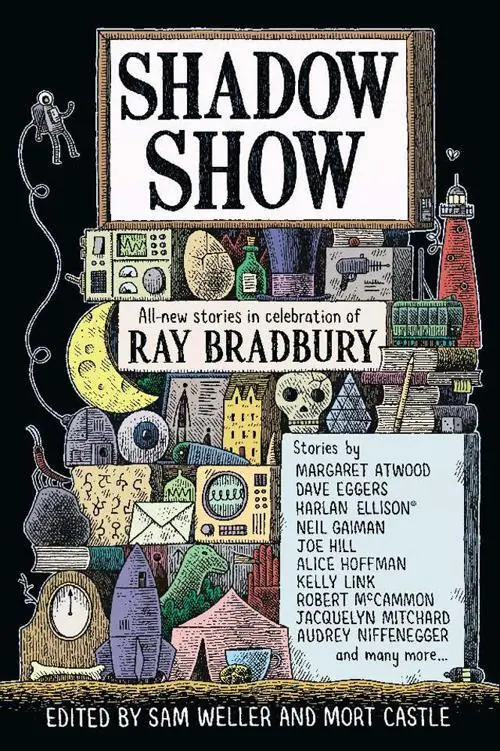
- Название:Shadow Show
- Автор:
- Издательство:William Morrow
- Жанр:
- Год:2012
- Город:New York
- ISBN:978-0-06-2122681
- Рейтинг книги:5 / 5. Голосов: 1
-
Избранное:Добавить в избранное
- Отзывы:
-
Ваша оценка:
Shadow Show: краткое содержание, описание и аннотация
Предлагаем к чтению аннотацию, описание, краткое содержание или предисловие (зависит от того, что написал сам автор книги «Shadow Show»). Если вы не нашли необходимую информацию о книге — напишите в комментариях, мы постараемся отыскать её.
.
Ray Bradbury—peerless storyteller, poet of the impossible, and one of America's most beloved authors—is a literary giant whose remarkable career has spanned seven decades. Now twenty-six of today's most diverse and celebrated authors offer new short works in honor of the master; stories of heart, intelligence, and dark wonder from a remarkable range of creative artists.
Shadow Show — читать онлайн бесплатно полную книгу (весь текст) целиком
Ниже представлен текст книги, разбитый по страницам. Система сохранения места последней прочитанной страницы, позволяет с удобством читать онлайн бесплатно книгу «Shadow Show», без необходимости каждый раз заново искать на чём Вы остановились. Поставьте закладку, и сможете в любой момент перейти на страницу, на которой закончили чтение.
Интервал:
Закладка:
I hope I’ve been able to do the same at the end of “Cat on a Bad Couch,” when my narrator, Lex, because of his own actions, is unable to fully connect with the one person left who might be most sympathetic to his loss.
—Lee MartinBY THE SILVER WATER OF LAKE CHAMPLAIN
Joe Hill
The robot shuffled clank-clank into the pitch dark of the bedroom, then stood staring down at the humans.
The female human groaned and rolled away and folded a pillow over her head.
“Gail, honey,” said the male, licking dry lips. “Mother has a headache. Can you take that noise out of here?”
“I CAN PROVIDE A STIMULATING CUP OF COFFEE,” boomed the robot in an emotionless voice.
“Tell her to get out, Raymond,” said the female. “My head is exploding.”
“Go on, Gail. You can hear mother isn’t herself,” said the male.
“YOU ARE INCORRECT. I HAVE SCANNED HER VITALS,” said the robot. “I HAVE IDENTIFIED HER AS SYLVIA LONDON. SHE IS HERSELF.”
The robot tilted her head to one side, inquisitively, waiting for more data. The pot on her head fell off and hit the floor with a great steely crash.
Mother sat up screaming. It was a wretched, anguished, inhuman sound, with no words in it, and it frightened the robot so much, for a moment she forgot she was a robot and she was just Gail again. She snatched her pot off the floor and hurried clangedy-clang-clang to the relative safety of the hall.
She peeked back into the room. Mother was already lying down, holding the pillow over her head again.
Raymond smiled across the darkness at his daughter. “Maybe the robot can formulate an antidote for martini poisoning,” he whispered, and winked.
The robot winked back.
For a while the robot worked on her prime directive, formulating the antidote that would drive the poison out of Sylvia London’s system. The robot stirred orange juice and lemon juice and ice cubes and butter and sugar and dish soap in a coffee mug. The resulting solution foamed and turned a lurid sci-fi green, suggestive of Venutian slime and radiation.
Gail thought the antidote might go down better with some toast and marmalade. Only there was a programming error; the toast burnt. Or maybe it was her own crossed wires beginning to smoke, shorting out the subroutines that required her to follow Asimov’s laws. With her circuit boards sizzling inside her, Gail began to malfunction. She tipped over chairs with great crashes and pushed books off the kitchen counter onto the floor. It was a terrible thing but she couldn’t help herself.
Gail didn’t hear her mother rushing across the room behind her, didn’t know she was there until Sylvia jerked the pot off her head and flung it into the enamel sink.
“What are you doing?” Sylvia screamed. “What in the name of sweet Mary God? If I hear one more thing crash over, I’ll take a hatchet to someone. My own self maybe.”
Gail said nothing, felt silence was safest.
“Get out of here before you burn the house down. My God, the whole kitchen stinks. This toast is ruined. And what did you pour in this Goddam mug?”
“It will cure you,” Gail said.
“There isn’t no cure for me,” her mother said, which was a double negative, but Gail didn’t think it wise to correct her. “I wish I had one boy. Boys are quiet. You four girls are like a tree full of sparrows, the shrill way you carry on.”
“Ben Quarrel isn’t quiet. He never stops talking.”
“You ought to go outside. All of you ought to go outside. I don’t want to hear any of you again until I have breakfast made.”
Gail shuffled toward the living room.
“Take those pots off your feet,” her mother said, reaching for the pack of cigarettes on the windowsill.
Gail daintily removed one foot, then the other, from the pots she had been using for robot boots.
Heather sat at the dining room table, bent over her drawing pad. The twins, Miriam and Mindy, were playing wheelbarrow. Mindy would hoist Miriam up by the ankles and walk her across the room, Miriam clambering along on her hands.
Gail stared over Heather’s shoulder at what her older sister was drawing. Then Gail got her kaleidoscope and peered at the drawing through that. It didn’t look any better.
She lowered her kaleidoscope and said, “Do you want me to help you with your drawing? I can show you how to draw a cat’s nose.”
“It isn’t a cat.”
“Oh. What is it?”
“It’s a pony.”
“Why is it pink?”
“I like them pink. There should be some that are pink. That’s a better color than most of the regular horse colors.”
“I’ve never seen a horse with ears like that. It would be better if you drew whiskers on it and let it be a cat.”
Heather crushed her drawing in one hand and stood up so quickly she knocked over her chair.
In the exact same moment, Mindy wheelbarrowed Miriam into the edge of the coffee table with a great bang. Miriam shrieked and grabbed her head and Mindy dropped her ankles and Miriam hit the floor so hard the whole house shook.
“GODDAM IT WILL YOU STOP THROWING THE GODDAM CHAIRS AROUND?” screamed their mother, reeling in from the kitchen. “WHY DO YOU ALL HAVE TO THROW THE GODDAM CHAIRS? WHAT DO I HAVE TO SAY TO MAKE YOU STOP?”
“Heather did it,” Gail said.
“I did not!” Heather said. “It was Gail!” She did not view this as a lie. It seemed to her that somehow Gail had done it, just by standing there and being ignorant.
Miriam sobbed, clutching her head. Mindy picked up the book about Peter Rabbit and stood there staring into it, idly turning the pages, the young scholar bent to her studies.
Their mother grabbed Heather by the shoulders, squeezing them until her knuckles went white.
“I want you to go outside. All of you. Take your sisters and go away. Go far away. Go down to the lake. Don’t come back until you hear me calling.”
They spilled into the yard, Heather and Gail and Mindy and Miriam. Miriam wasn’t crying anymore. She had stopped crying the moment their mother went back into the kitchen.
Big sister Heather told Miriam and Mindy to sit in the sandbox and play.
“What should I do?” Gail asked.
“You could go drown yourself in the lake.”
“That sounds fun,” Gail said, and skipped away down the hill.
Miriam stood in the sandbox with a little tin shovel and watched her go. Mindy was already burying her own legs in the sand.
It was early and cool. The mist was over the water and the lake was like battered steel. Gail stood on her father’s dock, next to her father’s boat, watching the way the pale vapor churned and changed in the dimness. Like being inside a kaleidoscope filled with foggy gray beach glass. She still had her kaleidoscope, patted it in the pocket of her dress. On a sunny day, Gail could see the green slopes on the other side of the water, and she could look up the stony beach, to the north, all the way to Canada, but now she could not see ten feet in front of her.
She followed the narrow ribbon of beach toward the Quarrels’ summer place. There was only a yard of rocks and sand between the water and the embankment, less in some places.
Something caught the light, and Gail bent to find a piece of dark green glass that had been rubbed soft by the lake. It was either green glass or an emerald. She discovered a dented silver spoon, not two feet away.
Gail turned her head and stared out again at the silvered surface of the lake.
She had an idea a ship had gone down, someone’s schooner, not far offshore, and she was discovering the treasure washed in by the tide. A spoon and an emerald couldn’t be a coincidence.
She lowered her head and walked along, slower now, on the lookout for more salvage. Soon enough she found a tin cowboy with a tin lasso. She felt a shiver of pleasure, but also sorrow. There had been a child on the boat.
Читать дальшеИнтервал:
Закладка:
Похожие книги на «Shadow Show»
Представляем Вашему вниманию похожие книги на «Shadow Show» списком для выбора. Мы отобрали схожую по названию и смыслу литературу в надежде предоставить читателям больше вариантов отыскать новые, интересные, ещё непрочитанные произведения.

![Lord Weller - Ритера или опасная любовь [СИ]](/books/421202/lord-weller-ritera-ili-opasnaya-lyubov-si-thumb.webp)







Обсуждение, отзывы о книге «Shadow Show» и просто собственные мнения читателей. Оставьте ваши комментарии, напишите, что Вы думаете о произведении, его смысле или главных героях. Укажите что конкретно понравилось, а что нет, и почему Вы так считаете.