Matt Bell - How They Were Found
Здесь есть возможность читать онлайн «Matt Bell - How They Were Found» весь текст электронной книги совершенно бесплатно (целиком полную версию без сокращений). В некоторых случаях можно слушать аудио, скачать через торрент в формате fb2 и присутствует краткое содержание. Год выпуска: 2011, ISBN: 2011, Издательство: Keyhole Press, Жанр: Фантастика и фэнтези, на английском языке. Описание произведения, (предисловие) а так же отзывы посетителей доступны на портале библиотеки ЛибКат.
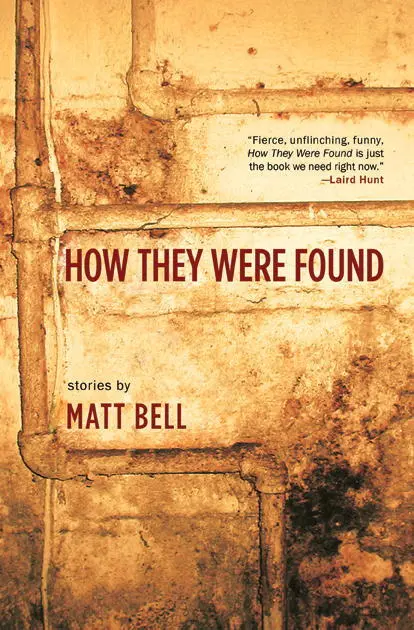
- Название:How They Were Found
- Автор:
- Издательство:Keyhole Press
- Жанр:
- Год:2011
- ISBN:9780982151259
- Рейтинг книги:4 / 5. Голосов: 1
-
Избранное:Добавить в избранное
- Отзывы:
-
Ваша оценка:
How They Were Found: краткое содержание, описание и аннотация
Предлагаем к чтению аннотацию, описание, краткое содержание или предисловие (зависит от того, что написал сам автор книги «How They Were Found»). Если вы не нашли необходимую информацию о книге — напишите в комментариях, мы постараемся отыскать её.
, Matt Bell draws from a wide range of genres to create stories that are both formally innovative and imaginatively rich. In one, a 19th-century minister follows ghostly instructions to build a mechanical messiah. In another, a tyrannical army commander watches his apocalyptic command slip away as the memories of his men begin to fade and fail. Elsewhere, murders are indexed, new worlds are mapped, fairy tales are fractured and retold and then fractured again.
Throughout these thirteen stories, Bell’s careful prose burrows at the foundations of his characters’ lives until they topple over, then painstakingly pores over the wreckage for what rubbled humanity might yet remain to be found.
Contains the story “Dredge,” selected for
. Review
“Body toll notwithstanding,
is anything but bleak. For one thing, there’s the prose: generous, urgent, rhythmic.”
—
“Reminscent of Friedrich Dürrenmatt’s
in its calm examination and unsettling embodiment of mental and physical extremes,
is a dreamer’s chronicle of the loss and partial recovery of a world given over to the wrecking ball. Fierce, unflinching, funny,
is just the book we need right now, Matt Bell just the writer.”
—Laird Hunt, author of
“
offers a world with shifting rules, described with a lovely and deceptive simplicity. This guide shows you thirteen different types of wilderness, and you can spend all day exploring before you realize you are lost.”
—Amelia Gray, author of
and
“You’re a robot if the stories in Matt Bell’s debut collection don’t exhilarate, frighten, and unalterably change you. His wild manipulation of form and genre makes the bulk of contemporary fiction feel bloodless and inert in comparison, but it is Bell’s recurring arrival at something sturdy and true about human behavior that makes the stories in *How They Were Found* so rewarding and resonant.”
—Matthew Derby, author of
How They Were Found — читать онлайн бесплатно полную книгу (весь текст) целиком
Ниже представлен текст книги, разбитый по страницам. Система сохранения места последней прочитанной страницы, позволяет с удобством читать онлайн бесплатно книгу «How They Were Found», без необходимости каждый раз заново искать на чём Вы остановились. Поставьте закладку, и сможете в любой момент перейти на страницу, на которой закончили чтение.
Интервал:
Закладка:
Besides the letters, there was one final object found in the master bedroom, hidden beneath a canvas tarp. It is a model, a doll house, a scaled approximation of the brownstone home. Inside, the model’s smooth wood floors are stained and then carpeted, the walls all papered or painted with care. There is an intricately carved staircase that winds to the second floor, its splendor shaming its murderous real-life counterpart. Tiny paintings hang on the walls, painstaking recreations of the smeared and slashed portraits found downstairs. Miniature chandeliers dangle from the ceilings in nearly every room.
There are tiny beds, tiny tables and chairs, tiny pianos. There are even tiny books with tiny pages and a violin so small that it would take a pair of tweezers to hold its bow.
In the downstairs sitting room, there is a tiny version of what Homer’s chair must have looked like before the leather tore open, before its stuffing leaked onto the floor.
This is a house without traps, without tunnels and stacks and collections that never seem complete.
In the absence of photographs, this is perhaps the closest thing to the truth of who these people used to be.
The wood floor around the model gleams, its surface scrubbed and polished, contrasting with the filth and rot of the rest of the room, left unprotected by the tarp.
Outside this circle, there are dozens of prototypes for what would have been the model’s finishing touches: Four figures, repeated over and over in different mediums. A man and a woman and two small boys, rendered from wood and clay and string and straw and hair and other, less identifiable materials. All discarded, cast aside, and no more a family than anything else we found lying upon the floors of the Collyer House.
I wanted to leave after both of you were dead, or at least after your bodies were bagged and covered and taken out into the sunlight that awaited you, that had always been waiting. Instead, I remain here, walking these emptying halls. Without you to talk to, I become desperate for connection, for these workers tearing down your tunnels to see what you had become, what you might have been instead. I tap a new father on the shoulder so that he turns and sees the child’s mobile hanging in a newly opened space, its meaning slanted by your own childlessness. I open a medical reference text to the page on treatments for rheumatoid arthritis or diabetic blindness, then leave it on top of the stack for someone else to read, to note what is absent, to see that nowhere on the page is the cure of the hundred oranges you prescribed your brother. I whisper explanations into curious ears, explain that what you had planned to do with all these piles of lumber was to build a house inside the house, to build a structure capable of holding a family together, something the previous one had failed to do.
I try to explain to them how close you were, how close I am, how with a little more help I could solve this puzzle, but they don’t understand. They are not trying to understand you.
They are trying to throw you away, and they are succeeding.
Before they finish, I go up to each nameless sanitation worker and offer him a facet of your lives, a single dusty jewel plucked from the thousands you had gathered.
To each person, I try to give the thing he has been looking for, to offer him a history of you that will clash with the official version, with the version of the facts already being assembled by the historians and newspapermen. I want them to see you as I wanted to see you when I first came to this place, before I started telling your story to my own ends.
I leave minutes ahead of the wrecking ball. All your possessions have been carted away to be burned, or else tied into garbage bags and discarded. What took you decades to acquire took other men mere weeks to throw away, and now all that you were is gone. Despite the many opportunities to take whatever I wanted, I have left all of your possessions behind, with only a few exceptions: I have taken one of Homer’s orange peels, with hopes that it might help me see, and I have taken the makings of one of your traps, on the off-chance that it might protect me better than it did you. I have left everything else for the historians and garbage men to do with what they will. The workers want to throw you away, but the historians who follow will want something else altogether. They will gather you into inventories, into feature articles and well-researched biographies. They will annotate and organize. They will hoard the facts, organizing them into timelines and tight paragraphs of passive prose, then publish their theories in journals and books before reciting them on television shows and in packed lecture halls. They will collect more of you and Homer than anyone should need or want, and then they will collect some more, never satisfied with what they have, always greedy for more facts and more theories.
Once, I wanted to be just like them.
Once, I too built a trap for myself out of a few obsessed pages, and when I fell in, it crushed me too. Sometimes I am still there, calling out for help to anyone who will listen.
AN INDEX OF HOW OUR FAMILY WAS KILLED
A BROTHER, A FATHER, A MOTHER, A SISTER.
A family, to begin with.
A family, whatever that is.
A list of evidence, compiled in alphabetical order rather than in order of importance, rather than in the order in which I gathered these clues.
A message, left on my answering machine and never deleted: My sister’s voice, telling me she’s okay, that she’s still there.
Absence of loved ones, never diminishing no matter how much time has passed.
Accidents happen, but what happened to us was not an accident.
Acquittal, but not for them, and not for us.
Alarms that failed to go off, that have never stopped ringing in my ears.
Alibis, as in, everyone’s got one.
Ambulances that never arrive in time to save anyone.
An index, a collection of echoes, each one suggesting a whole only partially sensed.
Arrest, to bring into custody.
Arrest, to bring to a stop.
Autopsy, as a means of discovering the cause of death.
Axe, as possibility. Also, other sharp objects, other combinations of handles and blades.
Ballistics, as method of investigation.
Blood, scrubbed from the floor of bedrooms and barrooms and hospital beds, sometimes by myself, more often by others, by strangers, by men and women in white clothes, unaffected by the crime at hand.
Brother, memory of: Once, my brother and I built a fort in the woods behind our house by digging a pit and covering it with plywood. Once, we put the neighbor kid down in that pit and covered the hole. Once, we listened to him scream for hours from the back porch, where we ate cookies and milk and misunderstood what it was we were doing wrong.
Brother, murdered. Murdered by a woman, a wife, his wife, the wife he had left but not divorced. Who he had left for another woman, a woman who could not protect him even with a house clasped tight with locks. Murdered in his sleep, with a blade to the eye. Murdered beside his new woman, who woke up screaming and didn’t stop for days.
Bruises so black I couldn’t recognize her face, couldn’t be sure when I told the coroner that yes, this is my mother.
Bullets, general, fear thereof.
Bullets, specific: One lodged in my father’s sternum, another passing through skin and tissue and lung, puncturing his last hot gasp of air.
Bullets, specific: Pieces of lead, twin mushrooms clattering in a clear film canister. Sometimes I shake them like dice, like bones, but when I pour them out onto my desk they tell me nothing, their prophecy limited to that which has already come.
Читать дальшеИнтервал:
Закладка:
Похожие книги на «How They Were Found»
Представляем Вашему вниманию похожие книги на «How They Were Found» списком для выбора. Мы отобрали схожую по названию и смыслу литературу в надежде предоставить читателям больше вариантов отыскать новые, интересные, ещё непрочитанные произведения.






Обсуждение, отзывы о книге «How They Were Found» и просто собственные мнения читателей. Оставьте ваши комментарии, напишите, что Вы думаете о произведении, его смысле или главных героях. Укажите что конкретно понравилось, а что нет, и почему Вы так считаете.