Arthur Clarke - The Last Theorem
Здесь есть возможность читать онлайн «Arthur Clarke - The Last Theorem» — ознакомительный отрывок электронной книги совершенно бесплатно, а после прочтения отрывка купить полную версию. В некоторых случаях можно слушать аудио, скачать через торрент в формате fb2 и присутствует краткое содержание. Город: New York, Год выпуска: 2008, ISBN: 2008, Издательство: Del Rey Books, Жанр: Фантастика и фэнтези, на английском языке. Описание произведения, (предисловие) а так же отзывы посетителей доступны на портале библиотеки ЛибКат.
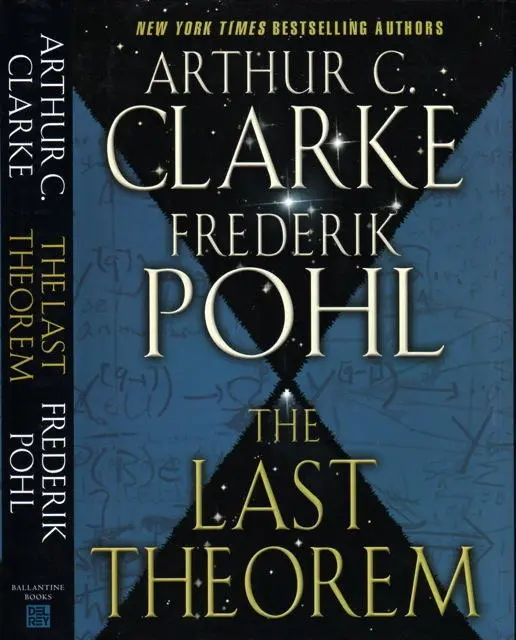
- Название:The Last Theorem
- Автор:
- Издательство:Del Rey Books
- Жанр:
- Год:2008
- Город:New York
- ISBN:9780345470218
- Рейтинг книги:3 / 5. Голосов: 1
-
Избранное:Добавить в избранное
- Отзывы:
-
Ваша оценка:
The Last Theorem: краткое содержание, описание и аннотация
Предлагаем к чтению аннотацию, описание, краткое содержание или предисловие (зависит от того, что написал сам автор книги «The Last Theorem»). Если вы не нашли необходимую информацию о книге — напишите в комментариях, мы постараемся отыскать её.
.
The Last Theorem In 1637, the French mathematician Pierre de Fermat scrawled a note in the margin of a book about an enigmatic theorem: “I have discovered a truly marvelous proof of this proposition which this margin is too narrow to contain.” He also neglected to record his proof elsewhere. Thus began a search for the Holy Grail of mathematics—a search that didn’t end until 1994, when Andrew Wiles published a 150-page proof. But the proof was burdensome, overlong, and utilized mathematical techniques undreamed of in Fermat’s time, and so it left many critics unsatisfied—including young Ranjit Subramanian, a Sri Lankan with a special gift for mathematics and a passion for the famous “Last Theorem.”
When Ranjit writes a three-page proof of the theorem that relies exclusively on knowledge available to Fermat, his achievement is hailed as a work of genius, bringing him fame and fortune. But it also brings him to the attention of the National Security Agency and a shadowy United Nations outfit called Pax per Fidem, or Peace Through Transparency, whose secretive workings belie its name. Suddenly Ranjit—together with his wife, Myra de Soyza, an expert in artificial intelligence, and their burgeoning family—finds himself swept up in world-shaking events, his genius for abstract mathematical thought put to uses that are both concrete and potentially deadly.
Meanwhile, unbeknownst to anyone on Earth, an alien fleet is approaching the planet at a significant percentage of the speed of light. Their mission: to exterminate the dangerous species of primates known as homo sapiens.
The Last Theorem — читать онлайн ознакомительный отрывок
Ниже представлен текст книги, разбитый по страницам. Система сохранения места последней прочитанной страницы, позволяет с удобством читать онлайн бесплатно книгу «The Last Theorem», без необходимости каждый раз заново искать на чём Вы остановились. Поставьте закладку, и сможете в любой момент перейти на страницу, на которой закончили чтение.
Интервал:
Закладка:
Item by item they ran through the list of domestic jobs, from replacing used lightbulbs and toilet paper rolls to paying the bills. It wasn’t a problem. Neither one of them wanted the other stuck at some chore that would keep him or her away from the other for a minute longer than necessary, because neither wanted to be so deprived of the other’s talk and company.
At this point the armada of One Point Fives was cruising at its maximum speed of .94c. By the time scale of most non-Earth beings, it would reach its destination in a mere blink of time. Of course, no human being knew this, so all nine billion went right on with their usual daily concerns.
Then one evening, as the Subramanians were finishing the dinner cleanup, the voice from their intercom spoke up. “Dr. Subramanian? This is Henry, down at the gate. There’s a man here who’d like to see you. He says he doesn’t want to give his name but you’ll know him because he’s Maggie’s ex-boyfriend. All right to let him in?”
Ranjit jumped to his feet. “Gamini!” he shouted. “Sure, let the bastard come in, and ask him what he’d like to drink!”
But when the man arrived, he wasn’t Gamini Bandara at all. He was a much older man, carrying a locked case that was chained to his right arm. When he opened it, he took out a chip and handed it to Ranjit. “Please play this,” he said. “I’m not authorized to see it, so I’ll have to wait outside, but Mrs. Subramanian is specifically permitted, and”—he offered them a polite smile—“I’m sure the baby won’t tell any secrets.”
When the courier was safely stowed in the hallway, Myra fed the chip into their player, and a grinning Gamini appeared on the screen. “Sorry to put you through all this cloak-and-dagger stuff, but we’re walking a tightrope here. We’re answering to five different national governments, plus the UN’s own security staff, and—well, I’ll tell you all about that another time. The thing is, that other job we’ve been talking about for you is all cleared now, if you want it. You will. You’d be crazy if you didn’t. However, before I answer all those questions, there is one little thing—No, to tell the truth, there’s one extremely big thing that has to happen first. I can’t say what it is, but you’ll know it when you see it on the news, and then you can say good-bye to Pasadena. So stay loose, Ranj. That’s all those intelligence agencies will let me say now—except love to you all!”
The chip ended and the screen went blank.
Ten minutes later, when the courier had retrieved his chip and departed, Myra pulled down from the top of the cupboard the bottle of wine they saved for special occasions. She filled two glasses, cocked an ear to where Natasha was sleeping, and, when satisfied about that, said, “Do you know what’s going on?”
Ranjit clinked her glass and took a sip from his own before he said, “No.” He sat silently for a moment, and then grinned. “All the same, if I can’t trust Gamini, who can I trust? So we’ll just have to wait and see.”
Myra nodded, finished her glass, got up to check on Natasha, and said, “At least it doesn’t sound like the waiting will be much longer.”
It wasn’t. It was only three days before Ranjit—doing his best to find a few more really large prime numbers for the cryptographers to play with, because his conscience wouldn’t let him do nothing at all—heard a huge commotion in the hallway and discovered that half the staff was trying to get into the lounge at the end of the corridor. Everybody was clustered before the news channels. What the channels were displaying was a procession of military vehicles, scores of them, pouring through a gap in an unfamiliar fence. “Korea,” a man near the screen called to quiet the questions. “They’re going into North Korea! Now shut up so we can hear what they’re saying.”
And North Korea was indeed where they were heading, and none of the Adorable Leader’s huge army seemed interested in trying to stop them!
“But that’s crazy!” the man next to Ranjit was saying. “Something must’ve happened!”
He hadn’t been looking to Ranjit for an answer, but Ranjit gave him one anyway. “I’m sure something did happen,” he told the man, grinning. “Something big.”
25
SILENT THUNDER
It had a formal name in the records of the Pentagon, but to the people who invented it, the people who built it, and the people who sent it on its way, it was called Silent Thunder.
In the dark of midnight Silent Thunder took off from its birthplace, which was in the old Boeing field outside of Seattle, Washington, and cruised westward at a leisurely thousand kilometers an hour. The choice of darkness wasn’t to keep it from being seen by some enemy. That would have been impossible. Every conceivable enemy, and everybody else as well, owned a sky full of observation satellites, and those were watching everybody’s every move.
But it was still dark when, several hours later, Silent Thunder completed its great circle crossing of the Pacific Ocean and dropped—“like a rock,” its pilot said later—almost to sea level. There it slid over the waters between the islands of Honshu and Hokkaido and entered the Sea of Japan.
It was then that the darkness became an advantage to the people who ran Silent Thunder. Darkness meant no nosy newscasters on one of the Japanese islands would get a good look at it, and therefore news of it would not be showing up at everybody’s breakfast table. The radars belonging to Japan’s tiny armed forces in Aomori and Hakodate did light up, of course. They didn’t matter. Japan didn’t have enough weaponry to do anything about something like Silent Thunder. Anyway, twelve hours earlier the Japanese generals had been notified, in strict secrecy, that America would be sending an experimental aircraft around there, and it would be courteous of them to look the other way.
Once well into the Sea of Japan, Silent Thunder climbed again, leveling off at twelve thousand meters. Of course, the western shores of the sea were Russian, and of course, the radars there were a lot more numerous and powerful than Japan’s. They didn’t matter, either. Russian top brass, too, knew that Silent Thunder was no threat—that is, to them.
When its pilot and navigator agreed they had reached their aiming point, Silent Thunder slowed to just enough velocity to keep it in the air and began to deploy its armaments. Those armaments—a modest-yield nuclear bomb and a hollow copper tube no wider than a man’s body—would have baffled the weapons specialists of even a decade earlier, but they were all Silent Thunder needed to do its job.
Inside the weapon’s guidance system, a map of the Adorable Leader’s North Korea appeared, overlaid by the long, narrow oval that was the footprint of the weapon.
No human being in Silent Thunder looked at that map, because no human being was there. Its captain—all of its crew—was back in Washington state, observing the map on a TV screen. “It looks all right to me,” the pilot, an American, said to the bombardier, who happened to be Russian. “Deploy the masks.”
“Right,” said the bombardier, fingers on his keypad. Black shapes formed around the edges of the oval, tracing the course of the Yalu River on its north and west, the Demarcation Line that was the border with South Korea, and then the Pacific coast to the south and east. Those shapes were nothing tangible, of course. Nothing made of matter could have survived what they needed to mask off, and devising the electronic fields that could do the masks’ job had been one of the trickiest parts of building Silent Thunder. “All set,” the bombardier reported to the pilot.
“Position still okay?” the pilot asked the Chinese navigator, and when the navigator reported that it was, the pilot crossed himself. (He thought of himself as a lapsed Catholic, but there were times when he didn’t feel lapsed at all.) “Fire the weapon,” he ordered the bombardier, and for the first time in the history of the world, a nation lost a war—totally, irrevocably lost it—without anyone getting hurt.
Читать дальшеИнтервал:
Закладка:
Похожие книги на «The Last Theorem»
Представляем Вашему вниманию похожие книги на «The Last Theorem» списком для выбора. Мы отобрали схожую по названию и смыслу литературу в надежде предоставить читателям больше вариантов отыскать новые, интересные, ещё непрочитанные произведения.



Обсуждение, отзывы о книге «The Last Theorem» и просто собственные мнения читателей. Оставьте ваши комментарии, напишите, что Вы думаете о произведении, его смысле или главных героях. Укажите что конкретно понравилось, а что нет, и почему Вы так считаете.