Robert Sawyer - Illegal Alien
Здесь есть возможность читать онлайн «Robert Sawyer - Illegal Alien» весь текст электронной книги совершенно бесплатно (целиком полную версию без сокращений). В некоторых случаях можно слушать аудио, скачать через торрент в формате fb2 и присутствует краткое содержание. Год выпуска: 1997, ISBN: 1997, Издательство: Ace Books, Жанр: Фантастика и фэнтези, на английском языке. Описание произведения, (предисловие) а так же отзывы посетителей доступны на портале библиотеки ЛибКат.
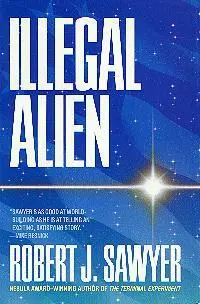
- Название:Illegal Alien
- Автор:
- Издательство:Ace Books
- Жанр:
- Год:1997
- ISBN:0-441-00592-6
- Рейтинг книги:5 / 5. Голосов: 1
-
Избранное:Добавить в избранное
- Отзывы:
-
Ваша оценка:
Illegal Alien: краткое содержание, описание и аннотация
Предлагаем к чтению аннотацию, описание, краткое содержание или предисловие (зависит от того, что написал сам автор книги «Illegal Alien»). Если вы не нашли необходимую информацию о книге — напишите в комментариях, мы постараемся отыскать её.
Illegal Alien — читать онлайн бесплатно полную книгу (весь текст) целиком
Ниже представлен текст книги, разбитый по страницам. Система сохранения места последней прочитанной страницы, позволяет с удобством читать онлайн бесплатно книгу «Illegal Alien», без необходимости каждый раз заново искать на чём Вы остановились. Поставьте закладку, и сможете в любой момент перейти на страницу, на которой закончили чтение.
Интервал:
Закладка:
The biggest fight at this stage was over whether the trial should be televised. Judge Pringle ultimately ruled that it would be, given the extraordinary interest the peoples of the entire world had in the outcome of the case. But there were dozens of other motions as well.
“Your Honor,” said Dale, “we move that the jury be sequestered. The media interest in this trial will be huge, and there’s no way to keep the jury from being exposed to possibly biased coverage.”
“Your Honor,” said Ziegler, “I think we’ve all been conscious ever since Simpson of the incredible hardship sequestration poses. Surely with a trial that may go on at great length, we can’t make prisoners out of all the jurors and alternates.”
“I’ve read your brief on this, Mr. Rice,” said Drucilla Pringle, “but I agree with Ms. Ziegler. The jurors will be instructed to avoid media coverage, but they will get to go home and sleep in their own beds each night.”
“Very well,” said Dale. “We move that no photographic evidence of Dr. Calhoun’s corpse be introduced. Such evidence could only serve to inflame the jury.”
“Your Honor,” said Linda Ziegler, rising, “the People vigorously oppose any limitation on photographic evidence. The jury questionnaire will enable us to screen out particularly squeamish individuals. Obviously, a significant portion of our case hinges on demonstrating that the method of killing is one no human would employ. There’s no better evidence of the method than the crime-scene photos showing the mutilated corpse.”
Judge Pringle frowned while she considered this. Finally: “You lose this one, Mr. Rice. But, Ms. Ziegler, I will shut you down so fast it’ll make your head spin if your use of the photos ever goes beyond the merely probative.”
“Very well,” said Dale, “but we further move, Your Honor, out of deference to Dr. Calhoun’s family, that only the jury be shown the photos of the corpse and removed organs.”
“The public is entitled to something, Mr. Rice,” said Pringle.
“We suggest stylized drawings be made, representing the injuries.”
“You’re setting me up for another battle with the media lawyers,” said Pringle, “and I’m not convinced your concern is over the family’s feelings.
You’re hoping for a hung jury, and don’t want to inflame the potential jurors for any second trial.”
Dale spread his arms. “You do me a disservice, Your Honor.”
Pringle scowled, unconvinced. “Pending review of the arguments from the media attorneys, I’ll agree to a ban on publication of the pictures while this trial is in progress; I’ll reserve judgment on whether the ban should remain in place following the handing down of a verdict.”
“Thank you, Your Honor,” said Dale. “Next, the defense moves…”
The jury questionnaire, prepared jointly by the prosecution and the defense, contained three hundred and eleven questions. It started off predictably enough, asking for information about age, ethnicity, marital status, employment, level of education, spouse or partner’s background, previous legal or courtroom experiences, political affiliation, organization memberships, and so on. It also asked if the potential juror knew the defendant, the decedent, any of the lawyers, the judge, or any of the courtroom staff.
In addition, it asked about the prospective juror’s beliefs concerning the legal process:
Do you believe that a defendant in a criminal case should testify or produce some evidence to prove that he or she is not guilty? If yes, please explain why.
To each of the following statements, indicate if you strongly agree, agree, disagree, disagree strongly, or have no opinion: a. “If the prosecution goes to the trouble of bringing someone to trial, the person is probably guilty.” b. “Celebrities are treated better by our court system than other people.”
The questionnaire also looked at possible bias from exposure to the extensive news coverage of the Calhoun murder:
Which of the following best describes how you would describe the media coverage overall? Biased in favor of the prosecution? Biased in favor of the defense? Basically fair to both sides?
It also asked about the Tosoks:
What was your first reaction to hearing that one of the Tosok explorers was a suspect in this case? Have you ever seen a Tosok in person? If yes, please explain the circumstances.
Will you hold the prosecution to a higher standard than is legally required because the defendant is from another planet? Because of possible repercussions for the human race?
Does the fact the defendant comes from a civilization more technologically advanced than our own make it unlikely in your mind that he could commit murder?
And then came what Linda Ziegler had dubbed the “space-cadet questions”:
Before the arrival of the Tosoks on Earth, did you read any nonfiction books, articles, or magazines concerning life on other worlds? If yes, please specify, and briefly describe what you recall having read.
Have you ever read any fiction (including science fiction) dealing with life on other worlds, or with aliens having come to Earth? If yes, please specify, and briefly describe what you recall having read.
Which of the following TV series have you watched regularly now or in the past? For those that you have seen, indicate whether you agreed with, disagreed with, or had no opinion about the portrayal of alien lifeforms:
ALF
Babylon 5
Lost in Space
Mork Mindy
Any Star Trek series
The X-Files
Members of LASFS, the Los Angeles Science Fantasy Society, helped in putting together a series of such questions. Apparently, anyone who agreed with the ALF, Star Trek , or Mork Mindy portrayals of aliens would be biased in favor of the defense, whereas those who liked the Babylon 5, Lost in Space , or X-Files portrayals would be biased toward the prosecution.
Regardless of which way they leaned, any out-and-out SF fans or space buffs had to be disqualified, hence these questions:
What’s the name of Mr. Spock’s father?
Do you know what the initials SETI stand for?
Have you ever attended a science-fiction convention?
Have you ever seen a UFO?
As with most Los Angeles trials likely to generate considerable media interest, The People of California v. Hask was scheduled into the main downtown Criminal Courts Building. That meant that jury pool had to be drawn from residents of central L.A. A thousand people were summoned.
Of course, not all of them showed up. Men, in particular, often simply disregard jury-duty notices; since little follow-up is ever done, they usually get away with it.
Every one of those who did show up was asked to fill in the jury questionnaire. Over seven hundred prospective jurors were eliminated based on their responses.
Among the reasons potential jurors were excused: they were single parents, or had an elderly relative living with them, or were in a precarious financial situation. One man had the irritable bowel syndrome—and a doctor’s note to prove it. Another was on a waiting list for a kidney transplant and could not guarantee he’d remain available until the end of the trial. A woman in her seventh month of pregnancy was let go as well.
Also struck from the list: all those who had difficulty seeing or hearing or who couldn’t read or write English effectively. Five people were dismissed because they knew one of the lawyers or court staff members—one had been to a lecture Dale had given once and had gotten him to autograph a book.
The remaining one hundred and eighty-five potential jurors—as always in central L.A., predominantly black, predominantly female, predominantly blue-collar or unemployed—were then examined by the lawyers during the process known as voir dire . And, at long last, a total of twelve jurors and six alternates were selected.
Читать дальшеИнтервал:
Закладка:
Похожие книги на «Illegal Alien»
Представляем Вашему вниманию похожие книги на «Illegal Alien» списком для выбора. Мы отобрали схожую по названию и смыслу литературу в надежде предоставить читателям больше вариантов отыскать новые, интересные, ещё непрочитанные произведения.


Обсуждение, отзывы о книге «Illegal Alien» и просто собственные мнения читателей. Оставьте ваши комментарии, напишите, что Вы думаете о произведении, его смысле или главных героях. Укажите что конкретно понравилось, а что нет, и почему Вы так считаете.