Peter Watts - Firefall
Здесь есть возможность читать онлайн «Peter Watts - Firefall» весь текст электронной книги совершенно бесплатно (целиком полную версию без сокращений). В некоторых случаях можно слушать аудио, скачать через торрент в формате fb2 и присутствует краткое содержание. Город: London, Год выпуска: 2014, ISBN: 2014, Издательство: Head of Zeus, Жанр: Фантастика и фэнтези, на английском языке. Описание произведения, (предисловие) а так же отзывы посетителей доступны на портале библиотеки ЛибКат.
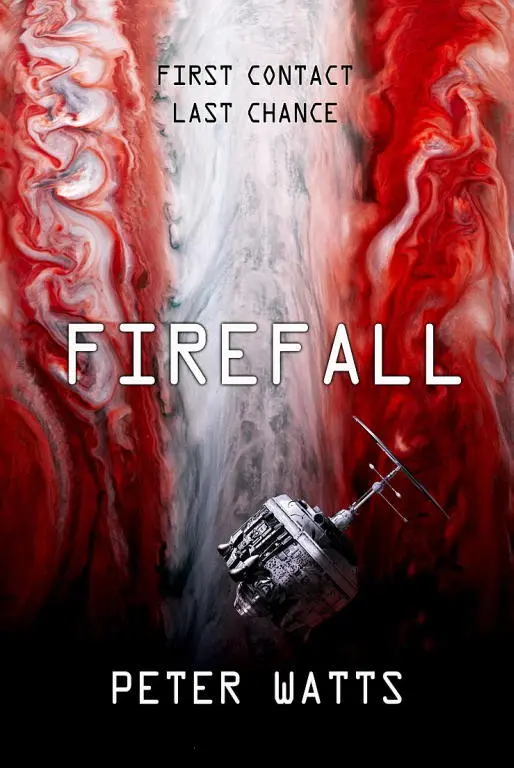
- Название:Firefall
- Автор:
- Издательство:Head of Zeus
- Жанр:
- Год:2014
- Город:London
- ISBN:978-1784080457
- Рейтинг книги:3 / 5. Голосов: 1
-
Избранное:Добавить в избранное
- Отзывы:
-
Ваша оценка:
Firefall: краткое содержание, описание и аннотация
Предлагаем к чтению аннотацию, описание, краткое содержание или предисловие (зависит от того, что написал сам автор книги «Firefall»). Если вы не нашли необходимую информацию о книге — напишите в комментариях, мы постараемся отыскать её.
and
.
February 13, 2082, First Contact. Sixty-two thousand objects of unknown origin plunge into Earth’s atmosphere—a perfect grid of falling stars screaming across the radio spectrum as they burn. Not even ashes reach the ground. Three hundred and sixty degrees of global surveillance: something just took a snapshot.
And then… nothing.
The world holds its breath and waits for the Second Coming—and while it waits, it fractures. Hive-minds coalesce, speaking in tongues; paleogeneticists resurrect nightmares from the dawn of humanity; soldiers are fitted with zombie switches to turn off consciousness in combat; half the population has retreated into the ersatz security of a virtual environment called Heaven.
Extinction beckons for
.
But from deep space: whispers. Something out there talks—but not to us. Two ships,
and the
, are launched to discover the origin of Earth’s visitation, one bound for the outer dark of the Kuiper Belt, the other for the heart of the Solar System.
Their crews can barely be called human, what they will face certainly can’t.
Firefall — читать онлайн бесплатно полную книгу (весь текст) целиком
Ниже представлен текст книги, разбитый по страницам. Система сохранения места последней прочитанной страницы, позволяет с удобством читать онлайн бесплатно книгу «Firefall», без необходимости каждый раз заново искать на чём Вы остановились. Поставьте закладку, и сможете в любой момент перейти на страницу, на которой закончили чтение.
Интервал:
Закладка:
She got to her feet. “I’m not giving you a choice.”
“I have to leave sometime. I can’t spend the rest of my life here.”
“If you try to leave now,” she said, “that’s exactly what you’ll have done.”
He looked down at her: thin as a pussy willow, she only came up to his chest.
“You going to stop me?”
She looked back without blinking. “I’m gonna try. If I have to. But I really hope it doesn’t come to that.”
He stood there for the longest time. Then he picked up his plate.
“Fuck you,” he said, and went back inside.
Within his prison, she gave him all the space in the world. She backed right off as he stalked down the hall, past the murmuring of the devout and the hyperkinetic gaze of the frozen zombies, past the closed-door deliberations of enemies-of-enemies and the open doors of dorms and studies and bathrooms. He moved without direction at first, following any corridor that presented itself, backtracking from every cul-de-sac, his feet exploring autonomously while his gut churned. After a while, some dull sullen pain behind his eyes brought him back to the here-and-now; he took more conscious note of his surroundings and decided to revisit Moore’s basement watchtower, as much for its relative familiarity as for any tactical insights he might glean.
He couldn’t find it. He remembered Lianna leading him through a hole in the wall; he remembered emerging from it after the armistice. It had to be off the main corridor, had to lie behind one of these identical oaken doors that lined the hall, but no perspective along that length seemed familiar. It was as though he was in some off-kilter mock-up of the place he’d been just an hour before, as though the layout of the monastery had changed subtly when he wasn’t looking. He started trying doors at random.
The third was ajar. Low voices murmured behind it. It swung inward easily; flat panels of vat-cloned hardwood lined the space beyond, a kind of library or map room that looked out onto a grassy compound (half sunlit, half in shadow). Past sliding glass doorways, arcane objects rose haphazardly from that immaculate lawn. Brüks couldn’t tell whether they were machines or sculptures or some half-assed hybrid of the two. The only thing that looked at all familiar out there was a shallow washbasin set atop a boxy waist-high pedestal.
There was one of those inside, too, just past a conference table that dominated the center of the room itself. Two mismatched Bicamerals stood at the table’s edge, gazing at a collection of dice-size objects scattered across some kind of hard-copy map or antique game board. The Japanese monk was gaunt as a scarecrow; the Caucasian could have passed for Santa Claus at the departmental Christmas party, given the right threads and a pillow stuffed down his front.
“From Queensland, maybe,” Santa remarked. “That place always bred the best neurotoxins.”
The scarecrow scooped up a handful of objects (not dice, Brüks saw now; a collection of multifaceted lumps that made him think of mahogany macramé) and arranged them in a rough crescent across the board.
Santa considered. “Still not enough. Even if we could sift the Van Allens dry on short notice.” He absently scratched the side of his neck, seemed to notice Brüks at last. “You’re the refugee.”
“Biologist.”
“Welcome anyway.” Santa smacked his lips. “I’m Luckett.”
“Dan Brüks.” He took the other man’s nod for an invitation and stepped closer to the table. The pattern decorating the game board—a multicolored spiral of interlocking Penrose tiles—was far more complex than any he remembered from his grandfather’s attic. It seemed to move at the corner of his eye, to crawl just so when he wasn’t quite looking.
The scarecrow clicked his tongue, eyes never leaving the table.
“Don’t mind Masashi,” Luckett remarked. “He’s not much for what you’d call normal conversation.”
“Does everyone around here speak in tongues?”
“Speak—oh, I see what you mean.” Luckett laughed softly. “No, with Masashi here it’s more like a kind of aphasia. When he’s not linked in, anyway.”
The scarecrow spilled a few more mahogany knuckles with chaotic precision. Luckett laughed again, shook his head.
“He talks through board games,” Brüks surmised.
“Close enough. Who knows? I might be doing the same thing by the time I graduate.”
“You’re not—?” Of course he wasn’t. His eyes didn’t sparkle.
“Not yet. Acolyte.”
It was enough that he spoke English. “I’m trying to find the room I was in last night. Basement, spiral stairs, kind of a war room bunker feel to it?”
“Ah. The Colonel’s lair. North hall, first right, second door on the left.”
“Okay. Thanks.”
“Not at all.” Luckett turned away as Masashi clicked and rolled the bones. “More than enough antimatter to break orbit, anyway. Least it saves on chemical mass.”
Brüks stopped, hand on the doorknob. “What was that?”
Luckett glanced back at him. “Just drawing up plans. Nothing to worry about.”
“You guys have antimatter ?”
“Before long.” Luckett grinned and dipped his hands into the washbasin. “God willing.”
Most of the tactical collage was dark, or writhing with analog static. A half-dozen windows flickered fitfully through random points of view: desert, desert, desert. No satcam imagery. Either Moore had shut down those feeds or whoever was behind the blockade had walled off the sky as well as the horizon.
Brüks tapped experimentally on an unlit patch of paint. His touch provoked a brief flicker of red, but nothing else.
The active windows kept changing, though. Some kind of motion sensor built into the feed, maybe: views would pan and pounce, flash-zooming on this flickering shadow or that distant escarpment. Sometimes Brüks couldn’t see anything noteworthy at the center of attention: a falcon grooming itself on a skeletal branch, or the burrow of a desert rodent halfway to the horizon. Once or twice a little fall of rock skittering down a distant slope, scree dislodged by some unseen disturbance.
Once, partially eclipsed by leaves and scrub, a pair of glassy reflections looking back.
“Help you?”
Jim Moore reached past Brüks’s shoulder and tapped the display. A new window sprang to life at his fingertip. Brüks stepped aside while the soldier stretched the window across the paint, called up a feed, zoomed on a crevice splitting a hillock to the south.
“I was trying to get online,” Brüks admitted. “See if anyone out there’s picked up on this whole— quarantine thing.”
“Net’s strictly local. I don’t think the Bicamerals actually have Quinternet access.”
“What, they’re afraid of getting hacked?” It was an ongoing trend, Brüks had heard: defensive self-partitioning in the face of Present Shock, and damn the legal consequences. People were starting to weigh costs against benefits, opt for a day or two outside the panopticon even in the face of the inevitable fines and detentions.
But Moore was shaking his head. “I don’t think they need it. Do you feel especially lost without access to the telegraph network?”
“What’s a telegraph?”
“Exactly.” Something caught the Colonel’s eye. “Huh. That’s not good.”
Brüks followed the other man’s gaze to the window he’d opened, to the crevice centered there. “I don’t see anything.”
Moore played a little arpeggio on the wall. The image blossomed into false color. Something glowed Euclidean yellow in all that fractal blue.
He grunted. “Aerosol delivery, looks like.”
“Your guys?”
The corner of Moore’s mouth curled the slightest bit. “Can’t really say.”
Читать дальшеИнтервал:
Закладка:
Похожие книги на «Firefall»
Представляем Вашему вниманию похожие книги на «Firefall» списком для выбора. Мы отобрали схожую по названию и смыслу литературу в надежде предоставить читателям больше вариантов отыскать новые, интересные, ещё непрочитанные произведения.


Обсуждение, отзывы о книге «Firefall» и просто собственные мнения читателей. Оставьте ваши комментарии, напишите, что Вы думаете о произведении, его смысле или главных героях. Укажите что конкретно понравилось, а что нет, и почему Вы так считаете.