Ben Bova - Voyagers
Здесь есть возможность читать онлайн «Ben Bova - Voyagers» весь текст электронной книги совершенно бесплатно (целиком полную версию без сокращений). В некоторых случаях можно слушать аудио, скачать через торрент в формате fb2 и присутствует краткое содержание. Год выпуска: 2010, ISBN: 2010, Издательство: Tor, Жанр: Фантастика и фэнтези, на английском языке. Описание произведения, (предисловие) а так же отзывы посетителей доступны на портале библиотеки ЛибКат.
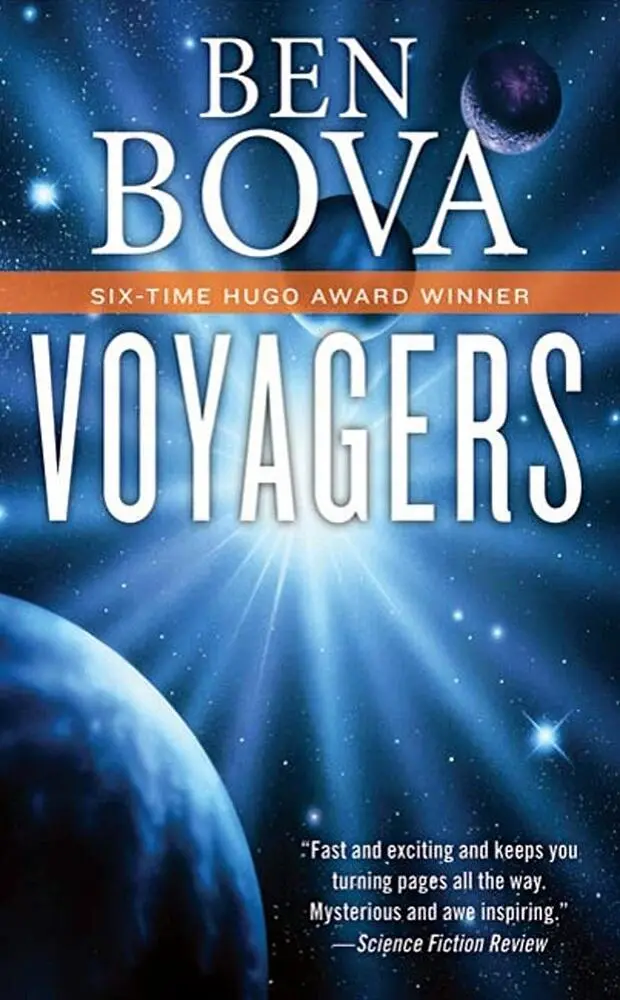
- Название:Voyagers
- Автор:
- Издательство:Tor
- Жанр:
- Год:2010
- ISBN:978-0-765-36365-7
- Рейтинг книги:5 / 5. Голосов: 1
-
Избранное:Добавить в избранное
- Отзывы:
-
Ваша оценка:
Voyagers: краткое содержание, описание и аннотация
Предлагаем к чтению аннотацию, описание, краткое содержание или предисловие (зависит от того, что написал сам автор книги «Voyagers»). Если вы не нашли необходимую информацию о книге — напишите в комментариях, мы постараемся отыскать её.
the signal that his research station is receiving from space is not random. Whatever it is, it’s real.
And it’s headed straight for Earth.
He’ll do anything to be the first man to go out to confront this enigma. Even lose the only woman he’s ever really loved.
And maybe start a world war.
Voyagers — читать онлайн бесплатно полную книгу (весь текст) целиком
Ниже представлен текст книги, разбитый по страницам. Система сохранения места последней прочитанной страницы, позволяет с удобством читать онлайн бесплатно книгу «Voyagers», без необходимости каждый раз заново искать на чём Вы остановились. Поставьте закладку, и сможете в любой момент перейти на страницу, на которой закончили чтение.
Интервал:
Закладка:
But Federenko’s gloomy frown sent a chill of apprehension through Stoner. He looks as if he’s just been ordered to attack the whole Chinese Army with his bare hands.
“What is it, Nikolai?”
Federenko turned toward him, defeat smoldering his eyes. “The tanker. We must not go near it. Malfunction.”
“What?”
“Very strange, they tell me. Malfunction in tanker self-destruct circuit. It can explode, they think.”
The cosmonaut’s hands reached for the stubby levers that controlled the Soyuz’s maneuvering jets.
“Wait!” Stoner yelped. “If we don’t link up with the tanker we can’t complete the mission!”
“If we do link with tanker—boom!”
Stoner sagged inside his restraining harness. “I don’t believe it. How could…?”
A flash caught his eye and they both craned toward the observation ports. In total silence the tanker blew apart, a trio of small flashes followed quicker than an eye-blink by an enormous fireball that nearly blinded them.
Stoner squeezed his eyes shut. Federenko growled something too low for Stoner to catch.
The fireball faded into darkness, leaving a burning afterimage against Stoner’s eyes. There was no shock wave, no noise, no debris pattering around them. It was as if they had been watching a silent picture. Stoner couldn’t believe it was real.
“Gone,” Federenko said heavily.
Stoner rubbed at his eyes, then looked out through the port again. Nothing but the unutterably distant stars.
“Gone,” he admitted. “And where does that leave us?”
“We are dead men, Shtoner. Without propellants from tanker, we cannot get back to Earth.”
It took a few moments for the realization to sink in. Finally Stoner heard himself say, “But we have enough fuel to make the rendezvous with the alien, don’t we?”
Federenko gave him a long, solemn look. “Da,” he said at last. “Plenty maneuvering fuel now.”
“Then let’s do it!” Stoner said. “That’s what we came out here for, isn’t it? Let’s do it!”
Federenko’s bearded face almost smiled. “I knew you would say that, Shtoner.”
“What else is there?” Stoner asked, feeling strangely excited. “Let’s go!”
Johnson Space Flight Center
“Hey, it’s quittin’ time, man!”
Hank Garvey planted his ponderous bulk on the computer analyst’s desk and leaned toward the skinny youngster.
“We got an emergency on our hands, boy,” Garvey said, his voice murderously calm and deep, like the throaty warning cough of a lion.
“The next shift…”
“Uncle Sam wants yew ,” said Garvey. “Yer the best goddam’ computer jockey in the Center. I know, ’cause I’ve had to lissen to yew tellin’ me ’bout it a thousand times or two. Now yer gonna prove it.”
“But my ol’lady…”
Garvey laid a hand the size of a football on the analyst’s bony shoulder. “Our man Stoner and his Rooskie pilot are in trouble. Their tanker blew up on ’em.”
“Jeezus!”
“They ain’t hurt. Their spacecraft’s intact, no damage. But they can’t get back home—not unless some damn smart boy comes up with a new flight plan for ’em—damn fast.”
“Holy shit!” the computer analyst said. “Why didn’t you say that in the first place? Okay, okay, get your fat ass off my desk an’ lemme get to work.”
Garvey grinned like a Poppa Bear. “That’s mah boy.”
Chapter 43
The communications center on Kwajalein was in an uproar. Even the technicians at their consoles were yelling at one another in confusion.
Jeff Thompson, standing beside Ramsey McDermott’s chair, was hollering into the old man’s ear, “We can’t let them go on! The farther out they go toward the alien, the more impossible it’ll be to get them back!”
McDermott’s jowls sagged. He had lost ten pounds and aged a decade in the months since he’d first seen the aurora mocking him. His shirt collar gaped around his wizened neck. His hands shook uncertainly. His eyes had lost their fire.
Edouard Reynaud, his arm no longer in its sling, gripped Thompson’s arm. “You must call them back. You must make them come back!”
“Can’t…” McDermott croaked.
“But they can retrofire into a lunar orbit,” Reynaud insisted. “I have the numbers in my head. They should have enough fuel for that.”
Thompson brightened. “Right! If they can get themselves back into an orbit around the Moon we might be able to send something up there to ferry them back to Earth.”
But McDermott shook his head weakly. “Stoner won’t listen…”
“QUIET!” an amplified boice roared.
Everything stopped. People froze where they were. The room went silent, except for the electrical hum of the communications consoles and the buzz of the air conditioners.
Lieutenant Commander Tuttle was standing on a desktop, microphone in hand. He gazed around the room and, satisfied that all attention was on him, let the hand holding the mike drop to his side.
“This is a Navy project,” he said, voice sharp and loud enough to be heard across the stilled room. “And I am the Navy officer in charge.”
Thompson stared at the little lieutenant commander. For the first time since he’d met the man, Tuttle was making his uniform look good.
“The goal of this project is to make contact with that alien spacecraft. Stoner and the Russian are on their way to do just that. So you will all get back to your jobs and stop the yakking.”
“But they won’t be able to return to Earth!” Reynaud shouted, his chubby face going red with either anger or embarrassment, or perhaps both.
“That’s a problem that we’ll have to tackle,” Tuttle snapped. “Stoner is aware of it. He’s the only one of you who’s kept his head. If he’s willing to risk his life to make contact with the alien, the least we can do is see to it that whatever he discovers is received here and properly recorded so that the whole human race can study it. Now get to work !”
They moved. Numbly, sullenly, with grumbles and whispers they turned back to their jobs.
Reynaud, trembling in his perspiration-soaked white shirt, glared across the big room at Tuttle as the Navy officer climbed down from the desk. For the first time in many years, Reynaud knew real anger. He also knew that Tuttle was right.
“There it is!” Stoner shouted. “I can see it!”
Federenko took his eyes from the radar screen and leaned across to look through Stoner’s observation port.
“It glows,” he whispered.
They had come up on the alien craft with the Sun at their backs. The radar image had been fuzzy, almost nebulous, at the longer wavelengths. But when Stoner turned on the microwave radar the image cleared up and showed a smaller but much sharper blip.
Now he saw the spacecraft itself.
It glowed with a strange, eerie, golden light, like a shimmering aura that surrounded the solid craft. The spacecraft was imbedded in the glowing light. From this distance it was still too far away to make out details, but it appeared to be roughly oblong in shape, with a smooth surface and rounded corners.
“No wonder it looked like a comet to the ground radars,” Stoner realized.
“What is the light?” Federenko asked.
“A screen of some kind?” Stoner guessed. “A screen of energy like a magnetic field, maybe. To protect it against cosmic radiation. Maybe a shield against micrometeors, too.”
They were closing fast on it. Stoner floated out of his seat and wormed his way back to the orbital module of the Soyuz. Taking the stubby, compact telescope from its clips on the equipment rack, he focused on the alien ship through the nearest observation port.
Читать дальшеИнтервал:
Закладка:
Похожие книги на «Voyagers»
Представляем Вашему вниманию похожие книги на «Voyagers» списком для выбора. Мы отобрали схожую по названию и смыслу литературу в надежде предоставить читателям больше вариантов отыскать новые, интересные, ещё непрочитанные произведения.


Обсуждение, отзывы о книге «Voyagers» и просто собственные мнения читателей. Оставьте ваши комментарии, напишите, что Вы думаете о произведении, его смысле или главных героях. Укажите что конкретно понравилось, а что нет, и почему Вы так считаете.