Ben Bova - Voyagers
Здесь есть возможность читать онлайн «Ben Bova - Voyagers» весь текст электронной книги совершенно бесплатно (целиком полную версию без сокращений). В некоторых случаях можно слушать аудио, скачать через торрент в формате fb2 и присутствует краткое содержание. Год выпуска: 2010, ISBN: 2010, Издательство: Tor, Жанр: Фантастика и фэнтези, на английском языке. Описание произведения, (предисловие) а так же отзывы посетителей доступны на портале библиотеки ЛибКат.
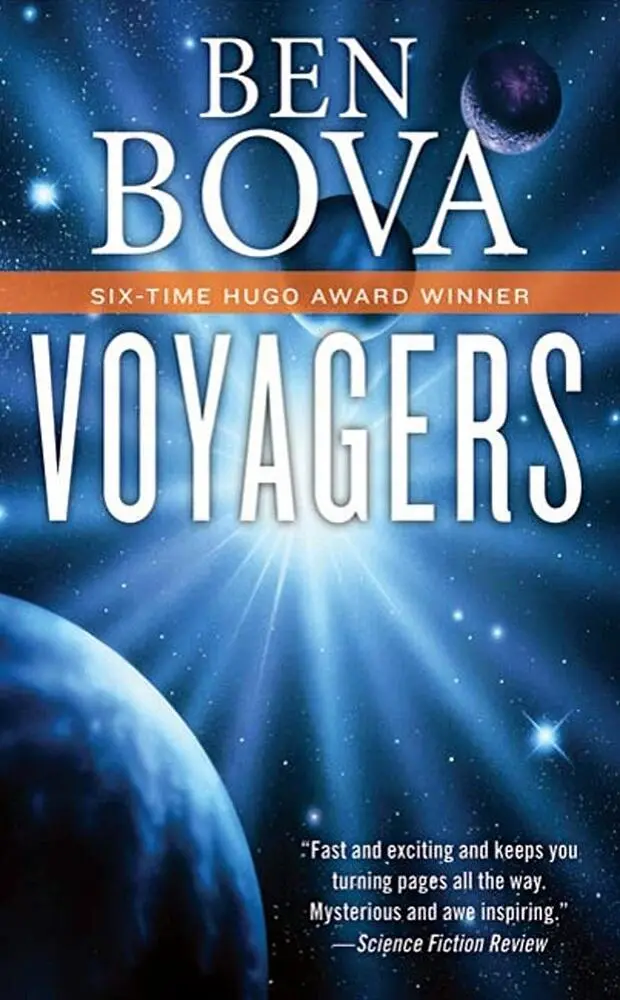
- Название:Voyagers
- Автор:
- Издательство:Tor
- Жанр:
- Год:2010
- ISBN:978-0-765-36365-7
- Рейтинг книги:5 / 5. Голосов: 1
-
Избранное:Добавить в избранное
- Отзывы:
-
Ваша оценка:
Voyagers: краткое содержание, описание и аннотация
Предлагаем к чтению аннотацию, описание, краткое содержание или предисловие (зависит от того, что написал сам автор книги «Voyagers»). Если вы не нашли необходимую информацию о книге — напишите в комментариях, мы постараемся отыскать её.
the signal that his research station is receiving from space is not random. Whatever it is, it’s real.
And it’s headed straight for Earth.
He’ll do anything to be the first man to go out to confront this enigma. Even lose the only woman he’s ever really loved.
And maybe start a world war.
Voyagers — читать онлайн бесплатно полную книгу (весь текст) целиком
Ниже представлен текст книги, разбитый по страницам. Система сохранения места последней прочитанной страницы, позволяет с удобством читать онлайн бесплатно книгу «Voyagers», без необходимости каждый раз заново искать на чём Вы остановились. Поставьте закладку, и сможете в любой момент перейти на страницу, на которой закончили чтение.
Интервал:
Закладка:
“I sent out the necessary information. Eliminating him proved impossible. We were constantly guarded.”
“Is that the only reason?”
Cavendish licked his lips. “I felt the orders were foolish. Why eliminate him when we can use what he knows, what he discovers?”
“You did well, Dr. Cavendish.”
His hands unclenched, his eyes brimmed with tears. “I want to do well. I really want to. Honestly I do.”
Maria felt her stomach wrenching within her. She closed her eyes to blot out the sight of the weeping old man.
It was well past midnight but neither Stoner nor Markov had left the electronics building. Outside, on a clear sweep of denuded, treeless land, two giant antennas pointed up into the windswept night.
Stoner and Markov hunched over the back of the radar technician who sat at the main console. All three of their faces were reflected dimly in the faint green glow of the circular screen that dominated the console’s front panel. Other men and women had left their tasks and were crowding around them.
“It’s a blip, all right,” the technician muttered. “Damned weak, though.”
The screen sparkled and scintillated almost as if it were alive. Concentric circles of hairline-thin yellow made a sort of bull’s-eye against the screen’s sickly green background. High in the upper right quadrant of the outermost circle, a flickering orange dot glowed faintly.
“Can you center it?” Stoner asked.
The technician checked a clipboard hanging beside the screen. “Not yet. Still some satellite traffic in the way. You’ll get scatter off them and lose the bogey you want.”
“Is that it ?” Markov whispered, staring fixedly at the screen.
“That’s it,” said Stoner.
The little group behind them seemed to sigh collectively. Markov tugged at his beard and saw his own reflection in the screen’s smooth glass: baggy-eyed, purse-lipped, nervous, awed, afraid.
“What do you have for a velocity vector?” Stoner asked the technician. To Markov, the American seemed calm, intensely calm, as if he was holding himself together for fear that if he let go for one single instant he would explode.
Wordlessly, the technician touched a set of buttons on the keyboard before him. Numbers and letter symbols sprang up on the screen next to the glittering orange blip.
“Where’s a computer terminal?” Stoner snapped. “I can’t tell if that’s within our prediction envelope…”
“There’s a terminal right over there, sir,” said one of the women technicians. She pointed to an empty desk with a computer screen and keyboard atop it.
Stoner slid into the chair and punched up the proper code. The screen flashed a long set of equations momentarily, then replaced it with a shorter list of alphanumerics. Stoner swiveled his chair to peer at the radar screen and its list.
“Zap!” he yelled. “Right on the money! That’s our bird, all right.”
Markov looked at the featureless blob of light on the radar screen and then back at Stoner’s satisfied grin. They were all smiling now, as if they had just witnessed a birth. All Markov saw was a featureless flicker of light and some numbers.
“What’s your frequency again?” Stoner asked the radar operator.
Markov let his attention wander as the two of them plunged into a discussion that was more numbers than any human language. He tried to get the significance straight in his mind. They had sent out a radar beam from the antennas outside this building, more than an hour ago. The beam had gone deep into space, reached the approaching spacecraft and been reflected back to the same antennas. That little gleam of light on the radar screen represented the alien spacecraft.
Later, when they stopped congratulating themselves and realized lamely that no one could find a bottle of champagne at this hour of the night, the triumphant little group broke up. Two of the technicians remained at their posts; the others headed homeward.
As they walked through the night, Markov asked Stoner, “What do we know now that we didn’t know before?”
The American shrugged. “Nothing. Not a damned thing. Except that it’s there, where we thought it would be.”
“Then why the excitement?”
“Because we’ve locked onto the bird,” Stoner said as they passed a row of darkened house trailers. “We’ve got a new way of examining it, like a new pair of eyes focused on it. Precisely calibrated eyes, too. Now we can get the other radars locked onto it—the big dishes at Roi-Namur, for instance. Goldstone and Haystack, back in the States. Even Arecibo. They’ll look at it in different frequencies—different wavelengths.”
“And what will that tell us?”
Stoner waved a hand in the night air. “Length, size…maybe the bird’s mass, if we’re clever enough. Put the radar measurements together with optical photos and maybe we can start to get some idea of what it’s made of—its material and shape.”
Markov nodded. “And when do we attempt to signal it?”
“I don’t know. That’s your end of the game. Big Mac will make that decision. But—in a way, we’ve already signaled it.”
“The radar beam?”
Nodding, Stoner said, “If there’s any kind of intelligence aboard that spacecraft—either a live crew or a smart computer—they’ll have sensors aboard that will tell them we’ve bounced a radar beam off them. They’ll know we’ve spotted them.”
Markov looked up toward the stars.
“If they don’t want to make contact with us,” Stoner went on, “they’ll start to maneuver away from us.”
Or if they are hostile, Markov thought, they will take some other form of action.
Chapter 24
ULTRA TOP SECRET
Memorandum
TO: The President
FROM: R. A. McDermott, Director,
Project JOVE
CC: S. Ellington, OSTP
SUBJECT: First contact
DATE: 18 April
REF: K/JOVE 84-011
1. This is to confirm my telephone message to the effect that we have successfully established radar contact with the subject object.
2. In response to suggestions raised by a minority of Project JOVE participants, I respectfully request a study by NASA and/or other appropriate Federal agencies as to the feasibility and desirability of launching a manned rendezvous mission to same, presumably at or near the time of the object’s closest approach to the Earth.
3. It is my considered opinion, however, that the ease of establishing electromagnetic contact and the difficulties inherent in any manned rendezvous mission must mitigate against the latter and in favor of the former.
4. A manned rendezvous mission would be extremely costly in funds and personnel, especially if it fails.
ULTRA TOP SECRET
The Lincoln sped through the dark Nevada night, arrowing along I-15, across the flat salt desert. On every horizon craggy mountains loomed pale and silent in the cold silver light of the crescent Moon.
“It’s gonna peak,” Charles Grodon was saying. “We can’t keep kidding the people along much longer.”
Willie Wilson sat slumped, eyes closed, chin on chest, in the velour rear seat of the Lincoln. Beside him sat his brother and manager, Bobby. Grodon was on the jump seat, facing them.
“Come on, Charlie,” whispered Bobby. “He’s wiped out.”
Bobby was three years younger than his brother, several inches shorter, twenty pounds heavier. Where Willie was blond and intense, Bobby was a pleasant-faced, freckled redhead. They joked about being twins.
“We’re all tired,” Grodon answered. “Battin’ around the country, working our butts off. I just don’t wanta see it all go down the drain.”
Grodon was wire-thin, sharp-featured, with nervous hands that were never still. He drummed his fingers on the razor-sharp creases of his pinstriped trousers. He toyed with the buttons of his vest. He rubbed at his nose.
Читать дальшеИнтервал:
Закладка:
Похожие книги на «Voyagers»
Представляем Вашему вниманию похожие книги на «Voyagers» списком для выбора. Мы отобрали схожую по названию и смыслу литературу в надежде предоставить читателям больше вариантов отыскать новые, интересные, ещё непрочитанные произведения.





Обсуждение, отзывы о книге «Voyagers» и просто собственные мнения читателей. Оставьте ваши комментарии, напишите, что Вы думаете о произведении, его смысле или главных героях. Укажите что конкретно понравилось, а что нет, и почему Вы так считаете.