Ben Bova - Voyagers
Здесь есть возможность читать онлайн «Ben Bova - Voyagers» весь текст электронной книги совершенно бесплатно (целиком полную версию без сокращений). В некоторых случаях можно слушать аудио, скачать через торрент в формате fb2 и присутствует краткое содержание. Год выпуска: 2010, ISBN: 2010, Издательство: Tor, Жанр: Фантастика и фэнтези, на английском языке. Описание произведения, (предисловие) а так же отзывы посетителей доступны на портале библиотеки ЛибКат.
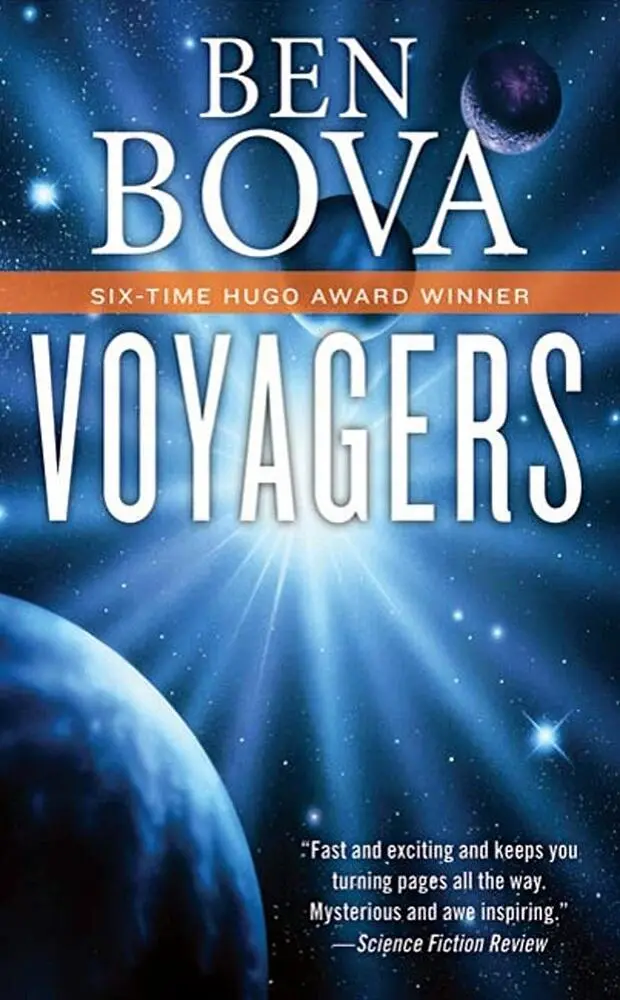
- Название:Voyagers
- Автор:
- Издательство:Tor
- Жанр:
- Год:2010
- ISBN:978-0-765-36365-7
- Рейтинг книги:5 / 5. Голосов: 1
-
Избранное:Добавить в избранное
- Отзывы:
-
Ваша оценка:
Voyagers: краткое содержание, описание и аннотация
Предлагаем к чтению аннотацию, описание, краткое содержание или предисловие (зависит от того, что написал сам автор книги «Voyagers»). Если вы не нашли необходимую информацию о книге — напишите в комментариях, мы постараемся отыскать её.
the signal that his research station is receiving from space is not random. Whatever it is, it’s real.
And it’s headed straight for Earth.
He’ll do anything to be the first man to go out to confront this enigma. Even lose the only woman he’s ever really loved.
And maybe start a world war.
Voyagers — читать онлайн бесплатно полную книгу (весь текст) целиком
Ниже представлен текст книги, разбитый по страницам. Система сохранения места последней прочитанной страницы, позволяет с удобством читать онлайн бесплатно книгу «Voyagers», без необходимости каждый раз заново искать на чём Вы остановились. Поставьте закладку, и сможете в любой момент перейти на страницу, на которой закончили чтение.
Интервал:
Закладка:
The Whiz Kid frowned. “I should have seen it…”
“I suppose you get so many Urgent and Top Secret memos that they just pile up on your desk,” the admiral said, straight-faced.
“Yeah. Well, okay…let’s get together, then. Tomorrow. I’ll phone you first thing in the morning.”
The admiral nodded cheerfully. “Good. I think you’ll find what I have to tell you quite interesting. And important enough to bring to the President’s attention—without any further delays.”
The young man from the White House nodded. Admiral O’Kelly turned his back on him and let the natural tides of the party pull them in opposite directions.
That takes care of that target, O’Kelly told himself. One down and one to go.
He glanced across the noisy room and saw that Tuttle, stubby and loyal as a bullterrier, was still standing resolutely beside his wife. Alma didn’t look too drunk. Still time to find Target Number Two.
And there he was, gliding toward the bar like a well-oiled smiling insurance salesman. O’Kelly headed for the bar.
Todd Nickerson had the bulbous red nose of a drunk. His eyes were always glazed over, even at important committee hearings and during vital votes on the floor of the House of Representatives. At parties he was loud, laughing, often lewd.
But Nickerson was the key man on the House subcommittee that examined ONR’s budget every year. Not the subcommittee chairman. The chairman was an ancient party warhorse from Missouri whose only real interests were pork barrels and buxom black women.
Despite being half drunk most of the time, Nickerson was the real power of the subcommittee. And O’Kelly had to make certain that the subcommittee would not rise up to haunt him once he had put Tuttle’s plan into action. The admiral elbowed his way through the crowd, stalking Nickerson like a submarine trailing an oil tanker.
They made a funny pair, once they started talking to each other in the middle of the party. O’Kelly, all steel gray with his bushy brows and piercing eyes, his uniform immaculate and pressed so well that the creases on his trousers could cut glass; Nickerson, weaving blearily, a tall, lank, alcoholic Ichabod Crane leaning over to hear what the stockier admiral had to say.
“The National Radio Astronomy Observatory?” the congressman yelled. “What the fuck are you talking about?”
Partygoers turned to stare, saw that it was Nickerson, and politely returned to their own conversations.
O’Kelly, feeling the collar of his uniform rasp against his neck, took the civilian by the arm. “Now, don’t get crazy on me, Congressman. This is important. Very important. I’m not even certain that we can bring it up before the subcommittee; I’m afraid of leaks.”
Nickerson focused his eyes on the admiral with an obvious effort. “Arecibo?” he asked, his voice lower. “That’s what you want? D’you know what kind of headlines it’d make if the Navy takes over a peaceful research facility?”
“We already fund a large part of its operation,” O’Kelly reminded the congressman. “We only need it full time for a short while.”
Nickerson waved his glass in the air, miraculously without spilling a drop or hitting any of the people standing nearby.
“And what will the National Science Foundation do?” he demanded with a lopsided smile. “They’ll go running to the media, tha’s what they’ll do. They’ll start screaming that the good ol’ Navy’s screwing them outta the world’s biggest radio telescope.”
“That’s why we need your support, Congressman. All of this must be done in utmost secrecy…”
“Secrecy my ass! The media’ll make Golgotha look like a rehearsal. They’ll crucify the Navy in general and you in particular. Ready to hang on a cross? In public?”
Suddenly O’Kelly looked as if he were on the bridge of a destroyer, charging into the enemy’s guns. “If I have to,” he answered firmly.
Nickerson blinked, then stared at him, mouth hanging open stupidly. The party babbled around them: raucous laughter, shrill voices, smoke, a blur of colorful women’s gowns and men’s somber formal suits.
“You’re serious,” Nickerson said at last.
“You bet I am.”
The glaze left Nickerson’s eyes. He was cold sober and alert. “Maybe you’d better tell me about it. In detail.”
The admiral shook his head. “Not here.”
“Outside then,” Nickerson said. “I doubt that the grounds are bugged.”
By the time the admiral came to reclaim his wife, the party had wound down considerably. The room was emptying, the noise level was down to a subdued buzz of conversations.
“Time for us to go, my dear,” Admiral O’Kelly said to his wife, taking the glass from her hand and putting it on the table next to him.
“It’s been a dull party,” she said, slurring the words slightly.
“I’m awfully sorry, sweetheart, but it was important for us to be here.” Turning toward Tuttle, “I was able to accomplish a couple of things that might have taken weeks, otherwise. Months, perhaps.”
Tuttle beamed happily.
“I shouldn’t have to go to boring parties,” Mrs. Admiral O’Kelly said as her husband led her by the hand. “I didn’t even get to meet the guest of honor.”
“Some other time, dear. Some other time. Tuttle,” he said over his shoulder, “thanks for taking such good care of the missus.”
“My pleasure, sir.”
“I’ll see you in the office at oh-eight-thirty,” the admiral said, by way of good night.
“Yes, sir !” Tuttle knew the admiral’s tone meant: mission accomplished.
He felt exalted. He had won over the admiral to his plan and the admiral had taken on the White House and Congressman Nickerson. And won. The project was definitely go .
Scanning the dwindling crowd, excitement bubbling within him, Tuttle saw Willie Wilson. The Urban Evangelist was shaking hands, wishing people well as they filed past him on their way out. He pumped the admiral’s hand, and then Mrs. O’Kelly’s. She smiled girlishly at him.
“Thank you kindly, Admiral. The people of the inner city will appreciate your help and understanding.” Wilson turned to the next couple in the impromptu line, as an aide whispered behind him. “God bless you, Senator. Hope you win by a landslide next year…. Thanks for coming…. Good to see you….”
Tuttle hung on the fringes of the dwindling crowd, practically bursting to tell somebody his Good News. It was Top Secret, of course, but he couldn’t keep all this excitement bottled up inside himself. Some of it had to come out.
Finally Wilson noticed him. “Freddie, is that you in that fancy uniform?”
“Hello, Will,” said Tuttle.
The evangelist was in his trademark blue denim suit, with a white shirt and flowery bandana knotted at his throat. He was scarcely taller than Tuttle, and whippet thin. His face was bony, all angles. His hair was angelic golden blond; his eyes the cold gray of an Atlantic storm.
“I haven’t laid eyes on you since—when was it, Freddie? Atlanta?”
“New Orleans,” Tuttle corrected. “After the cops tried to break up your street meeting.”
“Yes, I remember now. Two years ago. The Catholics were getting nervous in the service about me.”
He’s had his teeth capped, Tuttle saw. I guess you have to when you do so much work on television.
“I saw you over in Georgetown,” Tuttle said. “You pulled a good crowd.”
“A high school gym,” Wilson replied. “That’s not much. Next time I come back to this town we’ll fill RFK Stadium.”
“I hope you do.”
“We’re getting bigger all the time.”
“I know. People are starting to notice. Especially the TV spots. You put on a good show.”
Читать дальшеИнтервал:
Закладка:
Похожие книги на «Voyagers»
Представляем Вашему вниманию похожие книги на «Voyagers» списком для выбора. Мы отобрали схожую по названию и смыслу литературу в надежде предоставить читателям больше вариантов отыскать новые, интересные, ещё непрочитанные произведения.


Обсуждение, отзывы о книге «Voyagers» и просто собственные мнения читателей. Оставьте ваши комментарии, напишите, что Вы думаете о произведении, его смысле или главных героях. Укажите что конкретно понравилось, а что нет, и почему Вы так считаете.