Ben Bova - Voyagers
Здесь есть возможность читать онлайн «Ben Bova - Voyagers» весь текст электронной книги совершенно бесплатно (целиком полную версию без сокращений). В некоторых случаях можно слушать аудио, скачать через торрент в формате fb2 и присутствует краткое содержание. Год выпуска: 2010, ISBN: 2010, Издательство: Tor, Жанр: Фантастика и фэнтези, на английском языке. Описание произведения, (предисловие) а так же отзывы посетителей доступны на портале библиотеки ЛибКат.
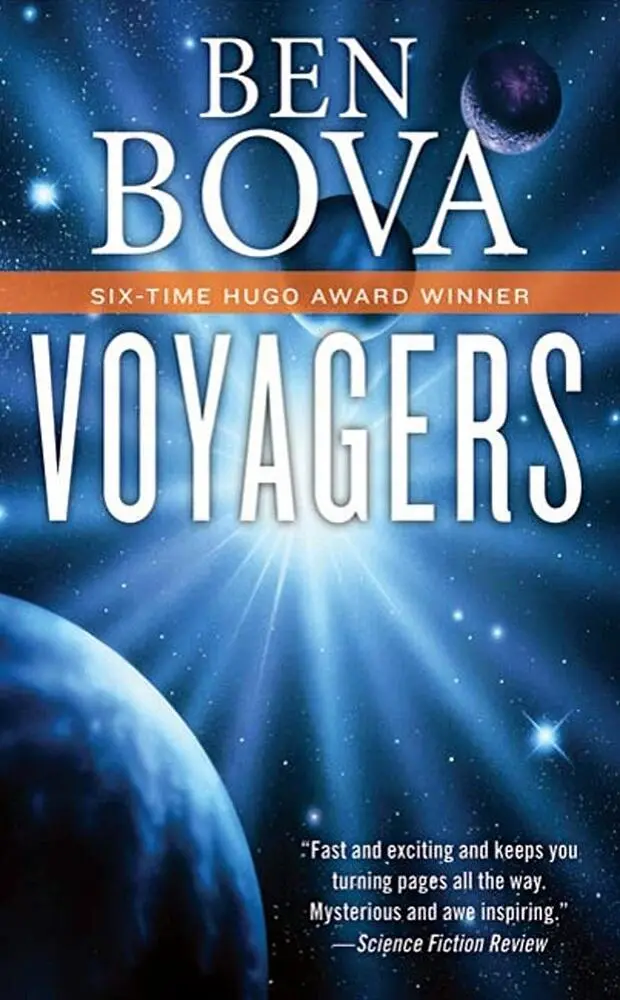
- Название:Voyagers
- Автор:
- Издательство:Tor
- Жанр:
- Год:2010
- ISBN:978-0-765-36365-7
- Рейтинг книги:5 / 5. Голосов: 1
-
Избранное:Добавить в избранное
- Отзывы:
-
Ваша оценка:
Voyagers: краткое содержание, описание и аннотация
Предлагаем к чтению аннотацию, описание, краткое содержание или предисловие (зависит от того, что написал сам автор книги «Voyagers»). Если вы не нашли необходимую информацию о книге — напишите в комментариях, мы постараемся отыскать её.
the signal that his research station is receiving from space is not random. Whatever it is, it’s real.
And it’s headed straight for Earth.
He’ll do anything to be the first man to go out to confront this enigma. Even lose the only woman he’s ever really loved.
And maybe start a world war.
Voyagers — читать онлайн бесплатно полную книгу (весь текст) целиком
Ниже представлен текст книги, разбитый по страницам. Система сохранения места последней прочитанной страницы, позволяет с удобством читать онлайн бесплатно книгу «Voyagers», без необходимости каждый раз заново искать на чём Вы остановились. Поставьте закладку, и сможете в любой момент перейти на страницу, на которой закончили чтение.
Интервал:
Закладка:
“Did you ask one of the secretaries to make plane reservations for you?”
Frowning, Stoner said, “No. I deliberately steered clear of them. Figured they’d go straight to McDermott with the information. I got one of the students to make my reservations…what’s her name, the tall one with the good figure?”
“Jo Camerata?”
“Yeah. Jo. That’s the one.”
Thompson gave a low whistle. “Then she must’ve told Big Mac herself. Or at least, one of the regular secretaries.”
“But I specifically told her not to.”
Thompson shrugged. “And here I thought she was after your body.”
“What?”
“She’s had her eye on you for quite a while. Coming around the observatory, cutting classes, trying to catch your attention.”
“Don’t be silly,” Stoner said. “She’s just a kid.”
“Some kid,” Thompson grinned. “She’s got the hots for you.”
Chapter 7
What of the occupants [of the UFOs] themselves? They seem to come in two sizes, large and small, with the former predominating. The Hopkinsville humanoids and many of those recounted…are much akin in appearance to the “little folk” of legend and story—elves, brownies, etc. Large heads, spindly feet, and, generally a head that sits square on the shoulders without much evidence of neck are often described. The larger humanoids are reported to be human size or a little larger and are generally very well formed. Sometimes they have been termed beautiful. The smaller ones are generally described as about three and a half feet tall….
Therefore I must leave it to the reader’s own judgment what weight to assign to Close Encounters of the Third Kind in assessing the whole problem [of UFOs], always remembering that it may yet be discovered that the humanoid cases are the key to the whole problem.
J. Allen Hynek, The UFO Experience: A Scientific Inquiry Ballantine Books 1972Kirill Markov stood squinting under his fur hat as the wind gusted down the street. No matter how long he lived, he would never become accustomed to the cold. It knifed through his fine coat and iced his bones.
Maria was speaking to the driver of the car parked at the curb in front of their apartment building, while Markov stamped his feet and waited at the doorway. Neighbors were peering out of their windows, discreetly of course, but Markov could see their shadowy forms behind the curtains. Even though the automobile was unmarked, everyone sensed that it was a government car. Markov could feel the mixture of curiosity and terror that rippled through the apartment blocks like an electric current.
“It’s the professor!”
“They’re taking him away? In broad daylight?”
“Look for yourself.”
“His wife, too?”
“No, it doesn’t seem so.”
“They don’t look upset, either one of them.”
“Perhaps it’s not what we think, then.”
“Usually they come at night.”
“Pah! I know how they work. The professor may think he’s being taken to the airport or to some fancy university campus. Even his wife may think so. But take a good look at him. It’s the last you’ll ever see of him.”
“No!”
“That’s the way they took my brother, Grisha. Told him he was being transferred to a new job, in Kharkov. He went with a smile on his face. Into a cattle car that took him straight to Siberia. Eight years, they kept him there. He was a broken man when they let him back home to die.”
“But what could the professor have done…?”
“He’s a thinker. It doesn’t pay to think certain kinds of thoughts.”
Markov smiled to himself as he sensed their whispered conversations swirling through the apartments all around him.
No, my neighbors, he wanted to say. It’s not what you think. The government values me for my ability to think.
Maria finished her talk with the driver, straightened up and turned toward Markov. She was wearing only her regulation uniform, with nothing but the thin jacket to protect her blocky body. How she stood the cold was something Markov could never understand. Yet her feet were always like icebergs when she got into bed.
“Well, come on,” she called impatiently.
Markov picked up his briefcase, trotted down the steps to the curb and reached for the car door.
“In the back,” Maria said. “You sit in the back seat.”
“Oh. I see.” He pulled the rear door open and hesitated. Maria was standing next to him with her usual scowl on her face.
Markov looked into her eyes. “I…may not see you again for quite a while.”
She nodded matter-of-factly.
“Well…take good care of yourself, old girl.”
“You too,” she mumbled.
He put a hand on her shoulder and she turned her face so that he could kiss her cheek. He pecked at it, then quickly ducked into the car. She slammed the door shut and the driver started the motor with a horrible screech of the ignition.
As the car pulled away from the curb, Markov turned to wave at his wife. She had already started back inside the apartment building. For some inexplicable reason he felt a lump in his throat.
The Naval Research Laboratory lies along the Potomac River, almost directly in the glide path of the commercial jetliners coming into Washington’s National Airport.
Ramsey McDermott, squeezed into one of the Eastern shuttle’s narrow seats between the window and the hyperthyroid businessman who had spent the entire forty-minute flight shuffling papers and tapping out numbers on a pocket calculator, smiled grimly to himself as the plane flashed past NRL. Atop the central riverfront building was the venerable dish antenna of NRL’s fifty-foot radio telescope.
They can’t pick up the Jovian pulses with that piece of crap, McDermott told himself.
He had “double shuttled” in his haste to get to a personal meeting with Tuttle, taking one Eastern 727 from Boston to New York and then immediately getting on to the New York-to-Washington plane.
Tuttle’s office was not at NRL, or at the Pentagon. He had lucked into a plush new office building that the Navy leased in Crystal City, one of the high-rise glass and steel towers that had given the area its name.
McDermott phoned the lieutenant commander from the airport, and they agreed to meet at a restaurant downtown.
Impatiently drumming his fingertips on the rickety little table out on the chilly sidewalk in front of the Connecticut Avenue restaurant, Ramsey McDermott waited for Lieutenant Commander Tuttle to select his lunch from the oversized menu.
They bombed Pearl Harbor with less attention to detail, the old man groused to himself.
Tuttle had insisted that they meet at an outdoor restaurant. “Less chance of being bugged,” he had whispered, quite seriously.
They discussed the problems of moving the staff to Arecibo, Tuttle clamping his mouth shut whenever a waiter or another customer drifted close to their table. McDermott, uncomfortable in the damp chill and the traffic noise from the street, struggled to keep his temper.
“If we need Arecibo,” Tuttle said finally, “we’ll get Arecibo, even if I have to get the President to declare a national emergency.”
“You can do that?”
Tuttle nodded solemnly. “If I have to.”
For the first time, McDermott felt impressed with the young officer’s powers.
“But this man Stoner,” Tuttle went on. “He’s the key to it all. We need him to correlate the optical sightings with the radio signals.”
“He’ll do it,” McDermott promised.
“He hasn’t called for a lawyer or tried to get away from the house where we’ve stashed him?”
“No. He’s going through a divorce; I think he’s kind of glad to be safely tucked away where the lawyers and his ex-wife can’t find him.” McDermott chuckled to himself. “And underneath it all, he’s got that old scientific curiosity—a fatal dose. It’s an itch he can’t scratch unless he plays ball with us.”
Читать дальшеИнтервал:
Закладка:
Похожие книги на «Voyagers»
Представляем Вашему вниманию похожие книги на «Voyagers» списком для выбора. Мы отобрали схожую по названию и смыслу литературу в надежде предоставить читателям больше вариантов отыскать новые, интересные, ещё непрочитанные произведения.

Обсуждение, отзывы о книге «Voyagers» и просто собственные мнения читателей. Оставьте ваши комментарии, напишите, что Вы думаете о произведении, его смысле или главных героях. Укажите что конкретно понравилось, а что нет, и почему Вы так считаете.