RF Duncan-Goodwillie - The English Teachers
Здесь есть возможность читать онлайн «RF Duncan-Goodwillie - The English Teachers» — ознакомительный отрывок электронной книги совершенно бесплатно, а после прочтения отрывка купить полную версию. В некоторых случаях можно слушать аудио, скачать через торрент в формате fb2 и присутствует краткое содержание. ISBN: , Жанр: Публицистика, на английском языке. Описание произведения, (предисловие) а так же отзывы посетителей доступны на портале библиотеки ЛибКат.
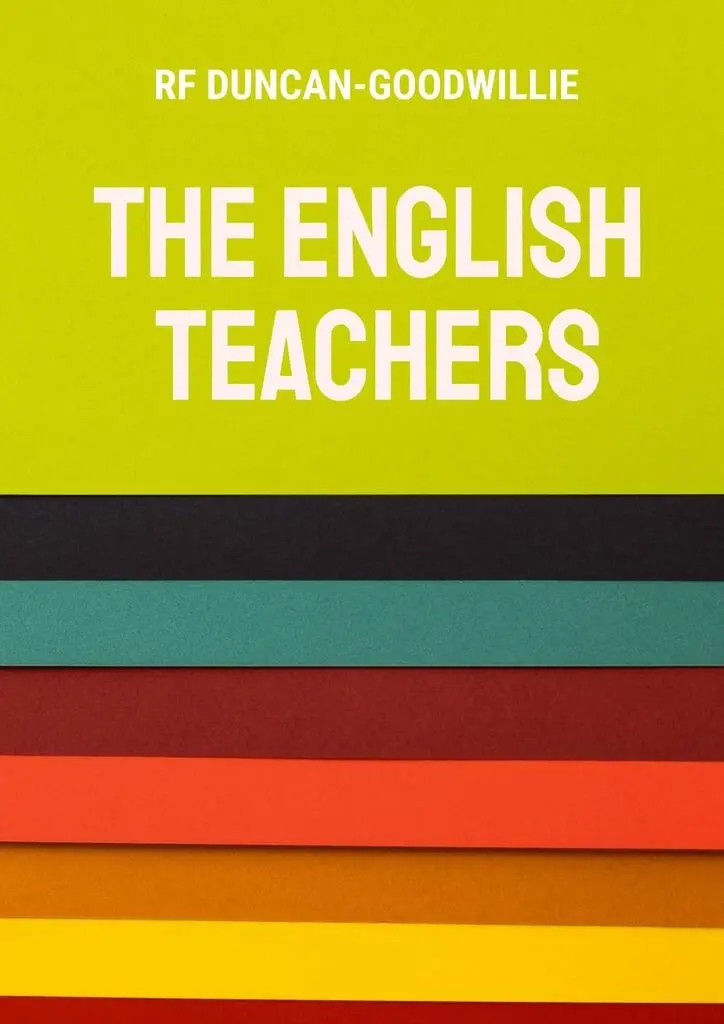
- Название:The English Teachers
- Автор:
- Жанр:
- Год:неизвестен
- ISBN:9785005111296
- Рейтинг книги:3 / 5. Голосов: 1
-
Избранное:Добавить в избранное
- Отзывы:
-
Ваша оценка:
The English Teachers: краткое содержание, описание и аннотация
Предлагаем к чтению аннотацию, описание, краткое содержание или предисловие (зависит от того, что написал сам автор книги «The English Teachers»). Если вы не нашли необходимую информацию о книге — напишите в комментариях, мы постараемся отыскать её.
The English Teachers — читать онлайн ознакомительный отрывок
Ниже представлен текст книги, разбитый по страницам. Система сохранения места последней прочитанной страницы, позволяет с удобством читать онлайн бесплатно книгу «The English Teachers», без необходимости каждый раз заново искать на чём Вы остановились. Поставьте закладку, и сможете в любой момент перейти на страницу, на которой закончили чтение.
Интервал:
Закладка:
And then at university we studied Marxism and Russian History, so coming to Russia to see the former Soviet Union really appealed to me.
Practically, it seemed like one of the biggest markets. I didn’t want to go to China because it seemed too far away really whereas, in spite of what most people think about Russia as being scary, it always struck me as quite similar to the rest of Europe. And having come here, it doesn’t feel much different from being in Germany, for example.
RFDG: If you hadn’t come to Moscow, where would you have gone?
SO: Probably Italy or France, but it seems like it’s hard to find work there. I’d probably have looked at China, but it wouldn’t have been my first choice. So, Western or Eastern Europe. There’s an International House in Ukraine.
RFDG: Would you still choose to be an English teacher, or would you choose anything else?
SO: I’ve looked into teaching English Literature back home. I don’t see myself doing anything else, really. I do enjoy teaching. I sometimes see myself in politics, but I think I’m basically too opinionated. I mean, in some parties you can say whatever you like about the opposition, but you have to think that every policy in your own party is wonderful and you can’t criticise that. And I think you can make more of a difference in teaching. I’ve met some great politicians, but I think you have to suck up to a lot of people and I don’t think I can do that.
*
Aline C (AC)
Setting the scene: We are in one of the bedrooms of a log cabin in the summer camp in Vladimir. It’s the middle of the day and it’s cooler and more comfortable here. Despite the relaxed setting, Aline sits up as straight as her black hair. She speaks slowly and carefully in her relaxed Latin American accent. Her eyes are large like her smile. A warm person on an equally warm day.
AC: I was born in Brazil and I studied Engineering but I never worked as an engineer. I decided I wanted to change careers and I took the CELTA in 2017. I decided I should be somewhere else and I ended up here in Moscow.
RFDG: What prompted the change?
AC: I really didn’t like what I was working and learning with in engineering. I started studying English when I was young and I have to thank my mother for that. She always motivated me to take the certificates so I already had something that would help me get a job in English teaching, at least in Brazil. I figured I could start with that and I actually ended up really liking it.
RFDG: You could have chosen hundreds of countries and cities. Why did you pick Russia and Moscow?
AC: I wanted to work for International House because I got to know their material during the CELTA and I saw Russia was hiring on their website and they would help with the visa. It was the opportunity I needed.
RFDG: Was it always going to be Moscow?
AC: I also applied for Mexico but Moscow answered first. By the time they replied I was already in the process of getting the visa and the adventure had begun.
RFDG: Do you think your life would have been different if you’d chosen Mexico instead?
AC: Definitely. I can’t think how different, but I am probably three days away from home and six time zones away, so communicating with my family would have been easier and it would get to me sometimes. And when it comes to the cultural aspect, I think if I were in a Latin American country it would have been easier to adapt and communicate with people.
RFDG: Are you still glad you came?
AC: Yes, I feel like I’ve been growing a lot. It’s the first time I’ve lived on my own and every time I have some kind of difficulty, trying to solve it has been great. Not only like teaching, but also in learning how to deal with problems in a language that I can’t speak.
RFDG: And has that been easy?
AC: No. The first time I went to the supermarket I bought kefir instead of milk because I didn’t know how to say milk in Russian. I learned how to say milk after that. Also, when I had to go to the optician and get new glasses it was very difficult. And talking to people. It’s difficult to meet people outside of work.
RFDG: Do you think most teachers you work with encounter the same problems?
AC: Talking about where I am based, the only other non-Russian teacher has the same issues and it’s why we got so close in such a short time. Not only are we from the same country, we have the same difficulties and it’s been nice to have someone to speak to about that.
RFDG: Why is help with a visa so important?
AC: I’m quite impulsive and when I decided to leave I wanted something fast. I thought, if I can have help with this experience maybe one day I can go to another country where they would be willing to help, not only because they should but because they like my CV.
*
Nico Benger (NB)
Setting the scene: It’s a dusty afternoon in late spring at Chistye Prudy in the heart of Moscow. Nico and I have stepped into one of the rooms of a language school located close to the top floor. The glare of the sun bounces off one of the tables and occasionally into my eyes as it moves across the sky.
Nico has a coffee and I have a plastic cup filled with water next to me as my phone records our interview. He’s older than I am but he speaks with an exuberance to rival any teenager and produces such a volume of words that when I was typing I struggled to keep up. It’s good, though, as it gives us a lot to work with and I don’t hear North American accents very often so it’s great practice.
NB: I was born in France. My father is Canadian and my mother is French. I moved to Canada when I was seven or eight. I grew up on the west coast in a village. It was a tiny island of about 1,000 people. I couldn’t wait to get out of there but I got a bit stuck. I had a restaurant there which was quite successful and kept me there for years. I should have left sooner than I did.
RFDG: How did you get into teaching from there?
NB: Well, we ran the restaurant in the summer. Because it was in the north there weren’t tourists in the winter and we were able to shut down for long periods and I had the opportunity to travel. One of the first places I went to was Japan. This was back in the 90s. You didn’t need a degree, a CELTA or anything. You could walk in and get a job teaching and that was what I did. I ended up in Japan, teaching as a way to make money. The first time I did it was a couple of months before going back to Canada. While I was there I met guys doing TEFL and they were making good money and I realised it was something to get into. It took a while but that was the start of it.
At some point I went back to university and started a degree. I did it over a decade because I’d already started teaching and I went to China. I was there for a year and got a TEFL. I was also in and out of Japan for a few years. After China I went to Kazakhstan and did my CELTA in Almaty. I got the job even before my CELTA so I could do it with my own classes. It was a dream situation. International House provided the accommodation while I was there doing my CELTA.
Then I went to Indonesia. It was a long process. I also went back to Canada in that time to finish my degree. Like I say, it was over a decade so I took my time.
Читать дальшеИнтервал:
Закладка:
Похожие книги на «The English Teachers»
Представляем Вашему вниманию похожие книги на «The English Teachers» списком для выбора. Мы отобрали схожую по названию и смыслу литературу в надежде предоставить читателям больше вариантов отыскать новые, интересные, ещё непрочитанные произведения.


Обсуждение, отзывы о книге «The English Teachers» и просто собственные мнения читателей. Оставьте ваши комментарии, напишите, что Вы думаете о произведении, его смысле или главных героях. Укажите что конкретно понравилось, а что нет, и почему Вы так считаете.