Гилберт Честертон - All Things Considered
Здесь есть возможность читать онлайн «Гилберт Честертон - All Things Considered» весь текст электронной книги совершенно бесплатно (целиком полную версию без сокращений). В некоторых случаях можно слушать аудио, скачать через торрент в формате fb2 и присутствует краткое содержание. Год выпуска: 2014, Издательство: epubBooks Classics, Жанр: Публицистика, Критика, на английском языке. Описание произведения, (предисловие) а так же отзывы посетителей доступны на портале библиотеки ЛибКат.
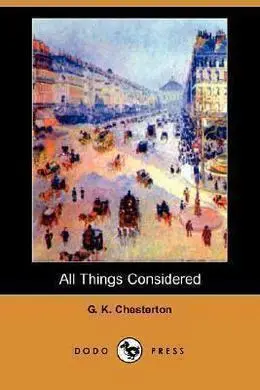
- Название:All Things Considered
- Автор:
- Издательство:epubBooks Classics
- Жанр:
- Год:2014
- ISBN:нет данных
- Рейтинг книги:3 / 5. Голосов: 1
-
Избранное:Добавить в избранное
- Отзывы:
-
Ваша оценка:
All Things Considered: краткое содержание, описание и аннотация
Предлагаем к чтению аннотацию, описание, краткое содержание или предисловие (зависит от того, что написал сам автор книги «All Things Considered»). Если вы не нашли необходимую информацию о книге — напишите в комментариях, мы постараемся отыскать её.
All Things Considered — читать онлайн бесплатно полную книгу (весь текст) целиком
Ниже представлен текст книги, разбитый по страницам. Система сохранения места последней прочитанной страницы, позволяет с удобством читать онлайн бесплатно книгу «All Things Considered», без необходимости каждый раз заново искать на чём Вы остановились. Поставьте закладку, и сможете в любой момент перейти на страницу, на которой закончили чтение.
Интервал:
Закладка:
There seems to be an extraordinary idea abroad that Fielding was in some way an immoral or offensive writer. I have been astounded by the number of the leading articles, literary articles, and other articles written about him just now in which there is a curious tone of apologising for the man. One critic says that after all he couldn't help it, because he lived in the eighteenth century; another says that we must allow for the change of manners and ideas; another says that he was not altogether without generous and humane feelings; another suggests that he clung feebly, after all, to a few of the less important virtues. What on earth does all this mean? Fielding described Tom Jones as going on in a certain way, in which, most unfortunately, a very large number of young men do go on. It is unnecessary to say that Henry Fielding knew that it was an unfortunate way of going on. Even Tom Jones knew that. He said in so many words that it was a very unfortunate way of going on; he said, one may almost say, that it had ruined his life; the passage is there for the benefit of any one who may take the trouble to read the book. There is ample evidence (though even this is of a mystical and indirect kind), there is ample evidence that Fielding probably thought that it was better to be Tom Jones than to be an utter coward and sneak. There is simply not one rag or thread or speck of evidence to show that Fielding thought that it was better to be Tom Jones than to be a good man. All that he is concerned with is the description of a definite and very real type of young man; the young man whose passions and whose selfish necessities sometimes seemed to be stronger than anything else in him.
The practical morality of Tom Jones is bad, though not so bad, spiritually speaking, as the practical morality of Arthur Pendennis or the practical morality of Pip, and certainly nothing like so bad as the profound practical immorality of Daniel Deronda. The practical morality of Tom Jones is bad; but I cannot see any proof that his theoretical morality was particularly bad. There is no need to tell the majority of modern young men even to live up to the theoretical ethics of Henry Fielding. They would suddenly spring into the stature of archangels if they lived up to the theoretic ethics of poor Tom Jones. Tom Jones is still alive, with all his good and all his evil; he is walking about the streets; we meet him every day. We meet with him, we drink with him, we smoke with him, we talk with him, we talk about him. The only difference is that we have no longer the intellectual courage to write about him. We split up the supreme and central human being, Tom Jones, into a number of separate aspects. We let Mr. J.M. Barrie write about him in his good moments, and make him out better than he is. We let Zola write about him in his bad moments, and make him out much worse than he is. We let Maeterlinck celebrate those moments of spiritual panic which he knows to be cowardly; we let Mr. Rudyard Kipling celebrate those moments of brutality which he knows to be far more cowardly. We let obscene writers write about the obscenities of this ordinary man. We let puritan writers write about the purities of this ordinary man. We look through one peephole that makes men out as devils, and we call it the new art. We look through another peephole that makes men out as angels, and we call it the New Theology. But if we pull down some dusty old books from the bookshelf, if we turn over some old mildewed leaves, and if in that obscurity and decay we find some faint traces of a tale about a complete man, such a man as is walking on the pavement outside, we suddenly pull a long face, and we call it the coarse morals of a bygone age.
The truth is that all these things mark a certain change in the general view of morals; not, I think, a change for the better. We have grown to associate morality in a book with a kind of optimism and prettiness; according to us, a moral book is a book about moral people. But the old idea was almost exactly the opposite; a moral book was a book about immoral people. A moral book was full of pictures like Hogarth's "Gin Lane" or "Stages of Cruelty," or it recorded, like the popular broadsheet, "God's dreadful judgment" against some blasphemer or murderer. There is a philosophical reason for this change. The homeless scepticism of our time has reached a sub–conscious feeling that morality is somehow merely a matter of human taste—an accident of psychology. And if goodness only exists in certain human minds, a man wishing to praise goodness will naturally exaggerate the amount of it that there is in human minds or the number of human minds in which it is supreme. Every confession that man is vicious is a confession that virtue is visionary. Every book which admits that evil is real is felt in some vague way to be admitting that good is unreal. The modern instinct is that if the heart of man is evil, there is nothing that remains good. But the older feeling was that if the heart of man was ever so evil, there was something that remained good—goodness remained good. An actual avenging virtue existed outside the human race; to that men rose, or from that men fell away. Therefore, of course, this law itself was as much demonstrated in the breach as in the observance. If Tom Jones violated morality, so much the worse for Tom Jones. Fielding did not feel, as a melancholy modern would have done, that every sin of Tom Jones was in some way breaking the spell, or we may even say destroying the fiction of morality. Men spoke of the sinner breaking the law; but it was rather the law that broke him. And what modern people call the foulness and freedom of Fielding is generally the severity and moral stringency of Fielding. He would not have thought that he was serving morality at all if he had written a book all about nice people. Fielding would have considered Mr. Ian Maclaren extremely immoral; and there is something to be said for that view. Telling the truth about the terrible struggle of the human soul is surely a very elementary part of the ethics of honesty. If the characters are not wicked, the book is. This older and firmer conception of right as existing outside human weakness and without reference to human error can be felt in the very lightest and loosest of the works of old English literature. It is commonly unmeaning enough to call Shakspere a great moralist; but in this particular way Shakspere is a very typical moralist. Whenever he alludes to right and wrong it is always with this old implication. Right is right, even if nobody does it. Wrong is wrong, even if everybody is wrong about it.
The Maid of Orleans
A considerable time ago (at far too early an age, in fact) I read Voltaire's "La Pucelle," a savage sarcasm on the traditional purity of Joan of Arc, very dirty, and very funny. I had not thought of it again for years, but it came back into my mind this morning because I began to turn over the leaves of the new "Jeanne d'Arc," by that great and graceful writer, Anatole France. It is written in a tone of tender sympathy, and a sort of sad reverence; it never loses touch with a noble tact and courtesy, like that of a gentleman escorting a peasant girl through the modern crowd. It is invariably respectful to Joan, and even respectful to her religion. And being myself a furious admirer of Joan the Maid, I have reflectively compared the two methods, and I come to the conclusion that I prefer Voltaire's.
When a man of Voltaire's school has to explode a saint or a great religious hero, he says that such a person is a common human fool, or a common human fraud. But when a man like Anatole France has to explode a saint, he explains a saint as somebody belonging to his particular fussy little literary set. Voltaire read human nature into Joan of Arc, though it was only the brutal part of human nature. At least it was not specially Voltaire's nature. But M. France read M. France's nature into Joan of Arc—all the cold kindness, all the homeless sentimental sin of the modern literary man. There is one book that it recalled to me with startling vividness, though I have not seen the matter mentioned anywhere; Renan's "Vie de Jésus." It has just the same general intention: that if you do not attack Christianity, you can at least patronise it. My own instinct, apart from my opinions, would be quite the other way. If I disbelieved in Christianity, I should be the loudest blasphemer in Hyde Park. Nothing ought to be too big for a brave man to attack; but there are some things too big for a man to patronise.
Читать дальшеИнтервал:
Закладка:
Похожие книги на «All Things Considered»
Представляем Вашему вниманию похожие книги на «All Things Considered» списком для выбора. Мы отобрали схожую по названию и смыслу литературу в надежде предоставить читателям больше вариантов отыскать новые, интересные, ещё непрочитанные произведения.


Обсуждение, отзывы о книге «All Things Considered» и просто собственные мнения читателей. Оставьте ваши комментарии, напишите, что Вы думаете о произведении, его смысле или главных героях. Укажите что конкретно понравилось, а что нет, и почему Вы так считаете.