Гилберт Честертон - Heretics
Здесь есть возможность читать онлайн «Гилберт Честертон - Heretics» — ознакомительный отрывок электронной книги совершенно бесплатно, а после прочтения отрывка купить полную версию. В некоторых случаях можно слушать аудио, скачать через торрент в формате fb2 и присутствует краткое содержание. Год выпуска: 2014, Издательство: epubBooks Classics, Жанр: Публицистика, Религия, на английском языке. Описание произведения, (предисловие) а так же отзывы посетителей доступны на портале библиотеки ЛибКат.
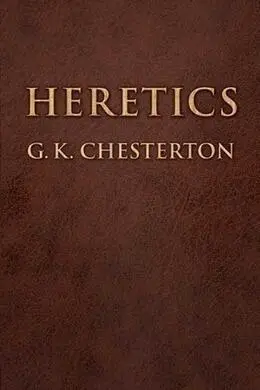
- Название:Heretics
- Автор:
- Издательство:epubBooks Classics
- Жанр:
- Год:2014
- ISBN:нет данных
- Рейтинг книги:4 / 5. Голосов: 1
-
Избранное:Добавить в избранное
- Отзывы:
-
Ваша оценка:
Heretics: краткое содержание, описание и аннотация
Предлагаем к чтению аннотацию, описание, краткое содержание или предисловие (зависит от того, что написал сам автор книги «Heretics»). Если вы не нашли необходимую информацию о книге — напишите в комментариях, мы постараемся отыскать её.
In addition to incisive assessments of well-known individuals (“Mr. Rudyard Kipling and Making the World Small” and “Mr. H. G. Wells and the Giants”), these essays contain observations on the wider world. On Sandals and Simplicity, Science and the Savages, On Certain Modern Writers and the Institution of the Family, On Smart Novelists and the Smart Set, and Slum Novelists and the Slums, reflect the main themes of Chesterton’s life’s work. Heretics roused the ire of some critics for censuring contemporary philosophies without providing alternatives; the author responded a few years later with a companion volume, Orthodoxy.
Heretics — читать онлайн ознакомительный отрывок
Ниже представлен текст книги, разбитый по страницам. Система сохранения места последней прочитанной страницы, позволяет с удобством читать онлайн бесплатно книгу «Heretics», без необходимости каждый раз заново искать на чём Вы остановились. Поставьте закладку, и сможете в любой момент перейти на страницу, на которой закончили чтение.
Интервал:
Закладка:
This bias against morality among the modern aesthetes is nothing very much paraded. And yet it is not really a bias against morality; it is a bias against other people's morality. It is generally founded on a very definite moral preference for a certain sort of life, pagan, plausible, humane. The modern aesthete, wishing us to believe that he values beauty more than conduct, reads Mallarme, and drinks absinthe in a tavern. But this is not only his favourite kind of beauty; it is also his favourite kind of conduct. If he really wished us to believe that he cared for beauty only, he ought to go to nothing but Wesleyan school treats, and paint the sunlight in the hair of the Wesleyan babies. He ought to read nothing but very eloquent theological sermons by old–fashioned Presbyterian divines. Here the lack of all possible moral sympathy would prove that his interest was purely verbal or pictorial, as it is; in all the books he reads and writes he clings to the skirts of his own morality and his own immorality. The champion of l'art pour l'art is always denouncing Ruskin for his moralizing. If he were really a champion of l'art pour l'art, he would be always insisting on Ruskin for his style.
The doctrine of the distinction between art and morality owes a great part of its success to art and morality being hopelessly mixed up in the persons and performances of its greatest exponents. Of this lucky contradiction the very incarnation was Whistler. No man ever preached the impersonality of art so well; no man ever preached the impersonality of art so personally. For him pictures had nothing to do with the problems of character; but for all his fiercest admirers his character was, as a matter of fact far more interesting than his pictures. He gloried in standing as an artist apart from right and wrong. But he succeeded by talking from morning till night about his rights and about his wrongs. His talents were many, his virtues, it must be confessed, not many, beyond that kindness to tried friends, on which many of his biographers insist, but which surely is a quality of all sane men, of pirates and pickpockets; beyond this, his outstanding virtues limit themselves chiefly to two admirable ones—courage and an abstract love of good work. Yet I fancy he won at last more by those two virtues than by all his talents. A man must be something of a moralist if he is to preach, even if he is to preach unmorality. Professor Walter Raleigh, in his "In Memoriam: James McNeill Whistler," insists, truly enough, on the strong streak of an eccentric honesty in matters strictly pictorial, which ran through his complex and slightly confused character. "He would destroy any of his works rather than leave a careless or inexpressive touch within the limits of the frame. He would begin again a hundred times over rather than attempt by patching to make his work seem better than it was."
No one will blame Professor Raleigh, who had to read a sort of funeral oration over Whistler at the opening of the Memorial Exhibition, if, finding himself in that position, he confined himself mostly to the merits and the stronger qualities of his subject. We should naturally go to some other type of composition for a proper consideration of the weaknesses of Whistler. But these must never be omitted from our view of him. Indeed, the truth is that it was not so much a question of the weaknesses of Whistler as of the intrinsic and primary weakness of Whistler. He was one of those people who live up to their emotional incomes, who are always taut and tingling with vanity. Hence he had no strength to spare; hence he had no kindness, no geniality; for geniality is almost definable as strength to spare. He had no god–like carelessness; he never forgot himself; his whole life was, to use his own expression, an arrangement. He went in for "the art of living"—a miserable trick. In a word, he was a great artist; but emphatically not a great man. In this connection I must differ strongly with Professor Raleigh upon what is, from a superficial literary point of view, one of his most effective points. He compares Whistler's laughter to the laughter of another man who was a great man as well as a great artist. "His attitude to the public was exactly the attitude taken up by Robert Browning, who suffered as long a period of neglect and mistake, in those lines of 'The Ring and the Book'—
"'Well, British Public, ye who like me not,
(God love you!) and will have your proper laugh
At the dark question; laugh it! I'd laugh first.'
"Mr. Whistler," adds Professor Raleigh, "always laughed first." The truth is, I believe, that Whistler never laughed at all. There was no laughter in his nature; because there was no thoughtlessness and self–abandonment, no humility. I cannot understand anybody reading "The Gentle Art of Making Enemies" and thinking that there is any laughter in the wit. His wit is a torture to him. He twists himself into arabesques of verbal felicity; he is full of a fierce carefulness; he is inspired with the complete seriousness of sincere malice. He hurts himself to hurt his opponent. Browning did laugh, because Browning did not care; Browning did not care, because Browning was a great man. And when Browning said in brackets to the simple, sensible people who did not like his books, "God love you!" he was not sneering in the least. He was laughing—that is to say, he meant exactly what he said.
There are three distinct classes of great satirists who are also great men—that is to say, three classes of men who can laugh at something without losing their souls. The satirist of the first type is the man who, first of all enjoys himself, and then enjoys his enemies. In this sense he loves his enemy, and by a kind of exaggeration of Christianity he loves his enemy the more the more he becomes an enemy. He has a sort of overwhelming and aggressive happiness in his assertion of anger; his curse is as human as a benediction. Of this type of satire the great example is Rabelais. This is the first typical example of satire, the satire which is voluble, which is violent, which is indecent, but which is not malicious. The satire of Whistler was not this. He was never in any of his controversies simply happy; the proof of it is that he never talked absolute nonsense. There is a second type of mind which produces satire with the quality of greatness. That is embodied in the satirist whose passions are released and let go by some intolerable sense of wrong. He is maddened by the sense of men being maddened; his tongue becomes an unruly member, and testifies against all mankind. Such a man was Swift, in whom the saeva indignatio was a bitterness to others, because it was a bitterness to himself. Such a satirist Whistler was not. He did not laugh because he was happy, like Rabelais. But neither did he laugh because he was unhappy, like Swift.
The third type of great satire is that in which he satirist is enabled to rise superior to his victim in the only serious sense which superiority can bear, in that of pitying the sinner and respecting the man even while he satirises both. Such an achievement can be found in a thing like Pope's "Atticus" a poem in which the satirist feels that he is satirising the weaknesses which belong specially to literary genius. Consequently he takes a pleasure in pointing out his enemy's strength before he points out his weakness. That is, perhaps, the highest and most honourable form of satire. That is not the satire of Whistler. He is not full of a great sorrow for the wrong done to human nature; for him the wrong is altogether done to himself.
He was not a great personality, because he thought so much about himself. And the case is stronger even than that. He was sometimes not even a great artist, because he thought so much about art. Any man with a vital knowledge of the human psychology ought to have the most profound suspicion of anybody who claims to be an artist, and talks a great deal about art. Art is a right and human thing, like walking or saying one's prayers; but the moment it begins to be talked about very solemnly, a man may be fairly certain that the thing has come into a congestion and a kind of difficulty.
Читать дальшеИнтервал:
Закладка:
Похожие книги на «Heretics»
Представляем Вашему вниманию похожие книги на «Heretics» списком для выбора. Мы отобрали схожую по названию и смыслу литературу в надежде предоставить читателям больше вариантов отыскать новые, интересные, ещё непрочитанные произведения.





Обсуждение, отзывы о книге «Heretics» и просто собственные мнения читателей. Оставьте ваши комментарии, напишите, что Вы думаете о произведении, его смысле или главных героях. Укажите что конкретно понравилось, а что нет, и почему Вы так считаете.